




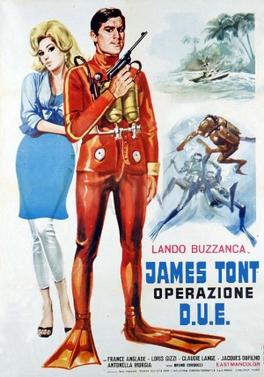
Eurospy
The Eurospy film genre, also known as the spaghetti spy film, is a type of spy film produced in Europe, particularly in Italy, France, and Spain, that either sincerely imitated or parodied the British James Bond spy series feature films. Emerging in the early 1960s, the Eurospy genre was an offshoot of the wider 1960s spy craze that had begun with James Bond films in 1962 and had taken root across the Western world, lasting into the early-to-mid '70s in countries such as the UK. Britain participated in the Eurospy movement it had inspired, albeit spreading its output across lower-budget Eurospy-style copycat media and more serious productions with higher budgets than were typical of the genre.
The Eurospy films were characterized by their low budgets, often featuring a mix of established and up-and-coming actors, and a reliance on action sequences, gadgets, and exotic locations to create a sense of excitement and adventure. Many of these films were produced by Italian companies, such as Dino De Laurentiis and Alberto Grimaldi, who saw an opportunity to capitalize on the success of the James Bond series and create their own brand of spy films. The Eurospy films often featured a mix of humor, action, and style, and were frequently released in a double bill format, with two films shown together in a single screening.
The Eurospy genre was not limited to Italy, however, and films were also produced in France, Spain, and other European countries. Some of the most notable Eurospy films include _Agent 3S3: Massacre in the Sun_ (1966), _The Spy with a Cold Nose_ (1965), and _The Liquidator_ (1965). These films often featured a mix of established and up-and-coming actors, including Sean Connery, Ursula Andress, and Klaus Kinski.
History
The Eurospy genre emerged in the early 1960s, as the James Bond series was gaining popularity across the Western world. The first James Bond film, _Dr. No_, was released in 1962, and was followed by a string of successful films, including _From Russia with Love_ (1963), _Goldfinger_ (1964), and _Thunderball_ (1965). The success of these films inspired a number of European producers to create their own spy films, often featuring a mix of action, adventure, and style.
The Eurospy genre was characterized by its low budgets and reliance on action sequences, gadgets, and exotic locations to create a sense of excitement and adventure. Many of these films were produced by Italian companies, such as Dino De Laurentiis and Alberto Grimaldi, who saw an opportunity to capitalize on the success of the James Bond series and create their own brand of spy films.
Early Years (1962-1965)
The early years of the Eurospy genre were marked by a number of low-budget films, often featuring a mix of established and up-and-coming actors. One of the first Eurospy films was _Agent 3S3: Massacre in the Sun_ (1966), which was produced by Dino De Laurentiis and starred Brad Harris and Luciana Gilli. This film was followed by a number of other low-budget Eurospy films, including _The Spy with a Cold Nose_ (1965) and _The Liquidator_ (1965).
Peak Years (1966-1970)
The peak years of the Eurospy genre were marked by a number of higher-budget films, often featuring a mix of established and up-and-coming actors. One of the most notable Eurospy films of this period was _The Dirty Dozen_ (1967), which was produced by Dino De Laurentiis and starred Lee Marvin and Ernest Borgnine. This film was followed by a number of other successful Eurospy films, including _The Ambushers_ (1967) and _The Wrecking Crew_ (1969).
Influence and Legacy
The Eurospy genre had a significant influence on the development of the spy film genre, and paved the way for a number of other European spy films, including the French _Commissaire Maigret_ series and the Italian _Ispettore Derrick_ series. The Eurospy films also influenced the development of the James Bond series, with many of the films featuring a mix of action, adventure, and style that was characteristic of the Bond films.
The Eurospy genre also had a significant impact on the careers of a number of actors, including Sean Connery, Ursula Andress, and Klaus Kinski. These actors often appeared in a number of Eurospy films, and their performances helped to establish them as leading stars of the genre.
Criticism and Controversy
The Eurospy genre was often criticized for its low budgets and reliance on action sequences, gadgets, and exotic locations to create a sense of excitement and adventure. Some critics also argued that the Eurospy films were too formulaic, and that they relied too heavily on the James Bond series for inspiration.


