




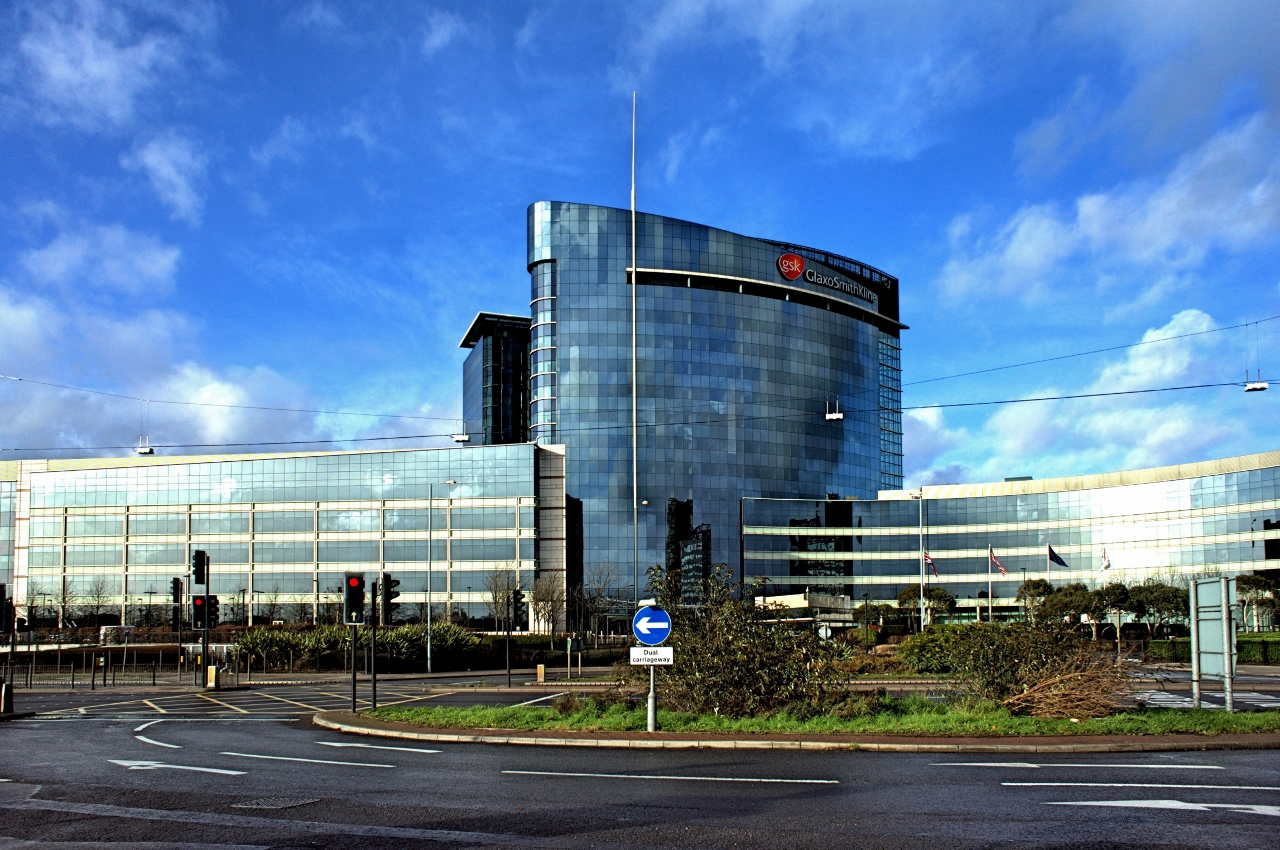
GlaxoSmithKline (commonly abbreviated as GSK) is a British multinational pharmaceutical and biotechnology corporation that researches, develops, manufactures, and markets a broad range of prescription medicines, vaccines, and consumer healthcare products. Formed in December 2000 through the merger of Glaxo Wellcome and SmithKline Beecham, the company has its principal executive offices in Brentford, London, and operates in more than 150 countries. With annual revenues exceeding £30 billion and a workforce of roughly 100,000 employees, GSK is one of the world’s largest research‑driven life‑science firms.
The firm’s portfolio spans therapeutic areas such as respiratory, HIV, oncology, immunology, and infectious diseases, and it is a leading global supplier of vaccines for influenza, hepatitis, and meningitis. GSK’s consumer health division, which includes brands like Sensodyne, Voltaren, and Panadol, contributes a substantial share of its revenue, although the company announced in 2022 a strategic split that will separate the consumer business into a standalone entity. Throughout its history, GSK has been a major investor in research and development (R&D), maintaining a pipeline of dozens of candidates in clinical trials, while also facing a series of high‑profile legal and ethical controversies related to drug safety, marketing practices, and pricing.
GSK’s influence extends beyond the pharmaceutical market; it plays a significant role in public‑health initiatives, collaborates with governments and NGOs on disease‑prevention programs, and has committed to sustainability goals such as carbon‑neutral operations by 2030. The company’s evolution reflects broader trends in the global healthcare sector, including consolidation, the rise of biologics, and increasing scrutiny of corporate conduct.
History
The origins of GlaxoSmithKline trace back to several 19th‑century British and American drug firms. Glaxo began as a baby‑food manufacturer in 1904, later entering the pharmaceutical market with the discovery of penicillin in the 1940s. Wellcome, founded in 1880 by Henry Wellcome, became a pioneer in vaccine development and the production of sulfonamide antibiotics. The two merged in 1995 to form Glaxo Wellcome, creating a diversified pipeline of prescription drugs and vaccines.SmithKline originated from the 1830 merger of Smith, Kline & French (established 1830) and later combined with Beecham Group in 1989, resulting in SmithKline Beecham. This entity brought together a strong presence in cardiovascular and central‑nervous‑system therapeutics, as well as a robust consumer health segment.
The 2000 merger that created GlaxoSmithKline was driven by the desire to achieve economies of scale, broaden geographic reach, and integrate complementary R&D capabilities. The combined company listed on the London Stock Exchange and the New York Stock Exchange, becoming a constituent of the FTSE 100 index. In the following decade, GSK pursued a series of strategic acquisitions, including the purchase of Novartis’s vaccine business (2005) and Stiefel Laboratories (2009), which expanded its immunology and dermatology portfolios.
In 2014, GSK entered a joint venture with Pfizer to develop a pipeline of novel antibiotics, reflecting growing concerns about antimicrobial resistance. The 2020s have been marked by a strategic refocus on core pharmaceuticals and vaccines, culminating in the 2022 decision to spin off the consumer health division into Haleon plc, a move intended to sharpen the company’s scientific focus and improve shareholder value.
Business Operations
GSK’s operations are organized into three primary segments: Pharmaceuticals, Vaccines, and Consumer Healthcare (the latter slated for separation). The Pharmaceuticals segment concentrates on prescription medicines for respiratory diseases (e.g., Advair, Trelegy), HIV (e.g., Tivicay, Triumeq), oncology (e.g., Zejula), and immunology (e.g., Benlysta). The Vaccines segment supplies both routine immunizations—such as Shingrix for shingles and Bexsero for meningitis B—and pandemic‑response products, notably the Shingrix and FluVax lines.Revenue distribution in 2022 showed approximately 55 % from pharmaceuticals, 30 % from vaccines, and 15 % from consumer health before the spin‑off. GSK maintains a global manufacturing network of more than 30 sites, with major production facilities in the United Kingdom, Belgium, the United States, and Singapore. The company adheres to Good Manufacturing Practice (GMP) standards and has implemented a Quality Management System that integrates risk‑based assessments across its supply chain.
Financially, GSK reported a 2022 turnover of £34.1 billion, an operating profit of £8.5 billion, and a net cash position of £12.3 billion. The firm’s capital allocation strategy emphasizes R&D investment (approximately £5 billion annually), dividend payouts, share repurchases, and strategic acquisitions. GSK’s share price is a component of the FTSE 100 and S&P 500 indices, reflecting its status as a blue‑chip multinational.
Research and Development
R&D is the cornerstone of GSK’s long‑term strategy. The company operates a network of research centers in the United Kingdom, United States, Belgium, China, and Singapore, employing over 15,000 scientists and clinicians. GSK’s R&D budget consistently ranks among the highest in the pharmaceutical industry, reaching £5.2 billion in 2022, which represents roughly 15 % of its total revenue.The firm’s research model integrates early‑stage discovery, clinical development, and open‑innovation collaborations. Notable partnerships include the Novartis‑GSK vaccine alliance, the GSK‑Sanofi COVID‑19 vaccine collaboration, and participation in the Innovative Medicines Initiative (IMI) funded by the European Union. GSK also runs the GSK Innovation Centre in London, which focuses on data‑driven drug design, artificial‑intelligence‑enabled target identification, and biologics development.
Key pipeline assets as of 2023 include a triple‑actin inhibitor for chronic obstructive pulmonary disease (COPD), a next‑generation HIV integrase inhibitor, and a herpes simplex virus vaccine currently in Phase III trials. GSK’s vaccine pipeline features candidates for respiratory syncytial virus (RSV), malaria, and a universal influenza vaccine. The company has embraced platform technologies such as mRNA and viral vectors, positioning itself to respond rapidly to emerging infectious threats.
GSK’s commitment to open science is exemplified by its Open Lab initiative, which provides external researchers access to proprietary data sets, assay libraries, and compound collections. This approach aims to accelerate drug discovery while fostering transparency and reproducibility in biomedical research.
Product Portfolio
GSK’s product portfolio is diversified across prescription medicines, vaccines, and consumer health items. In the pharmaceutical arena, the company’s best‑selling drugs include Ventolin (albuterol) for asthma, Nexavar (sorafenib) for liver cancer (now licensed out), and Jemperli (dostarlimab) for endometrial cancer, each generating annual sales exceeding £1 billion at peak.The vaccine segment is anchored by Shingrix, the recombinant zoster vaccine that has become the market leader in preventing shingles, and Bexsero, a conjugate vaccine against meningitis B. GSK also supplies Havrix and Twinrix for hepatitis A and B, and Infanrix for diphtheria, tetanus, and pertussis. During the COVID‑19 pandemic, GSK contributed to the development of the Novavax protein‑subunit vaccine, which received emergency use authorization in multiple jurisdictions.
Consumer health brands, now part of the forthcoming Haleon spin‑off, have historically contributed significant cash flow. Products such as Sensodyne (toothpaste for sensitive teeth), Voltaren (topical NSAID), Panadol (paracetamol), and Tums (antacid) are among the most recognized over‑the‑counter offerings worldwide.
GSK’s geographic market penetration is strongest in Europe, North America, and emerging economies in Asia and Africa, where it collaborates with local health ministries to improve vaccine coverage and access to essential medicines. The company reports that approximately 30 % of its revenue in 2022 derived from emerging markets, reflecting its strategic emphasis on global health equity.
Controversies and Legal Issues
GSK’s extensive history has been punctuated by several high‑profile controversies. In 2004, the United States Department of Justice announced a $3 billion settlement with GSK over allegations of illegal marketing practices, including the promotion of the antidepressant Paxil for unapproved pediatric use and the off‑label marketing of the asthma drug Ventolin. The settlement, one of the largest in pharmaceutical history, required GSK to implement a comprehensive corporate compliance program.In 2012, the UK’s Medicines and Healthcare products Regulatory Agency (MHRA) suspended the marketing authorisation for the anti‑influenza drug Relenza after concerns about its safety profile, prompting a temporary decline in sales and a subsequent review of the company’s pharmacovigilance processes. GSK later withdrew the product from several markets.
The company has also faced criticism over the pricing of its vaccines. In 2015, GSK was accused by NGOs of charging excessive prices for the HPV vaccine Cervarix in low‑income countries, leading to calls for tiered pricing and greater transparency. GSK responded by expanding its Access to Medicines program, which offers discounted or donated vaccines to eligible nations.
Environmental and sustainability concerns have emerged as well. A 2020 report by Friends of the Earth highlighted GSK’s carbon emissions from manufacturing sites, prompting the firm to pledge a net‑zero carbon target by 2030 and to invest in renewable energy projects across its supply chain.
Most recently, the 2023 UK Competition and Markets Authority (CMA) investigation into the proposed Haleon spin‑off examined whether the separation would reduce competition in the consumer health market. While the CMA ultimately cleared the transaction, it required GSK to maintain certain product supply commitments to prevent market disruption.
These episodes have shaped GSK’s corporate governance reforms, including the establishment of an independent Compliance Committee, the appointment of a Chief Ethics Officer, and the adoption of a Human Rights Policy aligned with the UN Guiding Principles on Business and Human Rights.


