




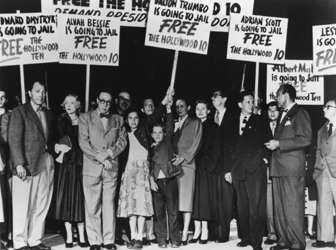
Hollywood Blacklist
The Hollywood Blacklist was a mid-20th century practice of banning suspected Communists from working in the United States entertainment industry, affecting actors, screenwriters, directors, musicians, and other professionals.
The Hollywood Blacklist began at the onset of the Cold War and Red Scare, and its impact was felt in Hollywood, New York, and elsewhere. The practice of blacklisting was a result of the increasing paranoia and fear of communism in the United States, which led to a wave of investigations and hearings by the House Un-American Activities Committee (HUAC) and the Federal Bureau of Investigation (FBI). The blacklist was a tool used by the entertainment industry to identify and exclude individuals suspected of being communists or having ties to the Communist Party USA (CPUSA).
The Hollywood Blacklist had a significant impact on the entertainment industry, leading to the loss of jobs, careers, and livelihoods for many individuals. It also led to a period of self-censorship and fear in the industry, as many individuals were reluctant to speak out against the blacklist or to take risks that might be perceived as "subversive." The blacklist was eventually dismantled in the late 1950s and early 1960s, but its legacy continues to be felt in the entertainment industry today.
Origins and History
The Hollywood Blacklist has its roots in the early 20th century, when the entertainment industry began to take an interest in the activities of the Communist Party USA (CPUSA). In the 1920s and 1930s, many artists and intellectuals in the entertainment industry were drawn to the ideals of communism, and some even joined the CPUSA. However, with the rise of fascism in Europe and the Soviet Union's alliance with Nazi Germany, the CPUSA's popularity began to decline.
In the aftermath of World War II, the United States government began to take a more aggressive stance against communism, and the entertainment industry became a target of suspicion. In 1947, the House Un-American Activities Committee (HUAC) launched an investigation into the entertainment industry, and in 1948, the Federal Bureau of Investigation (FBI) began a series of investigations into the CPUSA and its alleged ties to the entertainment industry.
The Hollywood Blacklist was formalized in 1947, when the Hollywood Anti-Nazi League, a group of artists and intellectuals who had opposed fascism during World War II, was disbanded and replaced by the Hollywood Democratic Committee, which was seen as more conservative. The Hollywood Democratic Committee began to compile a list of suspected communists and their sympathizers, which would eventually become the Hollywood Blacklist.
Mechanism and Impact
The Hollywood Blacklist was a complex and multifaceted system, with many different individuals and organizations involved. The blacklist was maintained by a group of industry executives, including studio heads and producers, who were responsible for identifying and excluding suspected communists from the industry.
The blacklist was used to bar individuals from working in the entertainment industry, and it was also used to pressure individuals to cooperate with investigations and to provide information about their colleagues. Many individuals were blacklisted without ever being formally accused of being a communist, and some were even blacklisted for their perceived sympathies or associations.
The impact of the Hollywood Blacklist was significant, with many individuals losing their jobs, careers, and livelihoods as a result of being blacklisted. The blacklist also led to a period of self-censorship and fear in the industry, as many individuals were reluctant to speak out against the blacklist or to take risks that might be perceived as "subversive."
Criticism and Legacy
The Hollywood Blacklist has been widely criticized for its impact on the entertainment industry and its treatment of individuals suspected of being communists. Many have argued that the blacklist was a form of McCarthyism, and that it was used to suppress dissent and to silence individuals who were perceived as threats to the status quo.
In the 1950s and 1960s, many individuals who had been blacklisted began to speak out against the practice, and in 1960, the Screen Actors Guild (SAG) officially condemned the blacklist. In 1967, the Writers Guild of America (WGA) also condemned the blacklist, and in 1976, the Hollywood Blacklist was officially dismantled.
Today, the Hollywood Blacklist is remembered as a dark chapter in the history of the entertainment industry, and it serves as a reminder of the dangers of McCarthyism and the importance of protecting individual rights and freedoms.


