




Overview
Emerging in the late 1960s, Land art thrust the outdoors onto the canvas of contemporary art, inviting viewers to experience sculpture, drawing, and performance on a planetary scale. Artists abandoned studio walls and conventional materials, opting instead for soil, rock, sand, water, and living vegetation—the very elements that compose the earth itself. By situating works in remote deserts, coastal cliffs, or rolling hills, creators emphasized the dialogue between human intention and the indifferent forces of weather, erosion, and time.The movement’s visual language is both stark and poetic: massive earth mounds that echo ancient burial cairns, spiraling trenches that mimic planetary orbits, and delicate interventions that coax seedlings into unexpected patterns. Because many sites are inaccessible to the public, photographic and video documentation become essential extensions of the artwork, translating the vastness of the landscape into gallery frames and museum walls. This duality—epic scale on site, intimate image in the city—has kept Land art at the forefront of discussions about ecology, temporality, and the role of the artist as a steward of the planet.
History/Background
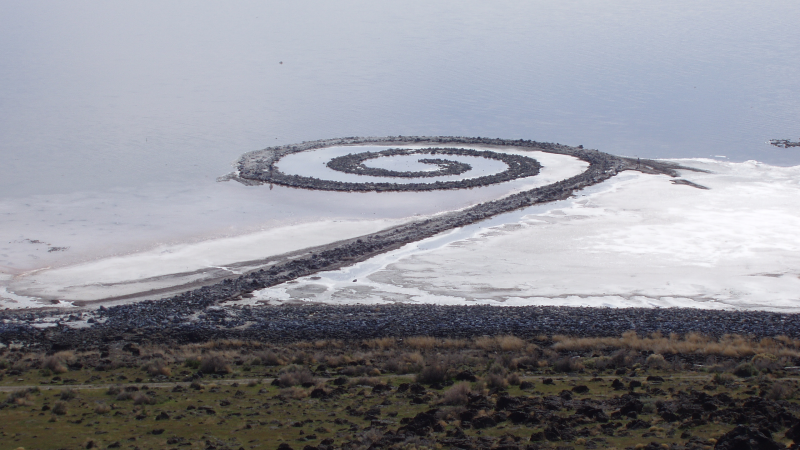
Land art germinated amid the social upheavals of the late 1960s, when artists sought alternatives to the commercial gallery system and the commodification of art objects. In the United States, the 1968 exhibition “Earthworks” at the Museum of Modern Art (MoMA) in New York, curated by Willoughby Sharp, introduced the public to pioneering projects such as Robert Smithson’s Spiral Jetty (1970) and Michael Heizer’s Double Negative (1969‑70). Across the Atlantic, British artists like Richard Long and Andy Goldsworthy explored walking as a performative act, leaving transient marks in the countryside that were later photographed.Key dates include:
- 1968 – MoMA’s “Earthworks” exhibition, signaling institutional recognition.
- 1970 – Completion of Spiral Jetty on Utah’s Great Salt Lake, a canonical work.
- 1976 – The formation of the Land Art Generator Initiative, linking art with renewable energy concepts.
- 1990s‑2000s – A resurgence of interest, with artists such as Christo and Jeanne‑Claude, Nils-Udo, and Maya Lin expanding the vocabulary to include large‑scale fabric installations and climate‑responsive sculptures.
While the movement’s early phase was dominated by American and British practitioners, subsequent decades saw vibrant contributions from Australia (e.g., James Turrell’s Roden Crater), Germany (Udo Kulisch), Japan (Nobuo Sekine), and South America (César López’s Cerro de la Muerte), underscoring its global resonance.
Key Information
- Materials: Native earth, rocks, sand, water, vegetation, and occasionally industrial debris repurposed in situ. - Scale: Works range from modest stone circles a few meters across to mile‑long earth cuts that reshape entire landscapes. - Documentation: High‑resolution photography, aerial drone footage, and satellite imaging are integral to the work’s dissemination. - Notable Projects: Spiral Jetty (Robert Smithson), Double Negative (Michael Heizer), Stonehenge II (Andy Goldsworthy), The Lightning Field (Walter De Maria), Sun Tunnels (Nancy Holt), The Umbrellas (Christo & Jeanne‑Claude). - Philosophical Tenets: Emphasis on impermanence, environmental awareness, and the interdependence of art and ecology. - Funding & Preservation: Many pieces are maintained by foundations, national parks, or private trusts; preservation debates often center on natural decay versus artistic intent.Significance
Land art reshaped the definition of sculpture, proving that the planet itself can be a medium. Its emphasis on site specificity forced museums and collectors to reconsider ownership, leading to new models of artist‑led stewardship and public‑private partnerships for conservation. By foregrounding ecological processes, the movement anticipated contemporary concerns about climate change, sustainability, and the Anthropocene, influencing generations of environmental artists, architects, and designers.Moreover, Land art’s reliance on documentation democratized access, allowing audiences worldwide to experience remote works through images and virtual tours. This practice has informed today’s digital archiving and augmented‑reality exhibitions, ensuring that even as the physical pieces erode, their cultural imprint endures. In sum, Land art stands as a testament to humanity’s capacity to collaborate with, rather than dominate, the natural world, leaving a legacy that continues to inspire dialogue between art, science, and the environment.


