



Overview
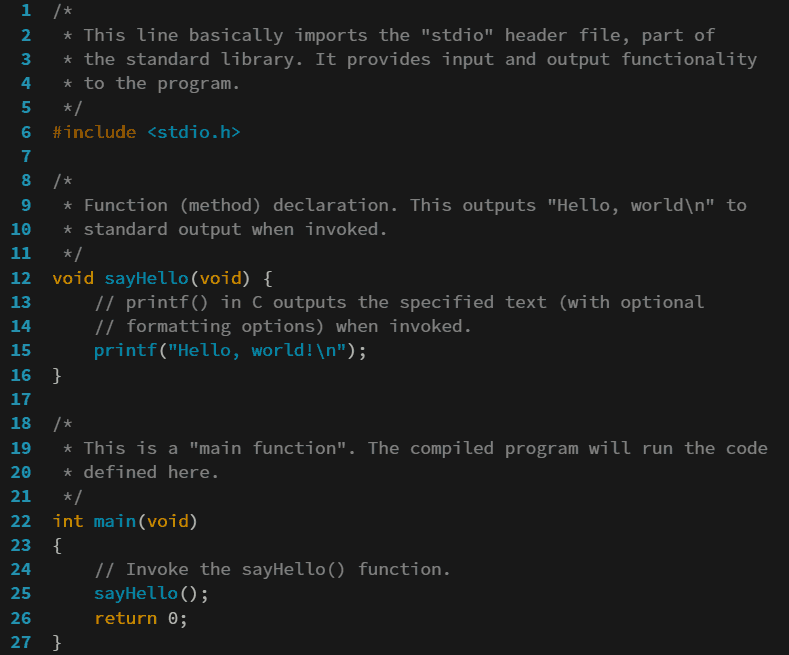
Programming languages are formal systems designed to communicate instructions to computers, enabling the creation of software, applications, and automated processes. They range from low-level languages like assembly, which closely mirror machine code, to high-level languages such as Python or JavaScript, which prioritize human readability and abstraction. These languages are categorized by paradigms—procedural (e.g., C), object-oriented (e.g., Java), functional (e.g., Haskell), and declarative (e.g., SQL)—each offering unique approaches to problem-solving. Programming languages are foundational to computer science, underpinning everything from operating systems and mobile apps to artificial intelligence and blockchain.The evolution of programming languages reflects advancements in computing power and software complexity. Early languages required direct hardware manipulation, while modern languages emphasize efficiency, scalability, and developer productivity. Tools like compilers, interpreters, and integrated development environments (IDEs) further streamline coding, translating human-readable code into machine-executable instructions. Today, programming languages are indispensable in industries ranging from finance and healthcare to entertainment and education.
History/Background
The concept of programming dates to the 19th century with Ada Lovelace’s notes on Charles Babbage’s Analytical Engine, often considered the first algorithm intended for machine processing. However, practical programming languages emerged in the 20th century alongside electronic computers. The 1940s–1950s saw the rise of assembly languages, which simplified binary code with symbolic representations. Fortran (1957) became the first high-level language, revolutionizing scientific computing by abstracting hardware details.The 1960s–1970s introduced multipurpose languages like C (1972), which combined low-level control with high-level flexibility, becoming a cornerstone for operating systems and embedded systems. The 1980s–1990s saw the proliferation of object-oriented languages like C++ (1985) and Java (1995), while Python (1991) prioritized simplicity and readability. The 2000s–2010s emphasized web development (JavaScript, 1995), data science (R, 2000), and concurrency (Go, 2009). Open-source movements and community-driven development further democratized language creation, with Rust (2010) and Swift (2014) addressing modern challenges like memory safety and mobile development.
Key Information
- Fortran: Pioneered scientific computing; still used in high-performance computing. - C: Influenced countless languages (C++, C#, Rust); ANSI C standardized in 1989 (C89). - Python: Emphasizes code readability; Python 3 (2008) replaced Python 2, with Python 3.11 (2022) offering performance boosts. - JavaScript: Dominates web development; ECMAScript standards (ES6, 2015) introduced modern features like arrow functions. - Java: "Write once, run anywhere" via the Java Virtual Machine (JVM); Java 17 (2021) is the latest long-term support (LTS) version. - TIOBE Index: Tracks language popularity; as of 2023, Python, C, and Java lead. - Domain-Specific Languages (DSLs): SQL for databases, MATLAB for engineering, and Julia for scientific computing.Significance
Programming languages are the bedrock of the digital age, enabling innovation across sectors. They empower developers to solve complex problems, automate tasks, and build scalable systems. High-level languages reduce development time, while low-level languages optimize performance for hardware. The choice of language impacts project success, influencing factors like maintainability, security, and performance.Moreover, programming languages shape how humans interact with technology. Web languages like HTML/CSS and JavaScript drive the internet, while AI/ML frameworks (Python, R) advance data-driven decision-making. In education, languages like Scratch (visual programming) and Python (beginner-friendly) democratize coding literacy. As technology evolves, new languages emerge to address challenges in quantum computing, blockchain, and decentralized systems, ensuring programming remains a dynamic, ever-relevant field.


