




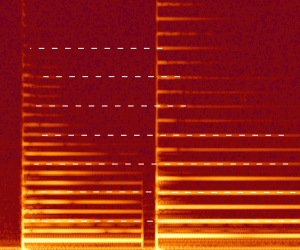
Spectral Music
Spectral music is a musical composition technique that utilizes the acoustic properties of sound, or sound spectra, as a basis for creating unique and often unconventional soundscapes.
Spectral music emerged as a distinct compositional approach in the late 20th century, primarily among avant-garde and experimental musicians. By focusing on the spectral properties of sound, composers can create complex, layered soundscapes that push the boundaries of traditional music. This approach often involves manipulating sound waves to reveal hidden harmonics, timbres, and textures, resulting in a rich and immersive listening experience.
Spectral music has been employed by a variety of musicians, from classical composers to electronic music artists, and has influenced a range of musical genres, including ambient, experimental, and noise music. The technique has also been used in film and video game soundtracks to create immersive and engaging sonic environments.
History
Spectral music has its roots in the early 20th century, when composers such as Igor Stravinsky and Edgard Varèse began experimenting with unconventional sound sources and techniques. However, it was not until the 1960s and 1970s that spectral music began to take shape as a distinct compositional approach.
During this period, musicians such as Pierre Henry and György Ligeti developed techniques for manipulating sound waves to reveal hidden harmonics and timbres. Henry's work, in particular, was influential in the development of spectral music, as he used a range of unconventional sound sources, including electronic instruments and found objects.
Key Figures
- Pierre Henry: A French composer and musician who was instrumental in the development of spectral music. His work often featured unconventional sound sources and techniques, and he is widely regarded as one of the pioneers of spectral music.
- György Ligeti: A Hungarian composer who was known for his use of spectral techniques in his music. His compositions often featured complex, layered soundscapes that pushed the boundaries of traditional music.
- Iannis Xenakis: A Greek composer who was a key figure in the development of spectral music. His work often featured complex, mathematical structures and was characterized by its use of unconventional sound sources and techniques.
Mechanism
Spectral music involves manipulating sound waves to reveal hidden harmonics, timbres, and textures. This can be achieved through a range of techniques, including:
- Frequency analysis: Breaking down sound waves into their component frequencies to reveal hidden harmonics and timbres.
- Time-stretching: Manipulating the duration of sound waves to create complex, layered soundscapes.
- Ring modulation: Modulating sound waves to create new, complex timbres.
These techniques can be used in a variety of ways, from creating complex, layered soundscapes to manipulating sound waves to create new, unconventional timbres.
Software and Tools
- Max/MSP: A software platform that allows musicians to create and manipulate sound waves in real-time.
- SuperCollider: A programming language that allows musicians to create and manipulate sound waves using a range of algorithms and techniques.
- Ableton Live: A digital audio workstation that allows musicians to create and manipulate sound waves using a range of techniques and effects.
Significance and Impact
Spectral music has had a significant impact on the development of music and sound design. Its use of unconventional sound sources and techniques has pushed the boundaries of traditional music and has influenced a range of musical genres, including ambient, experimental, and noise music.
Spectral music has also been used in film and video game soundtracks to create immersive and engaging sonic environments. Its use of complex, layered soundscapes has created a new level of depth and realism in sound design, and has influenced a range of other art forms, including visual art and dance.
Criticism and Controversy
Spectral music has been criticized for its complexity and difficulty, with some musicians and critics arguing that it is inaccessible to a wider audience. Others have criticized the use of unconventional sound sources and techniques, arguing that they are too experimental or avant-garde.
However, spectral music has also been praised for its innovative and groundbreaking approach to sound and music. Its use of complex, layered soundscapes has created a new level of depth and realism in sound design, and has influenced a range of other art forms.


