




**
Overview
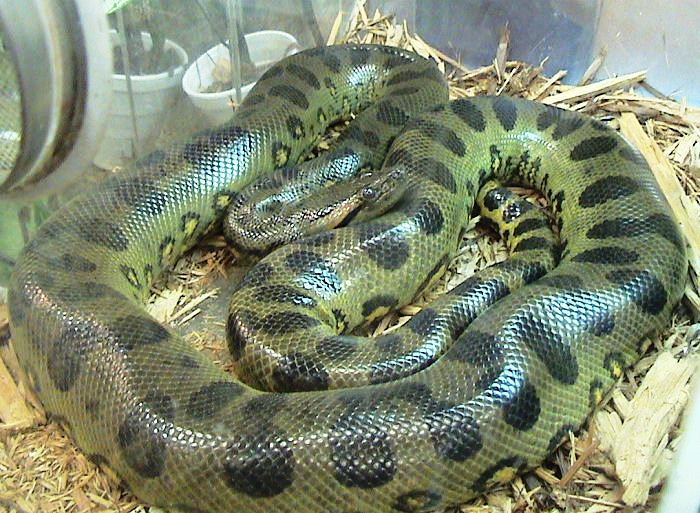
The anacondas, commonly called water boas, comprise four living species—Eunectes murinus (green anaconda), E. notaeus (yellow anaconda), E. deschauenseei (dark‑spotted anaconda), and E. beniensis (Bolivian anaconda)—and one extinct relative known from Pleistocene deposits. These snakes are among the world’s heaviest and longest reptiles, with the green anaconda routinely exceeding 5 m (16 ft) in length and weighing over 150 kg (330 lb). Their bodies are robust, muscular, and laterally compressed, adaptations that facilitate stealthy movement through the dense vegetation and slow‑moving waters of the Amazon, Orinoco, and Pantanal basins.Anacondas are semiaquatic specialists: they spend much of their time submerged, using their eyes and nostrils positioned on top of the head to breathe and observe while the rest of the body remains hidden. Their diet is opportunistic and includes fish, caimans, capybaras, deer, and occasionally large mammals such as jaguars. They employ constrictive predation, wrapping their powerful coils around prey until circulatory arrest occurs. Reproduction is ovoviviparous; females give birth to live young after a gestation of 6–7 months, producing litters of up to 40 neonates.
Culturally, anacondas have inspired myth and folklore throughout indigenous Amazonian societies, often portrayed as guardians of the river or as symbols of primal power. In modern media, they are frequently sensationalized, but scientific study reveals a nuanced picture of a species finely tuned to its environment and essential to the health of tropical ecosystems.
History/Background
The genus Eunectes was first described by French naturalist Georges Cuvier in 1805, derived from the Greek “eu‑” (good) and “nektes” (swimmer), reflecting the snakes’ aquatic prowess. Fossil evidence indicates that anacondas diverged from other boas during the Miocene epoch, roughly 15–20 million years ago, coinciding with the rise of extensive South American wetlands. The extinct species Eunectes stirtoni (known from a partial skull dated to ~1 Ma) suggests that the lineage once occupied a broader range, including higher altitude river systems now unsuitable for such large, water‑dependent reptiles.European explorers in the 16th and 17th centuries recorded encounters with “serpents of the Amazon,” often exaggerating their size. Scientific scrutiny began in earnest in the 19th century, with naturalists like Alexander von Humboldt and John Edward Gray collecting specimens that clarified taxonomy. The 20th century saw the first comprehensive ecological studies, notably Harold Heatwole’s 1970 survey of Pantanal anacondas, which documented population densities, habitat preferences, and reproductive cycles. Recent advances in radio telemetry and drone imaging (2010s‑2020s) have refined our understanding of movement patterns and home‑range dynamics, revealing that anacondas can travel up to 30 km during the breeding season.
Key Information
- Species Count: 4 extant (E. murinus, E. notaeus, E. deschauenseei, E. beniensis) + 1 extinct (E. stirtoni). - Size Range: E. murinus up to 5.2 m and 150 kg; E. notaeus averages 2–3 m. - Habitat: Swamps, marshes, slow‑moving rivers, and flooded forest floors of the Amazon, Orinoco, and adjacent basins. - Diet: Broad carnivorous spectrum; primary prey includes fish, amphibians, reptiles, birds, and mammals up to 30 kg. - Reproduction: Ovoviviparous; gestation 6–7 months; litters 10–40 neonates, each 30–45 cm at birth. - Conservation Status: E. murinus – Least Concern (IUCN), but populations face pressure from habitat loss, illegal hunting for skin, and the pet trade. - Ecological Role: Apex predator regulating vertebrate populations; their burrowing and movement aid in nutrient redistribution within wetland soils. - Unique Adaptations: Valvular nostrils, infrared‑sensing pits (limited compared to pit vipers), and a highly elastic rib cage allowing expansion during large meals.Significance
Anacondas serve as keystone species in South American wetland ecosystems. By preying on a variety of vertebrates, they help maintain balanced trophic cascades, preventing overpopulation of herbivores that could otherwise degrade vegetation and water quality. Their presence is an indicator of ecosystem integrity; declines often signal broader environmental stressors such as deforestation, mining runoff, or climate‑driven hydrological changes.From a conservation perspective, protecting anacondas aligns with safeguarding the Pantanal and Amazon floodplains, regions that store immense carbon and support countless endemic species. Community‑based initiatives in Brazil and Bolivia now incorporate anaconda monitoring into broader wetland management plans, emphasizing sustainable use of resources and education to dispel myths that fuel persecution.
Scientifically, anacondas provide a living model for studying large‑body physiology, especially regarding respiratory efficiency under water, metabolic adaptations to infrequent but massive meals, and reproductive strategies in fluctuating environments. Their genetic diversity also offers insights into speciation processes across the complex riverine networks of South America.
In popular culture, the anaconda’s formidable reputation has been harnessed for storytelling, yet responsible outreach can transform fear into appreciation, fostering a conservation ethic that values these remarkable reptiles as integral components of the planet’s biodiversity.
INFOBOX:
- Name: Anaconda (Genus Eunectes)
- Type: Large, semiaquatic boas (reptiles)
- Date: First described 1805 (genus authority)
- Location: Tropical wetlands of South America (Amazon, Orinoco, Pantanal)
- Known For: Being among the world’s largest snakes and a top wetland predator
TAGS: reptiles, snakes, South America, wetlands, apex predator, conservation, biodiversity, ecology


