Overview
From the moment Constantine I dedicated “New Rome” on the Bosporus in 330 CE, the eastern Mediterranean world acquired a capital that would outlive its western counterpart by eleven centuries. The polity we now call the Byzantine Empire was, in its own chanceries and coins, simply the Roman Empire: autocratic, Christian, Greek-speaking, and tightly centralized around a professional bureaucracy that could tax, legislate, and field armies from the Danube to the Euphrates. Its genius lay in fusing Roman law, Hellenic culture, and Christian theology into a resilient imperial identity that survived barbarian migrations, Arab conquests, iconoclastic civil wars, crusading greed, and repeated plague. Even when reduced to a few Aegean ports in the fifteenth century, Constantinople remained the magnetic “Queen of Cities,” whose fall to the Ottomans on 29 May 1453 closed the Middle Ages and redirected world trade toward the Atlantic.Background
The seeds of Byzantium were sown in the administrative bifurcation of the late third century. Emperor Diocletian (r. 284–305) divided the sprawling empire into Eastern and Western prefectures to stem economic collapse and frontier pressure. Constantine’s founding of Constantinople (330) shifted the gravitational center eastward, where greater urban density, richer tax bases, and closer access to Anatolian and Egyptian granaries gave the East structural advantages. The formal split into two imperial courts (395) became permanent when Germanic generals deposed the last western emperor (476). In the East, a succession of soldier-emperors—Zeno, Anastasius, Justinian—reconquered North Africa, Italy, and part of Spain, but also fortified the Anatolian theme system that would repel Persians, Avars, Slavs, and Arabs. By the time Heraclius (r. 610–641) replaced Latin with Greek as the official language and styled himself “Basileus ton Rhomaion,” the transformation from Roman to Byzantine was complete, though contemporaries never abandoned the Roman label.Key Facts
- Capital: Byzantion → Constantinople → Istanbul (330–1453)
- Founding: 330 (dedication of Constantinople)
- Terminal Date: 29 May 1453 (Ottoman conquest)
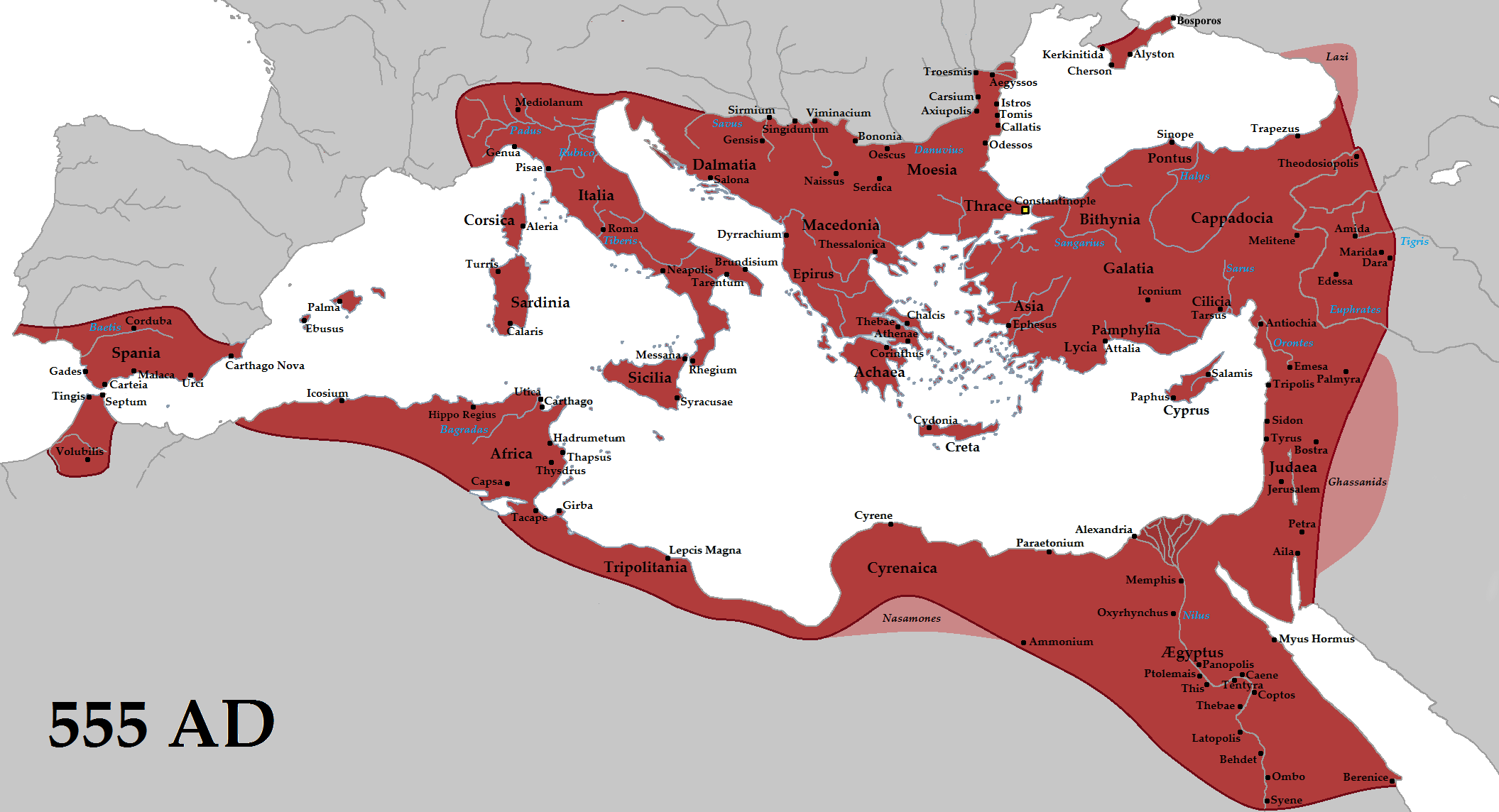
- Peak Territorial Extent: c. 555 under Justinian I—North Africa, Italy, southern Spain, Balkans, Anatolia, Levant, Egypt
- Longevity: 1,123 years (330–1453) or 2,206 years if counting from traditional founding of Rome (753 BCE)
- Administrative Language: Latin to early 7th c.; Greek thereafter
- State Religion: Christianity (Nicene/Chalcedonian); caesaropapist control of Patriarchate
- Military Units: Late Roman legions → Thematic armies → Tagmata (elite central regiments)
- Iconoclasm: Two waves, 726–787 and 814–843
- Schism: 1054 (Great Schism with Rome)
- Crusades: Fourth Crusade sacks Constantinople 1204; Latin Empire 1204–1261
- Revival: 1261–1453 under Palaiologoi; population fell from c. 500,000 (6th c.) to c. 50,000 (1453)
- Cultural Legacy: Preserved and transmitted classical Greek texts; codified Roman law (Corpus Juris Civilis, 529–534); Byzantine chant and Orthodox iconographyImpact
Byzantium served as the hinge between antiquity and modernity. Its legal code underpinned civil-law traditions from the Holy Roman Empire to modern Greece, Serbia, and Russia. Its missionaries, Cyril and Methodius, devised the Glagolitic alphabet (ancestor of Cyrillic) that still scripts much of Eastern Europe. By sheltering classical manuscripts and maintaining schools of rhetoric and philosophy, Byzantine scholars seeded the Italian Renaissance—most visibly when émigrés such as Manuel Chrysoloras introduced Greek studies to Florence after 1397. Strategically, the empire’s long wars with Persia, then the Caliphates, blunted eastern thrusts into Europe, buying time for fledgling western kingdoms to coalesce. Theologically, Byzantine debates over Christology and icon veneration defined the creeds and artistic canons of Orthodox Christianity, now professed by over 250 million believers. Finally, the fall of Constantinople triggered a scramble for new spice routes that accelerated Iberian maritime expansion and, ultimately, global modernity.
Tip: double-click any word in this article for an instant definition from the NerdDictionary.