
Cantor's Theorem
Cantor's Theorem is a fundamental result in mathematical set theory that describes the relationship between a set and its power set, stating that the power set of any set has a strictly greater cardinality than the set itself.
In the late 19th century, German mathematician Georg Cantor developed this theorem as part of his groundbreaking work on set theory. Cantor's Theorem has far-reaching implications in mathematics, particularly in the study of infinite sets and their properties. It has been instrumental in the development of modern mathematics, influencing various branches such as topology, analysis, and logic.
Cantor's Theorem has been extensively applied in mathematics, computer science, and philosophy, providing a framework for understanding the nature of infinity and the limits of mathematical reasoning. The theorem has been used to prove various results in mathematics, including the uncountability of the real numbers and the existence of uncountable sets.
History
Cantor's Theorem was first introduced by Georg Cantor in his 1874 paper "On a Characteristic Property of All Real Algebraic Numbers." Cantor's work on set theory was revolutionary, and his Theorem was a key component of his contributions to the field. In the late 19th century, Cantor's Theorem was widely accepted and became a fundamental result in mathematics.
Mechanism
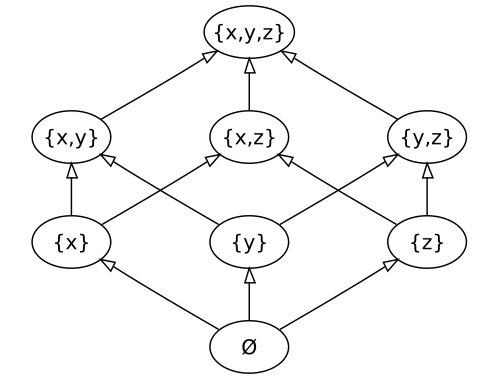
Cantor's Theorem states that for any set A, the power set P(A) has a strictly greater cardinality than A. The power set P(A) is the set of all subsets of A, including the empty set and A itself. The cardinality of a set is a measure of its size, and Cantor's Theorem shows that the power set of any set has a larger cardinality than the set itself.
The proof of Cantor's Theorem involves a diagonal argument, which is a technique used to show that a set is uncountable. The diagonal argument involves constructing a new set from the elements of the original set, using a diagonal process to ensure that the new set is distinct from the original set.
Applications
Cantor's Theorem has far-reaching implications in mathematics, particularly in the study of infinite sets and their properties. The theorem has been used to prove various results in mathematics, including the uncountability of the real numbers and the existence of uncountable sets.
In computer science, Cantor's Theorem has been used to study the complexity of algorithms and the limits of computational power. The theorem has also been applied in philosophy, particularly in the study of the nature of infinity and the limits of mathematical reasoning.
Impact
Cantor's Theorem has had a profound impact on mathematics and its applications. The theorem has influenced various branches of mathematics, including topology, analysis, and logic. Cantor's Theorem has also been used to study the nature of infinity and the limits of mathematical reasoning.
In the early 20th century, Cantor's Theorem was used to prove the existence of uncountable sets, which had significant implications for the study of mathematics and its applications. The theorem has also been used to study the complexity of algorithms and the limits of computational power.
Criticisms and Controversies
Cantor's Theorem has been the subject of various criticisms and controversies, particularly in the early 20th century. Some mathematicians, such as Henri Poincaré, questioned the validity of Cantor's Theorem, arguing that it was based on a flawed assumption about the nature of infinity.
However, Cantor's Theorem has been extensively validated and has become a fundamental result in mathematics. The theorem has been used to prove various results in mathematics, and its implications have been widely accepted by mathematicians and philosophers.
INFOBOX:
- Name: Cantor's Theorem
- Type: Mathematical Theorem
- Date: 1874
- Location: Mathematics
- Known For: Describing the relationship between a set and its power set
TAGS: Set theory, Georg Cantor, Power set, Cardinality, Diagonal argument, Uncountability, Infinity, Mathematical logic, Topology, Analysis, Logic.