



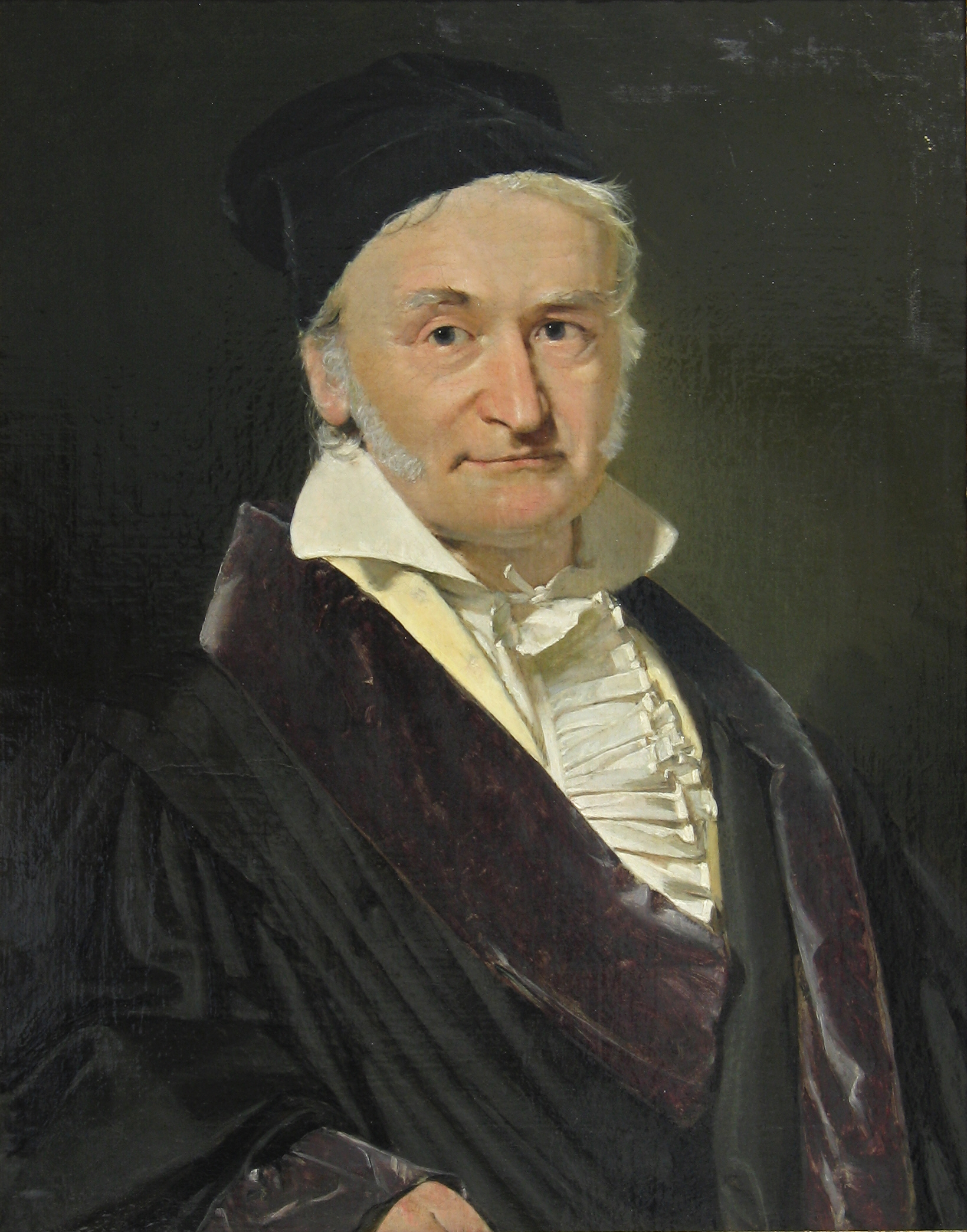

Overview
On 30 April 1777, in Brunswick, Germany, a brick-layer’s wife gave birth to a boy who would later correct his father’s payroll arithmetic at age three. By nineteen, Carl Friedrich Gauss had constructed a regular 17-gon with ruler and compass—something the Greeks had hunted for 2000 years—and by twenty-four he had calculated the orbit of the dwarf planet Ceres from fewer than 9° of observed sky-arc, allowing astronomers to relocate it a full year later. From 1807 until his death in 1855 he directed the Göttingen Observatory and turned it into the world’s leading mathematical research hub.
Gauss did not publish prolifically; he “published only the peaks, not the foothills.” Yet those peaks reshaped number theory, statistics, geodesy, magnetism, and astronomy. His 1801 Disquisitiones Arithmeticae systematized modular arithmetic and gave us the Gaussian integers; his 1809 Theoria Motus introduced the Gaussian distribution; his 1830s surveys laid the geometric groundwork for Einstein’s curved space-time. Even the humble Gaussian elimination—the way your spreadsheet solves simultaneous equations—carries his name.
Background & Origins
Born Johann Carl Friedrich Gauss, he grew up in a half-timbered house on the river Oker. His mother, illiterate but numerate, noticed her toddler could add faster than the adults. A local duke, impressed by the boy’s rapid mental multiplication of the series 1 + 2 + … + 100, financed his schooling and later his university studies at the Collegium Carolinum (1792–1795) and Göttingen (1795–1798). Gauss kept a “mathematical diary” of 146 terse statements; when decoded decades after his death, it revealed that he had discovered non-Euclidean geometry, the Fast Fourier Transform, and quaternion multiplication years before their official inventors.
Major Achievements & Milestones
Construction of the 17-gon (1796): Proved the heptadecagon is constructible, opening the whole new field of constructible polygons.
Method of Least Squares (1795, published 1809): Minimized observational error; still the backbone of every regression line in data science.
Ceres Orbit Rediscovery (1801): Used his least-squares technique to predict the lost asteroid’s position to within 0.5°.
Directorship of Göttingen Observatory (1807): Turned a sleepy post into Europe’s premier astronomical workplace.
Magnetometer & Gauss Unit (1833): With Wilhelm Weber, built the first electromagnetic telegraph and defined the magnetic flux unit (1 G = 10⁻⁴ T).
Fundamental Theorem of Algebra—First Rigorous Proof (1799): Closed a century-long gap in polynomial theory.
Gauss’s Law in Electrostatics (1835): One of Maxwell’s four equations, it relates electric flux to enclosed charge ∮ E·dA = Q/ε₀.
Timeline
- 1777: Born in Brunswick, Holy Roman Empire
- 1796: Discovered 17-gon constructibility; started diary entry “ΕΥΡΗΚΑ!”
- 1801: Published Disquisitiones Arithmeticae; predicted Ceres return
- 1807: Appointed Professor of Astronomy & Director, Göttingen Observatory
- 1809: Released Theoria Motus with Gaussian distribution
- 1833: Built 2-km telegraph line with Weber
- 1839: Completed 3000-km geodetic survey of Hanover
- 1855: Died in Göttingen; brain preserved to study “mathematical anatomy”
Impact & Legacy
Gauss’s insistence on rigorous proof elevated mathematics from a toolbox of tricks to a deductive science. His normal distribution underlies modern quality control, medical trials, and machine-learning kernels. Gaussian curvature lets Google Maps project the round Earth onto a flat screen without tearing angles. Gaussian integers a+bi are now standard in cryptography; every time you shop online, your browser relies on properties he first explored. Physicists measure magnetic fields in gauss; astronomers still use his least-squares algorithm to fit exoplanet orbits. When Einstein needed tensor calculus for general relativity, he turned to the intrinsic geometry formalized by Gauss in 1827.
Records & Notable Facts
- Gauss could mentally multiply two 20-digit numbers in his head, speaking only the final product.
- He refused to publish anything non-rigorous; non-Euclidean geometry stayed in his notes until 1855, depriving him of priority over Bolyai and Lobachevsky.
- The gauss unit remained legal for magnetic flux density until SI units replaced it in the 1960s.
- His brain, preserved at the University of Göttingen, weighs 1492 g—slightly above average but shows unusually deep convolutions in the pre-frontal region.
> “Mathematics is the queen of the sciences and number theory is the queen of mathematics.”
> — Carl Friedrich Gauss, 1850 lecture to students


