




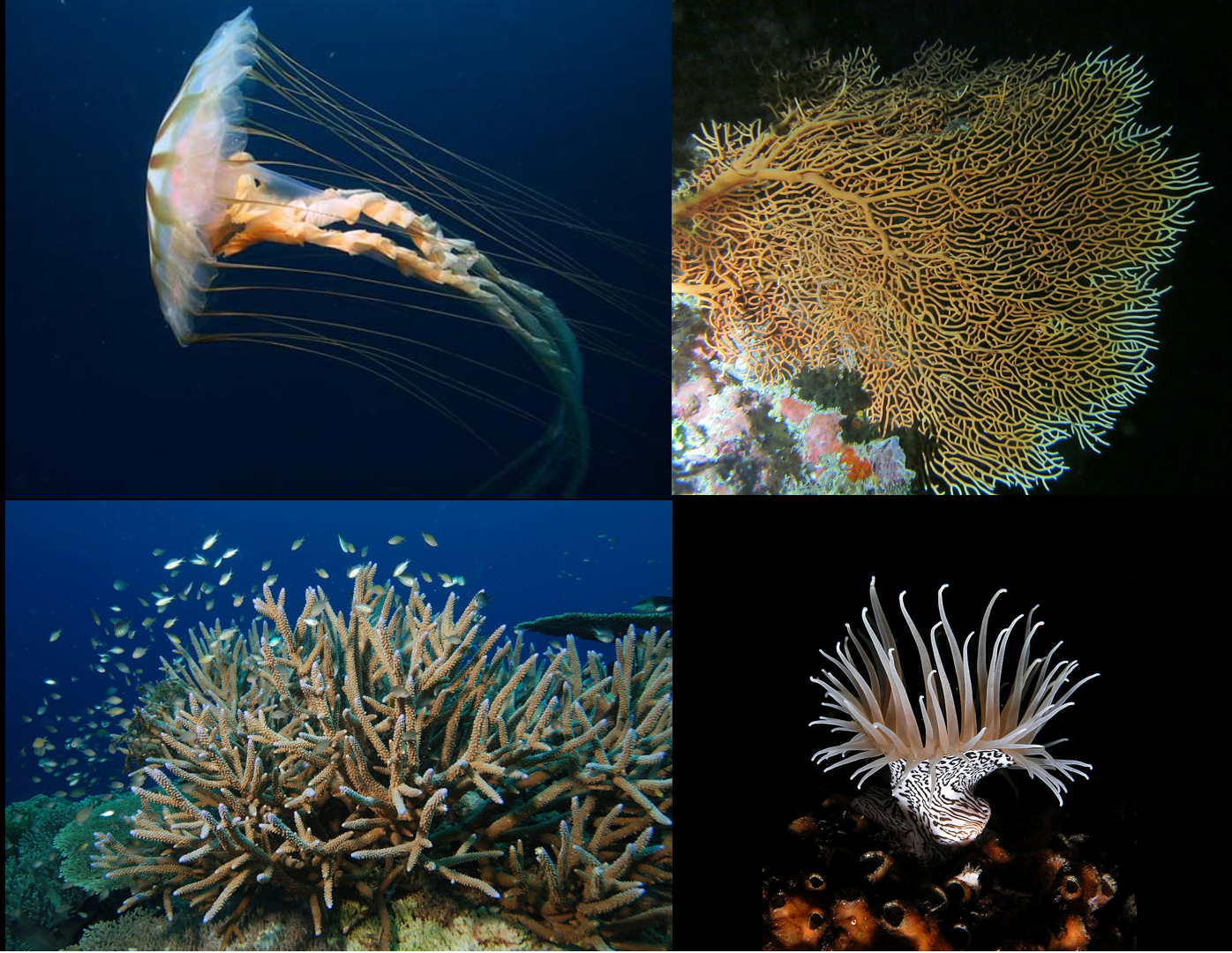
Cnidarians
Cnidarians are a phylum of animals that contain over 11,000 species of aquatic invertebrates found both in freshwater and marine environments, including jellyfish, hydroids, sea anemones, corals, and some of the smallest marine parasites. Their distinguishing features are an uncentralized nervous system distributed throughout a gelatinous body and the presence of cnidocytes or cnidoblasts, specialized cells with ejectable organelles used mainly for envenomation and capturing prey. Their bodies consist of mesoglea, a non-living, jelly-like substance, sandwiched between two layers of epithelium that are mostly one cell thick. Many cnidarian species can reproduce both sexually and asexually.
Cnidarians are one of the most ancient animal groups, with fossil evidence dating back to the Neoproterozoic era, approximately 580 million years ago. They are found in a wide range of environments, from shallow tide pools to the deep sea, and are an essential component of marine ecosystems. Cnidarians play a crucial role in the food chain, serving as both predators and prey for other animals. They are also important indicators of water quality and are used as bioindicators in environmental monitoring.
The study of cnidarians has led to significant advances in our understanding of animal development, evolution, and ecology. Cnidarians have been the subject of extensive research in fields such as marine biology, ecology, and evolutionary biology. Their unique body structure and development have made them an important model system for studying animal development and evolution.
Phylogeny and Classification
Cnidarians belong to the phylum Cnidaria, which is divided into three classes: Anthozoa (sea anemones, corals, and sea pens), Cubozoa (box jellyfish), and Hydrozoa (hydroids and jellyfish). The phylum Cnidaria is thought to have originated from a common ancestor with the phylum Ctenophora, which is also a group of aquatic invertebrates. The exact relationships between the different classes of cnidarians are still a subject of debate and research.
Body Structure
Cnidarians have a simple, radially symmetrical body structure, consisting of a gelatinous body with a non-living, jelly-like substance called mesoglea. The mesoglea is sandwiched between two layers of epithelium that are mostly one cell thick. The epithelium is responsible for the movement and feeding of the cnidarian, while the mesoglea provides support and structure. Cnidarians also have a network of nerve cells, called a nerve net, that is distributed throughout the body.
Sensory Organs
Cnidarians have a range of sensory organs that allow them to detect and respond to their environment. These include statocysts, which are balance organs that help the cnidarian maintain its orientation, and ocelli, which are light-sensitive organs that allow the cnidarian to detect light and darkness.
Feeding and Digestion
Cnidarians are carnivorous animals that feed on a wide range of prey, including small fish, plankton, and other invertebrates. They use their cnidocytes, which are specialized cells with ejectable organelles, to capture and kill their prey. The cnidocytes are triggered by the presence of prey and release a venom that immobilizes the prey. The prey is then digested in the cnidarian's stomach, which is a simple, sac-like structure.
Reproduction
Cnidarians are capable of reproducing both sexually and asexually. Sexual reproduction involves the fusion of gametes, which are reproductive cells, to form a zygote. Asexual reproduction involves the production of offspring without the fusion of gametes. Cnidarians can reproduce asexually through a process called budding, where new individuals are produced from the body of the parent.
Ecology and Conservation
Cnidarians play a crucial role in marine ecosystems, serving as both predators and prey for other animals. They are also important indicators of water quality and are used as bioindicators in environmental monitoring. Many cnidarian species are threatened by human activities such as overfishing, pollution, and climate change. The coral reefs, which are formed by cnidarians, are particularly vulnerable to climate change and are experiencing widespread bleaching and die-off.
Coral Reefs
Coral reefs are formed by cnidarians, specifically the coral polyps, which are small, sessile animals that secrete a hard, calcium carbonate exoskeleton. Coral reefs are some of the most diverse ecosystems on the planet, supporting a wide range of species, including fish, invertebrates, and algae. However, coral reefs are facing significant threats from human activities such as overfishing, pollution, and climate change.
Conservation Efforts
Conservation efforts are underway to protect cnidarian species and their habitats. These efforts include the establishment of marine protected areas, the reduction of pollution and overfishing, and the promotion of sustainable fishing practices. Additionally, researchers are working to develop new technologies and methods for monitoring and managing cnidarian populations.
INFOBOX:
- Name: Cnidarians
- Type: Phylum
- Date: 580 million years ago (fossil evidence)
- Location: Worldwide, in freshwater and marine environments
- Known For: Unique body structure, cnidocytes, and role in marine ecosystems
TAGS: Cnidaria, Phylum, Aquatic invertebrates, Jellyfish, Sea anemones, Corals, Cnidocytes, Mesoglea, Nerve net, Sensory organs, Feeding and digestion, Reproduction, Ecology, Conservation, Coral reefs.




