




Overview
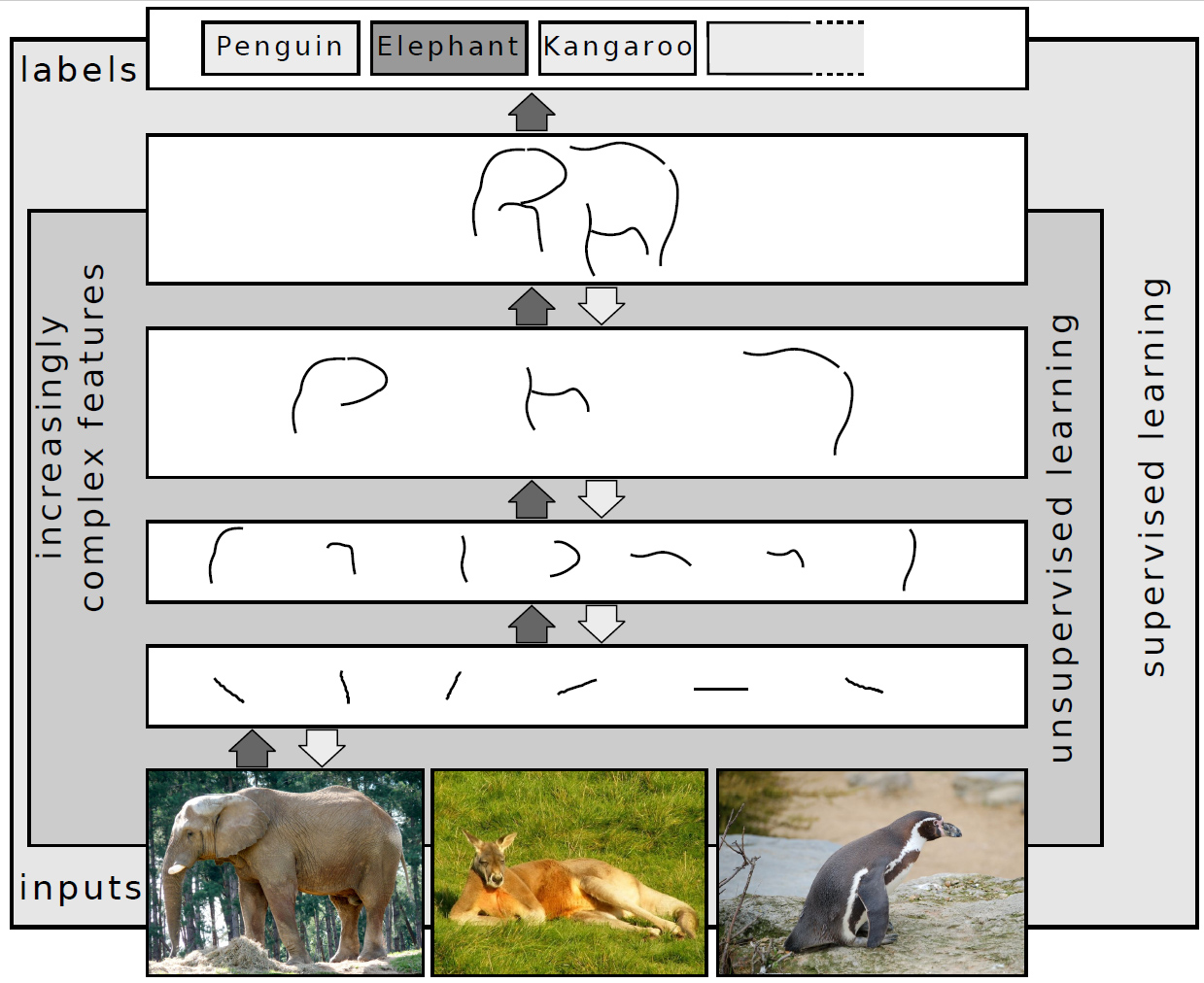
Deep learning is a subset of machine learning that uses artificial neural networks with multiple layers to model complex patterns in data. By mimicking the human brain’s structure, these networks process information through interconnected nodes (artificial neurons) organized in input, hidden, and output layers. The "depth" of these networks—often dozens or hundreds of layers—enables them to automatically extract hierarchical features from raw data, such as pixels in images or words in text. This approach has transformed fields like computer vision, natural language processing, and speech recognition, achieving superhuman performance in tasks like image classification and game-playing.
The field’s rise began in the 2000s, fueled by advances in computational power (e.g., GPUs) and the availability of large datasets. A landmark moment came in 2012 when Geoffrey Hinton’s team used a deep convolutional neural network (CNN) to win the ImageNet competition with 85% accuracy, a dramatic improvement over previous methods. Since then, deep learning has become the backbone of technologies like self-driving cars (Tesla’s Autopilot), virtual assistants (Siri, Alexa), and even creative tools like DALL-E.
Background & Origins
The conceptual roots of deep learning trace back to 1943, when neuroscientists Warren McCulloch and Walter Pitts proposed the first mathematical model of an artificial neuron. In 1957, Frank Rosenblatt introduced the perceptron, a single-layer neural network capable of simple pattern recognition. However, the perceptron’s limitations—highlighted by Marvin Minsky and Seymour Papert in 1969—led to a decline in neural network research during the 1970s and 1980s.
The field revived in the 1980s with the development of backpropagation, an algorithm for training multi-layer networks by adjusting weights based on errors. Geoffrey Hinton, Yann LeCun, and Yoshua Bengio became pivotal figures, advancing techniques like convolutional networks (LeCun, 1989) and deep belief networks (Hinton, 2006). These breakthroughs laid the groundwork for modern deep learning, which gained momentum in the 2010s with the advent of big data and cloud computing.
Major Achievements & Milestones
Deep Learning Breakthrough (2006): Geoffrey Hinton and his team at the University of Toronto introduced deep belief networks (DBNs), demonstrating that unsupervised pre-training could effectively initialize deep networks. This overcame the vanishing gradient problem, enabling the training of networks with multiple hidden layers.
ImageNet Victory (2012): Hinton’s team used a CNN called AlexNet to achieve 85% accuracy in the ImageNet Large Scale Visual Recognition Challenge, a 10.9% improvement over the second-place entry. This victory proved deep learning’s superiority in image recognition and sparked widespread adoption.
AlphaGo’s Triumph (2016): DeepMind’s AlphaGo, powered by deep reinforcement learning, defeated world champion Go player Lee Sedol. The achievement demonstrated deep learning’s ability to master complex, strategic tasks previously thought impossible for machines.
Transformer Models (2017): Google researchers introduced the transformer architecture, which uses self-attention mechanisms to process sequential data more efficiently than recurrent neural networks (RNNs). This innovation led to models like BERT (2018) and GPT-3 (2020), revolutionizing natural language understanding.
Timeline
- 1943: Warren McCulloch and Walter Pitts propose the first artificial neuron model.
- 1957: Frank Rosenblatt develops the perceptron, a foundational neural network.
- 1986: Backpropagation algorithm popularized, enabling multi-layer network training.
- 2006: Geoffrey Hinton introduces deep belief networks, marking the start of the deep learning revolution.
- 2012: AlexNet wins ImageNet, showcasing deep CNNs’ power in computer vision.
- 2016: AlphaGo defeats Go champion Lee Sedol, demonstrating deep reinforcement learning.
- 2018: GANs (Generative Adversarial Networks) gain prominence for creating realistic synthetic data.
- 2020: Large transformer models like GPT-3 and BERT achieve human-like text generation and understanding.
Impact & Legacy
Deep learning has reshaped industries, from healthcare (e.g., cancer detection via medical imaging) to finance (fraud detection) and entertainment (AI-generated art). Its cultural impact is profound, inspiring films like Ex Machina and raising ethical debates about AI’s role in society. However, challenges remain, including the "black box" nature of deep models, energy consumption of large networks, and biases in training data.
The field continues to evolve with innovations like neuromorphic computing (mimicking brain architecture) and hybrid models combining deep learning with symbolic AI. As datasets grow and algorithms improve, deep learning’s legacy will likely expand into areas like quantum machine learning and autonomous robotics, pushing the boundaries of what machines can achieve.





