Science Editor
4 views
3 min read
Jun 29, 2026
Overview
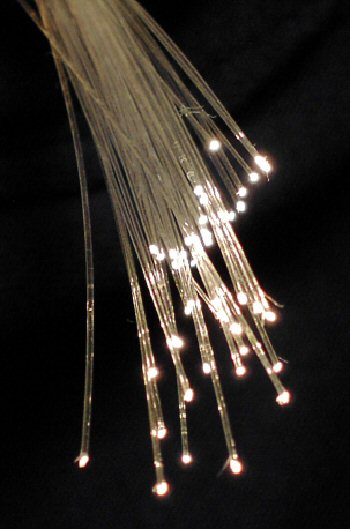
An optical fiber is a thin, flexible strand of glass or plastic designed to transmit light via total internal reflection. These fibers form the backbone of modern fiber-optic communication, allowing data to travel at speeds exceeding 100 terabits per second (Tbps) over thousands of kilometers. Unlike traditional copper cables, optical fibers suffer minimal signal degradation (as low as 0.2 decibels per kilometer) and are immune to electromagnetic interference, making them ideal for high-bandwidth applications. Beyond communication, fibers are used in medical endoscopes to visualize internal organs, in industrial sensors to monitor temperature and pressure, and in laser systems for precision cutting and welding.History/Background
The concept of guiding light through transparent materials dates to 1870, when physicist John Tyndall demonstrated light’s ability to bend along water streams during a Royal Institution lecture. However, practical optical fibers emerged in the 1950s, driven by advancements in cladding—a reflective outer layer that traps light within the core. In 1966, British scientists Charles Kao and George Hockham proposed that ultra-pure glass could transmit light with losses below 20 dB/km, a breakthrough that earned Kao the 2009 Nobel Prize in Physics. By 1970, Corning Inc. produced the first low-loss fiber (loss: 20 dB/km), later improved to 0.2 dB/km by 1979. The 1980s saw global deployment of fiber-optic networks, revolutionizing telecommunications and enabling the internet’s exponential growth.Key Information
- Structure: Optical fibers consist of a core (light-carrying glass/plastic), cladding (lower refractive index material), and a protective polymer coating.
- Materials: Most fibers use silica glass for long-distance communication; plastic optical fibers (POF) are cheaper but suited for short-range applications.
- Bandwidth: Modern fibers support data rates up to 100 Tbps using wavelength-division multiplexing (WDM), which transmits multiple light wavelengths simultaneously.
- Advantages: Signals travel 10–100x farther than copper cables with less energy, and fibers are thinner, lighter, and resistant to corrosion.
- Applications:
- Telecommunications: 99% of transoceanic data (e.g., undersea cables like Marea and Curie).
- Medicine: Fiberscopes enable non-invasive surgery and diagnostics.
- Sensing: Distributed fiber sensors monitor structural health in bridges and pipelines.
- Lasers: High-powered industrial and medical lasers rely on doped fibers (e.g., erbium-doped for amplification).Significance
Fiber optics have redefined global connectivity, enabling the internet, 5G networks, and cloud computing. Their low latency and high capacity underpin modern economies, supporting everything from streaming services to AI-driven data centers. In healthcare, fiber-based imaging has improved early cancer detection and minimally invasive procedures. Environmentally, fiber networks consume less energy than copper, reducing carbon footprints. Looking ahead, quantum communication and LiFi (light-based wireless) could further leverage fiber’s potential, ensuring its role in future tech for decades.