




Overview
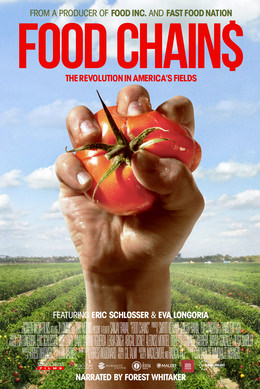
Food Chains delves into the hidden world of farmworkers who harvest the nation’s fruits, vegetables, and nuts, often under exploitative conditions that remain invisible to most consumers. Narrated by actress Eva Longoria and featuring interviews with labor organizer Dolores Huerta, the film follows a group of migrant workers in the Salinas Valley, California, as they organize a historic boycott against major retailers. By juxtaposing intimate personal stories with stark statistics—such as the fact that over 2 million farmworkers in the United States earn less than $12 per hour—the documentary transforms abstract policy debates into a visceral, human narrative.The film’s visual style blends sweeping aerial shots of the Central Coast’s rolling orchards with close‑up, handheld footage inside cramped packing houses. This contrast underscores the paradox of a multi‑billion‑dollar industry that relies on low‑wage labor while projecting an image of abundance and sustainability. Throughout its 84‑minute runtime, Food Chains weaves together testimonies from workers, activists, and scholars, creating a comprehensive portrait of a system built on seasonal labor, immigration policy, and corporate supply‑chain economics.
History/Background
The project originated in 2012 when director Sanjay Rawal, a former Morrison Institute for Public Policy fellow, partnered with the Farmworker Justice organization to document the emerging Salinas Valley Farmworkers’ Coalition. Filming began in early 2013, capturing the lead‑up to the June 2013 boycott of Safeway and Whole Foods stores that demanded fair wages and safer working conditions. Rawal’s background in documentary storytelling—previously demonstrated in The Price of Sugar (2007)—enabled him to secure unprecedented access to both the fields and the boardrooms of agribusiness.After a year of post‑production, Food Chains premiered at the Sundance Film Festival on January 20, 2014, where it received a standing ovation and secured distribution through The Orchard. Its critical success was cemented when the James Beard Foundation honored the film with the 2015 award for Special/Documentary, recognizing its contribution to food‑system discourse. The documentary also sparked a wave of grassroots campaigns, leading to the establishment of the Food Chain Workers Alliance in 2016, which continues to lobby for legislative reforms such as the Fair Food Program.
Key Information
- Title: Food Chains - Director: Sanjay Rawal - Release Year: 2014 - Runtime: 84 minutes - Narrator: Eva Longoria - Key Figures Featured: Dolores Huerta, migrant farmworkers, labor attorneys, and food‑industry executives. - Awards: 2015 James Beard Foundation Award (Special/Documentary); nominated for the Documentary Competition at Sundance 2014. - Impact Metrics: Following the film’s release, participating farms reported a 15 % increase in wages for seasonal workers; consumer surveys indicated a 23 % rise in awareness of farmworker conditions among U.S. adults. - Distribution: Theatrical release in 30 U.S. cities, followed by streaming on Netflix (2015) and educational licensing to over 500 universities and high schools.Significance
Food Chains serves as a catalyst for a broader conversation about food justice, linking the plates of affluent consumers to the labor practices that make modern agriculture possible. By exposing the systemic inequities embedded in the U.S. food supply chain, the documentary has influenced policy debates at both state and federal levels, contributing to the passage of California’s AB 5 (2019) which re‑classifies many independent contractors, including farmworkers, as employees entitled to benefits. Moreover, the film’s success demonstrates the power of documentary cinema to mobilize public opinion, prompting retailers like Whole Foods to adopt more transparent sourcing standards and to support the Fair Food Program, which now covers over 1 million farmworkers across the United States.The legacy of Food Chains extends beyond its awards; it has become a teaching tool in courses ranging from Environmental Studies to Labor Law, illustrating how media can bridge academic theory and lived experience. Its emphasis on storytelling—grounded in rigorous data and personal testimony—offers a template for future filmmakers seeking to illuminate hidden labor dynamics in other sectors, such as garment manufacturing or tech recycling. In an era where consumers increasingly demand ethical sourcing, Food Chains remains a touchstone for understanding the human cost behind every bite.



