



Overview
Imagine a riddle so simple a child can grasp it, yet so complex that it has stumped the greatest mathematical minds for centuries. The Goldbach Conjecture is precisely that: the claim that every even natural number greater than 2 can be expressed as the sum of two prime numbers. For example, 4 = 2 + 2, 6 = 3 + 3, 8 = 3 + 5, and so on. Despite its apparent simplicity, no one has yet proven it for all even numbers. Verified up to 4 × 10¹⁸ using supercomputers, the conjecture remains one of mathematics’ most tantalizing open problems, straddling the line between recreational curiosity and deep theoretical inquiry.The conjecture’s allure lies in its duality: it is both a gateway to the beauty of prime numbers and a fortress guarding the limits of human ingenuity. Its unresolved status has inspired breakthroughs in sieve theory, analytic number theory, and computational mathematics, making it a cornerstone of modern mathematical research.
Background & Origins
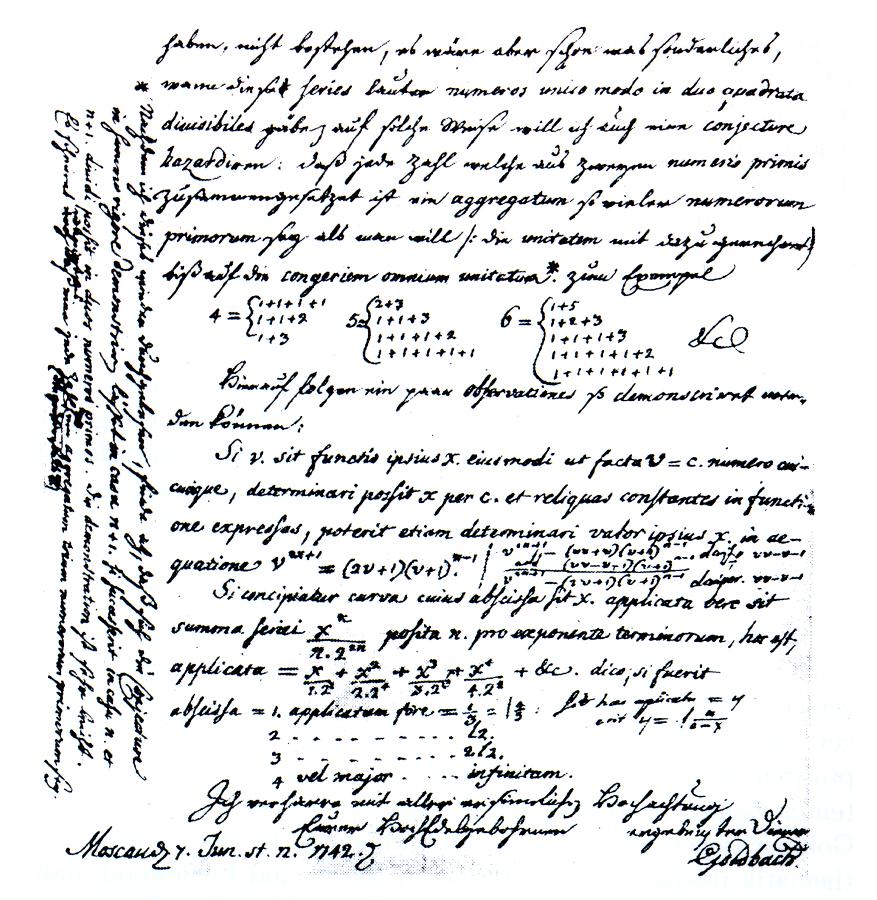
The conjecture traces its roots to Christian Goldbach (1690–1764), a Prussian mathematician and historian. Born in Königsberg (now Kaliningrad, Russia), Goldbach studied law and mathematics before becoming a professor and later a tutor to the Russian royal family. His intellectual curiosity led him to correspond with Leonhard Euler, one of history’s most prolific mathematicians.In a letter dated June 7, 1742, Goldbach proposed a variant of the conjecture to Euler, suggesting that every integer greater than 2 is the sum of three primes. Euler refined this, recognizing the stronger claim about even numbers. This “strong” conjecture—every even number > 2 is the sum of two primes—became the standard formulation. Though Goldbach’s original ideas were rooted in number theory, Euler’s endorsement elevated the conjecture to prominence, cementing its place in mathematical history.
Major Achievements & Milestones
Goldbach Conjecture (1742): Proposed by Christian Goldbach in correspondence with Euler, this conjecture became a defining problem in number theory.Schnirelmann’s Theorem (1930): Soviet mathematician Lev Schnirelmann proved that every even number can be written as the sum of not more than 20 primes, a foundational step toward understanding additive properties of primes.
Chen’s Theorem (1975): Chinese mathematician Chen Jingrun demonstrated that every sufficiently large even number is the sum of a prime and a semiprime (a product of two primes). This remains the closest partial proof to date.
Ramaré’s Theorem (1995): French mathematician Olivier Ramaré showed that every even number ≥ 4 can be expressed as the sum of at most six primes, refining earlier bounds.
Timeline
- 1742: Goldbach and Euler exchange letters, formalizing the conjecture. - 1930: Schnirelmann develops additive number theory, proving even numbers are sums of ≤20 primes. - 1975: Chen Jingrun publishes Chen’s Theorem, bridging the gap between primes and semiprimes. - 1995: Ramaré reduces the upper bound to six primes for all even numbers ≥ 4.Impact & Legacy
The Goldbach Conjecture is more than a mathematical puzzle—it is a cultural touchstone. It appears in novels like Apostolos Doxiadis’ Uncle Petros and Goldbach’s Conjecture, films, and even motivational posters celebrating intellectual perseverance. Its influence extends to computational mathematics, where efforts to verify it have driven advancements in distributed computing projects like Goldbach’s Conjecture Verification.Mathematically, the conjecture has spurred the development of sieve methods, such as the Sieve of Eratosthenes and modern refinements, which are critical in cryptography and algorithm design. Its unresolved status also underscores the vastness of number theory’s uncharted territories, reminding us that even in an age of quantum computing, some truths remain stubbornly out of reach.
Records & Notable Facts
- Verification Limit: As of 2014, the conjecture has been checked for all even numbers up to 4 × 10¹⁸. - Chen’s Theorem: The closest proven result to Goldbach’s claim, yet to fully resolve the conjecture. - Cultural Impact: The conjecture inspired a 2004 play, Goldbach, and a 2009 BBC documentary.> “Mathematics is the queen of the sciences, and number theory is the queen of mathematics.” — Carl Friedrich Gauss


