Overview
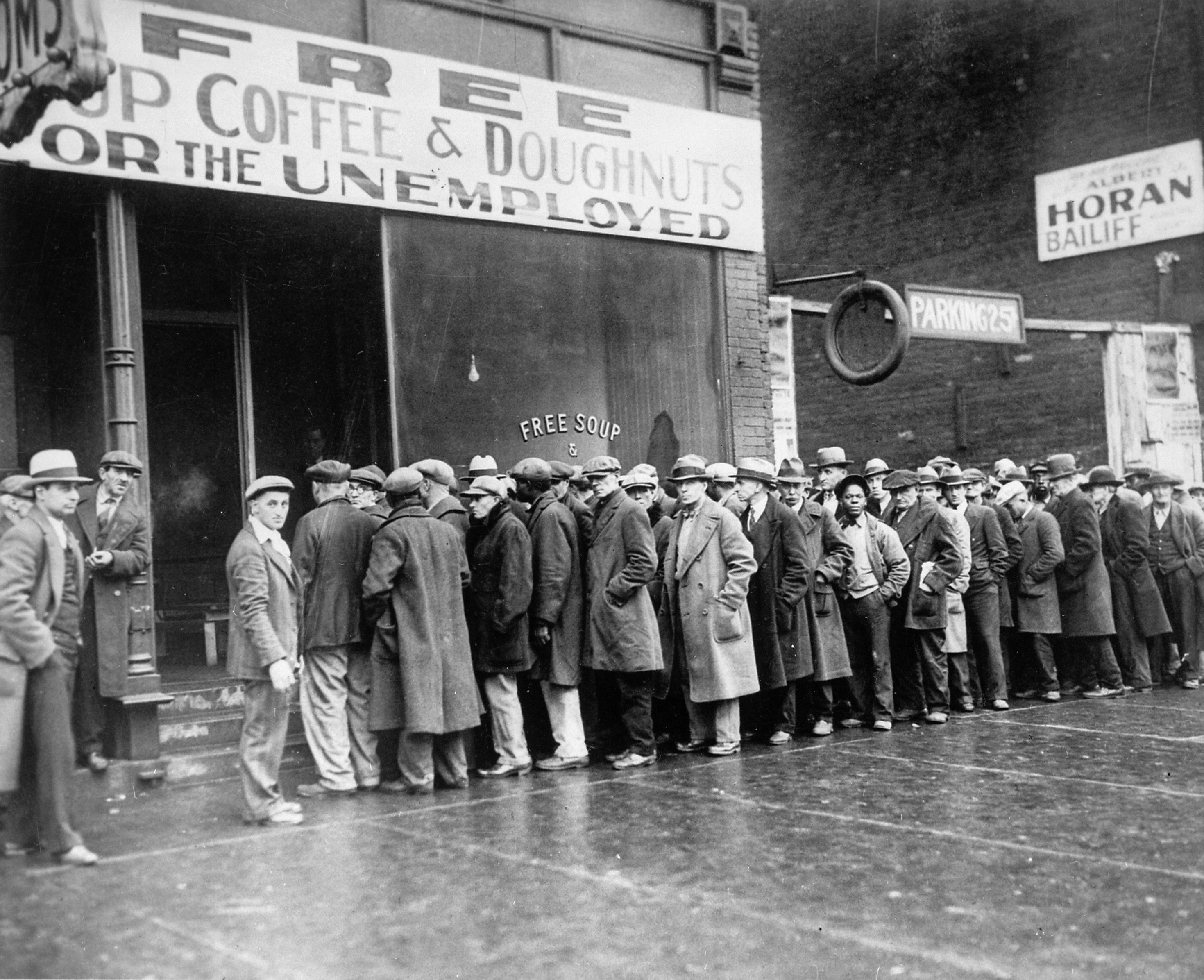
The Great Depression was a global economic catastrophe that began with the Wall Street Crash of October 1929 and persisted through most of the following decade. Unlike previous downturns, this depression penetrated every sector of industrialized economies, driving world trade to one-third of its 1929 value and pushing unemployment rates above 20 percent in the United States, Germany, and the United Kingdom. The crisis shattered public confidence in liberal capitalism, discredited the gold-standard orthodoxy, and forced governments to experiment with unprecedented levels of intervention—from Roosevelt’s New Deal in the United States to Stalin’s Five-Year Plans in the Soviet Union.What distinguished the Great Depression from earlier recessions was its depth, duration, and diffusion. Industrial output in the United States fell 47 percent between 1929 and 1933; prices tumbled 33 percent in a deflationary spiral that left farmers unable to repay loans and urban workers unable to afford basic necessities. The psychological impact was equally severe: shantytowns dubbed “Hoovervilles” dotted American cities, while over a million desperate migrants roamed the country in search of work. The crisis quickly radiated outward through the arteries of global finance, turning a speculative crash on Wall Street into a worldwide trauma that emboldened extremist movements and ultimately helped precipitate the Second World War.
History/Background
Roots of the disaster lay in the unstable prosperity of the 1920s. Agricultural overproduction, income inequality, and an unsustainable stock-market boom masked structural weaknesses: American farmers earned less in 1929 than they had in 1919, while the top 1 percent of households controlled over 40 percent of financial wealth. The fragile edifice cracked on 24 October 1929—“Black Thursday”—when nearly 13 million shares changed hands on the New York Stock Exchange. Prices plunged another 12 percent on 29 October (“Black Tuesday”), wiping out $14 billion in value and triggering a cascade of bank failures that erased $7 billion in deposits by 1933.The Federal Reserve’s adherence to the gold standard and its decision to raise interest rates in 1931 to defend the dollar intensified the contraction. International transmission mechanisms—reparations, war-debt payments, and the gold-exchange standard—propagated American deflation abroad. By 1932, industrial production had fallen 25 percent in Britain, 40 percent in Germany, and 46 percent in the United States. Japan abandoned the gold standard in December 1931, devaluing the yen and pioneering the export-led recovery that would later inspire Keynesian critiques of austerity. Germany’s Brüning government clung to orthodox deflation, deepening unemployment and fueling Nazi electoral gains that made Adolf Hitler chancellor in January 1933.
Key Information
- Unemployment Peaks: United States 24.9% (1933), Germany 30% (1932), United Kingdom 20% (1932) - Global GDP Contraction: roughly −15% from 1929 to 1932 - Bank Failures: 9,000 U.S. banks suspended operations (1930-33) - Dust Bowl: severe soil erosion on the Great Plains displaced 3.5 million agricultural workers - New Deal Programs: Civilian Conservation Corps (CCC), Works Progress Administration (WPA), Social Security Act (1935) - Gold Standard Abandonment: Britain September 1931, United States April 1933, France September 1936 - Literary Landmarks: John Steinbeck’s The Grapes of Wrath (1939), Dorothea Lange’s photograph Migrant Mother (1936)Policy responses varied ideologically. Scandinavian social democracies pioneered counter-cyclical fiscal spending and unemployment insurance. The Soviet Union, insulated by a non-convertible currency and centralized planning, advertised full employment while concealing famine in Ukraine. In the United States, Franklin D. Roosevelt’s New Deal expanded federal authority: deposit insurance (FDIC), securities regulation (SEC), and the right to collective bargaining (Wagner Act). Yet only the massive rearmament of World War II finally restored U.S. unemployment to pre-crash levels.
Significance
The Great Depression redefined the relationship between citizens and states, legitimizing macroeconomic management and welfare safety nets. It discredited the classical doctrine of balanced budgets and laissez-faire, paving the way for Keynesian demand management and, later, the Bretton Woods system of managed exchange rates. Socially, the crisis eroded faith in liberal elites and emboldened populists of both left and right: Roosevelt’s fireside chats, Huey Long’s Share-Our-Wealth movement, and Father Coughlin’s radio sermons foreshadowed today’s media-driven politics.Internationally, the depression accelerated imperial protectionism—Britain’s Ottawa Agreements of 1932—and contributed to Japan’s invasion of Manchuria and Germany’s pursuit of autarkic “Lebensraum.” Memory of the slump shaped post-1945 institutions: the International Monetary Fund, the World Bank, and the United Nations system were designed to prevent a recurrence. Domestically, New Deal landmarks such as Social Security became permanent fixtures of American life, while the Tennessee Valley Authority provided a template for regional development worldwide. In historiography, the episode remains a cautionary tale of how financial panic, policy errors, and ideological rigidity can transform a market correction into a decade of human misery—and how, conversely, pragmatic experimentation can salvage both democracy and capitalism.