Overview
The Gulf War—often dubbed “The First Iraq War” or “The 1991 War”—erupted after Saddam Hussein’s Iraq invaded and annexed neighboring Kuwait on 2 August 1990. What began as regional aggression quickly became the first major post-Cold-War international crisis. Within days the United Nations imposed a global embargo on Iraq and, at the behest of Saudi Arabia, the United States began assembling the largest multinational military coalition since World War II. After five months of deterrence and economic strangulation (Operation Desert Shield), coalition forces launched a devastating six-week air campaign followed by a 100-hour ground blitz (Operation Desert Storm) that liberated Kuwait, crippled Iraq’s army, and redefined modern warfare through precision-guided munitions, real-time satellite intelligence, and live 24-hour news coverage.The war’s brevity—42 days of combat—belies its long shadow. It restored Kuwaiti sovereignty, reaffirmed the principle of territorial integrity, yet left Saddam in power and Iraq under draconian sanctions. The conflict’s unresolved issues—no-fly zones, weapons inspections, Kurdish and Shiʿa uprisings, and a heavy U.S. troop presence—set the stage for the 2003 Iraq War and the region’s ongoing turbulence.
History/Background
Iraq’s grievances dated to the 1980-88 Iran-Iraq War, which left Baghdad indebted to Gulf creditors, including Kuwait. Saddam accused Kuwait of overproducing OPEC quotas and slant-drilling into Iraqi oil fields, branding it “economic warfare.” Diplomatic talks collapsed in July 1990; on 2 August 120,000 Iraqi troops swept across the desert. The UN Security Council immediately demanded withdrawal (Resolution 660) and, when ignored, imposed comprehensive sanctions (661). U.S. President George H. W. Bush, invoking the Carter Doctrine’s pledge to defend Gulf oil, partnered with Soviet leader Mikhail Gorbachev to craft Resolution 678 (29 November 1990), authorizing “all necessary means” to expel Iraq after 15 January 1991.Operation Desert Shield began 7 August 1990: 500,000 U.S. personnel, 45,000 British, 15,000 French, 60,000 Egyptian, 20,000 Saudi, and contingents from Syria, Pakistan, Bangladesh, Morocco, and others deployed under U.S. Central Command (CENTCOM) General Norman Schwarzkopf. Meanwhile, Iraq constructed formidable defenses along Kuwait’s 200-km frontier and in southeastern Iraq, boasted 5,500 tanks, and held foreign hostages as “human shields.”
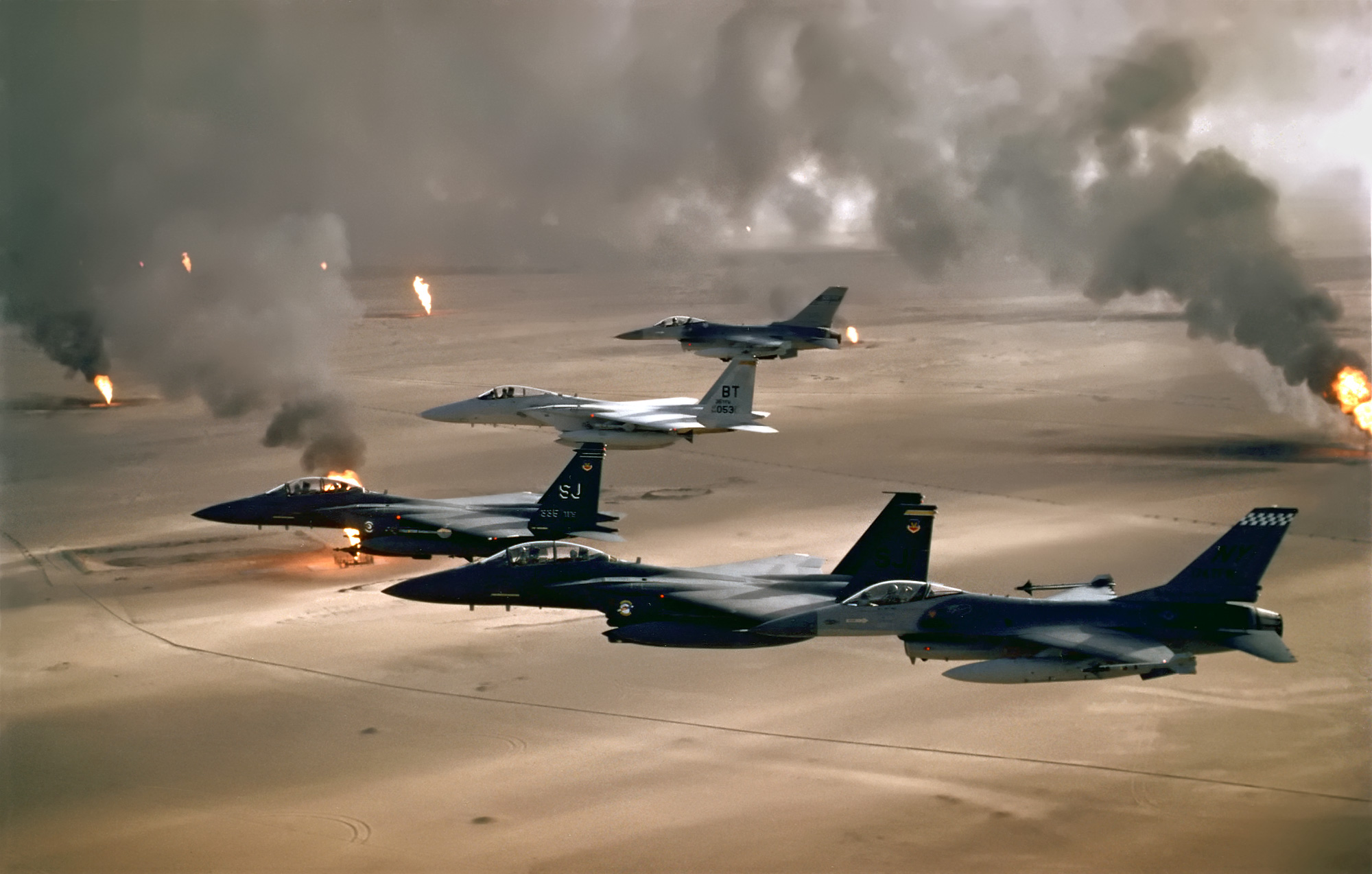
When the 15 January deadline passed, the coalition commenced Operation Desert Storm at 02:38 local time, 17 January 1991. Stealth F-117s struck Baghdad; Tomahawk cruise missiles followed GPS coordinates to targets. For 38 days B-52s, F-15Es, Tornados, and A-10s pummeled command bunkers, bridges, power grids, and Republican Guard divisions. Iraq responded by firing 88 Scud missiles at Israel (seeking to fracture Arab unity) and at Saudi Arabia. Patriot missile batteries offered partial defense, while Israeli restraint—under heavy U.S. pressure—kept Arab allies in the coalition.
The ground assault, code-named Operation Desert Sabre, opened 24 February. Marines feinted toward Kuwait City while VII Corps’ 1,500 M1A1 Abrams tanks swept west in a massive “left hook” through Iraq’s desert. Within 100 hours coalition forces had destroyed 3,700 Iraqi tanks, captured 70,000 prisoners, and severed the Basra-Kuwait highway—dubbed the “Highway of Death.” President Bush declared a cease-fire at 08:00 on 28 February, citing coalition objectives met.