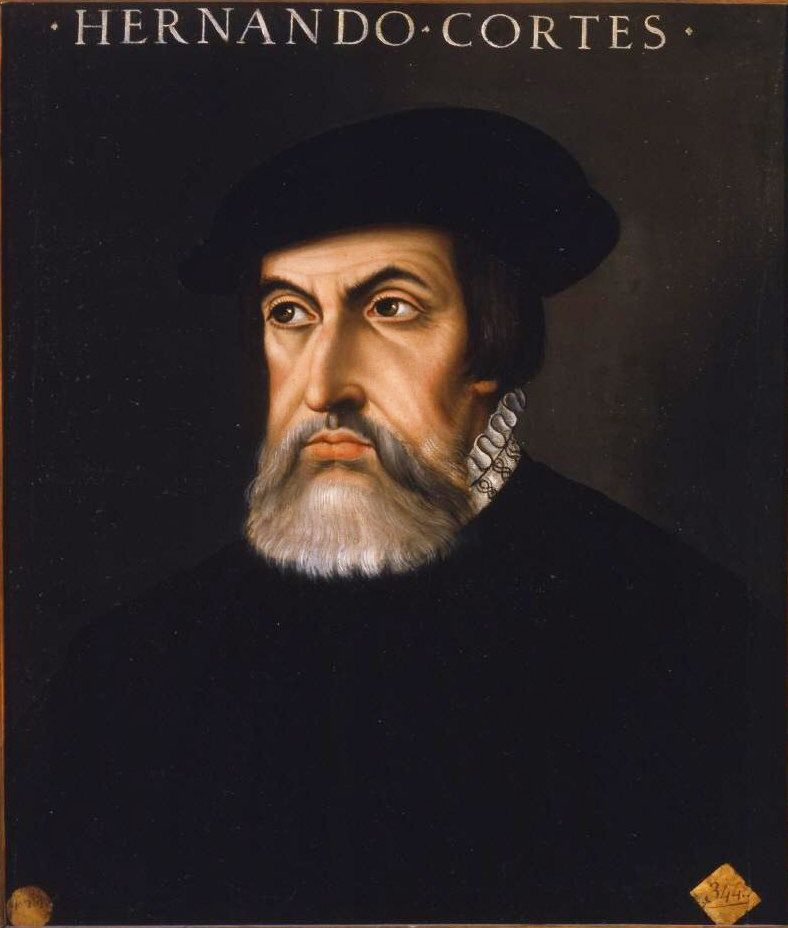
Hernán Cortés was the ambitious Spanish conquistador whose 1519–1521 campaign toppled the Aztec Empire and welded much of modern-day Mexico to the Crown of Castile, forever altering the political, cultural, and demographic trajectory of the Americas.
Hernán Cortés de Monroy y Pizarro Altamirano, 1st Marquis of the Valley of Oaxaca, arrived in the New World a minor nobleman and departed a legend—or a scourge, depending on one’s vantage. In a breathtakingly brief span he transformed from restless lawyer’s apprentice to the most powerful European in the Western Hemisphere, dismantling an empire of five million souls and replacing it with a Spanish dominion that would funnel silver, souls, and syphilis across the Atlantic for three centuries. Cortés embodied the contradictions of the early Renaissance: a devout Catholic who burned temples, a loyal subject who twice defied his king, and a self-made marquis who insisted he served both God and Crown. His letters to Charles V—part battlefield dispatch, part self-promotion—remain foundational texts for understanding the mental universe of conquest.
History/Background
Born in 1485 in Medellín, Extremadura, Cortés grew up amid the martial culture of Reconquista Spain. He studied Latin and law at Salamanca but chafed at the prospect of a desk-bound life; in 1504 he sailed to Hispaniola, where Governor Nicolás de Ovando granted him encomienda rights to Taíno labor. Cortés proved an able administrator and ruthless enforcer, qualities that caught the eye of Diego Velázquez, future governor of Cuba. Between 1511 and 1518 he helped subjugate eastern Cuba, amassing cattle ranches and a reputation for audacity. When Velázquez planned an exploratory voyage to the mainland in 1518, Cortés—despite a last-minute recall order—slipped out of Santiago harbor with eleven ships, 530 men, and a private agenda: glory beyond the horizon.
Key Information
- 1519 Landing & March Inland: Cortés founded Veracruz, scuttled his fleet to forestall mutiny, and allied with the Tlaxcalans, long-time enemies of the Mexica.
- Tenochtitlán Entry (8 Nov 1519): Accompanied by La Malinche—his enslaved interpreter and later mistress—he was initially received by Moctezuma II as a semi-divine visitor.
- Noche Triste (30 June 1520): After the massacre in the Great Temple, the Spanish fled the island city, losing half their force and most of their loot.
- Siege & Fall (May–Aug 1521): Reinforced by brigantines built from the salvaged timbers of his own ships, Cortés blockaded Tenochtitlán; smallpox and famine did the rest.
- 1522–1526 Consolidation: Cortés became governor-captain general of “New Spain of the Ocean Sea,” commissioned cathedrals, introduced European crops and livestock, and launched the encomienda system that would funnel tribute to Spain.
- 1524–1527 Honduras Expedition: He personally marched south to suppress Cristóbal de Olid’s rebellion, crossing the jungles of Petén and nearly losing his life—an episode that eroded royal confidence.
- 1528 Recall & Marquisate: Charles V summoned him to Spain, elevated him to the Marquisate of the Valley of Oaxaca, but stripped him of civil authority.
- 1540 Final Return: Cortés died near Seville in 1547, embittered, heavily indebted, and convinced the Crown had rewarded him with “baubles rather than justice.”
Significance
Cortés’s conquest set the template for Spanish expansion: alliance with discontented vassals, psychological warfare, and the ruthless exploitation of epidemic disease. The fall of Tenochtitlán shifted global power balances, funneling Mexican silver into Habsburg coffers and financing Spain’s European wars. Culturally, the fusion—sometimes violent, sometimes syncretic—of Mesoamerican and Iberian traditions produced modern Mexico: Virgin of Guadalupe atop Tonantzin, chocolate laced with cinnamon, Nahuatl loans in Mexican Spanish. Yet the demographic toll was staggering: central Mexico’s population plummeted from roughly 5 million in 1519 to 1.6 million by 1620. Cortés remains contested terrain: to some, the architect of Hispanic civilization; to others, the symbol of genocide. Either way, his shadow stretches from the Zócalo of Mexico City to the debates over colonial statues that still convulse the Atlantic world.
Tip: double-click any word in this article for an instant definition from the NerdDictionary.