




Overview
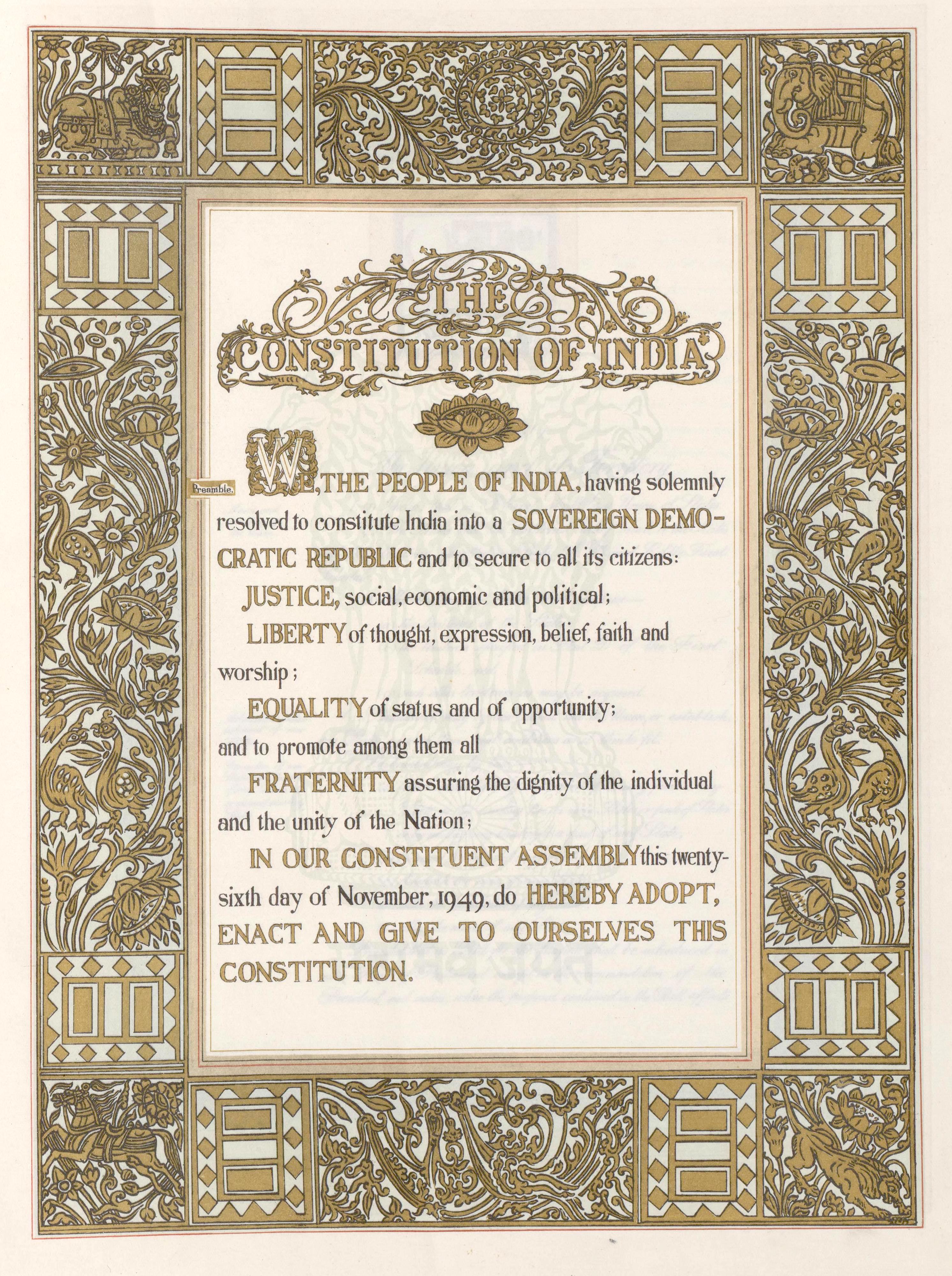
The Constitution of India serves as the supreme legal document of the Republic of India, delineating the structure, powers, and duties of the three branches of government—legislative, executive, and judicial—as well as the relationship between the Union and the States. Adopted on 26 January 1950, it replaced the Government of India Act 1935 and marked the birth of a sovereign, democratic, and secular republic. The Constitution is celebrated for its blend of rigidity and flexibility, allowing amendments through a detailed procedure while preserving core ideals such as liberty, equality, and fraternity.Comprising 448 articles (including 12 schedules) and over 100 amendments, it is the longest written constitution in the world. Its length reflects the diversity of India’s linguistic, cultural, religious, and regional landscape, and the framers’ intent to accommodate a wide array of social and economic aspirations. The document is organized into a preamble, fundamental rights, directive principles of state policy, fundamental duties, and detailed provisions on the Union, states, local bodies, and emergency powers.
History/Background
The genesis of the Indian Constitution can be traced to the Indian independence movement and the demand for a self‑governing nation. After the British Parliament passed the Indian Independence Act 1947, the newly independent Dominion of India required a permanent charter. A Constituent Assembly was elected in 1946, consisting of 389 members representing various political parties, social groups, and regions. Dr. B. R. Ambedkar, often called the “Father of the Constitution,” chaired the Drafting Committee, which drew upon a mosaic of sources: the British Bill of Rights, the U.S. Constitution, the Irish Constitution, the French Declaration of the Rights of Man, and the Government of India Act 1935.The drafting process spanned nearly three years, involving rigorous debates on topics ranging from federalism to minority rights. The final draft was adopted on 26 November 1949, a date later commemorated as Constitution Day. It came into force on 26 January 1950, coinciding with the first Republic Day celebration. Since then, the Constitution has been amended 105 times (as of 2024), reflecting evolving political, social, and economic realities.
Key Information
- Length & Structure: 448 articles, 12 schedules, and over 100 amendments; organized into a preamble, parts, and schedules. - Fundamental Rights: Six chapters guaranteeing civil liberties such as equality before law, freedom of speech, and protection against discrimination. - Directive Principles of State Policy: Non‑justiciable guidelines directing the state toward social welfare, economic justice, and environmental protection. - Fundamental Duties: Eleven duties enshrined in Article 51A, encouraging responsible citizenship. - Federal System: A quasi‑federal arrangement with a strong Union, a bicameral Parliament (Lok Sabha and Rajya Sabha), and state legislatures. - Judicial Review: The Supreme Court holds the power to interpret the Constitution and strike down unconstitutional laws. - Amendment Procedure: Articles 368 outlines three tiers of amendment—simple majority, special majority, and ratification by states—balancing stability with adaptability. - Emergency Provisions: Articles 352‑360 empower the President to declare national, state, or financial emergencies, a feature that has been invoked sparingly. - Secularism & Democracy: The Constitution declares India a secular, democratic republic, guaranteeing freedom of religion and equal political participation.Significance
The Indian Constitution stands as a living document that has guided the world’s largest democracy through periods of rapid change, social upheaval, and economic transformation. Its comprehensive nature has enabled India to manage diversity, protect minority rights, and promote inclusive development. The fundamental rights have become a powerful tool for civil society and the judiciary to challenge oppressive laws, while the directive principles have shaped progressive policies on education, health, and land reform. Moreover, the Constitution’s amendment flexibility has allowed it to incorporate landmark reforms such as the Right to Information Act, Goods and Services Tax, and the Aadhaar biometric identification system.Internationally, the Indian Constitution is studied as a model of constitutional engineering that balances rigidity with adaptability, and its emphasis on social justice influences emerging democracies. Domestically, it remains a source of national identity, inspiring citizens to uphold the ideals of justice, liberty, equality, and fraternity. Its endurance underscores the foresight of the framers and the continued relevance of constitutional governance in a complex, pluralistic society.



