Overview
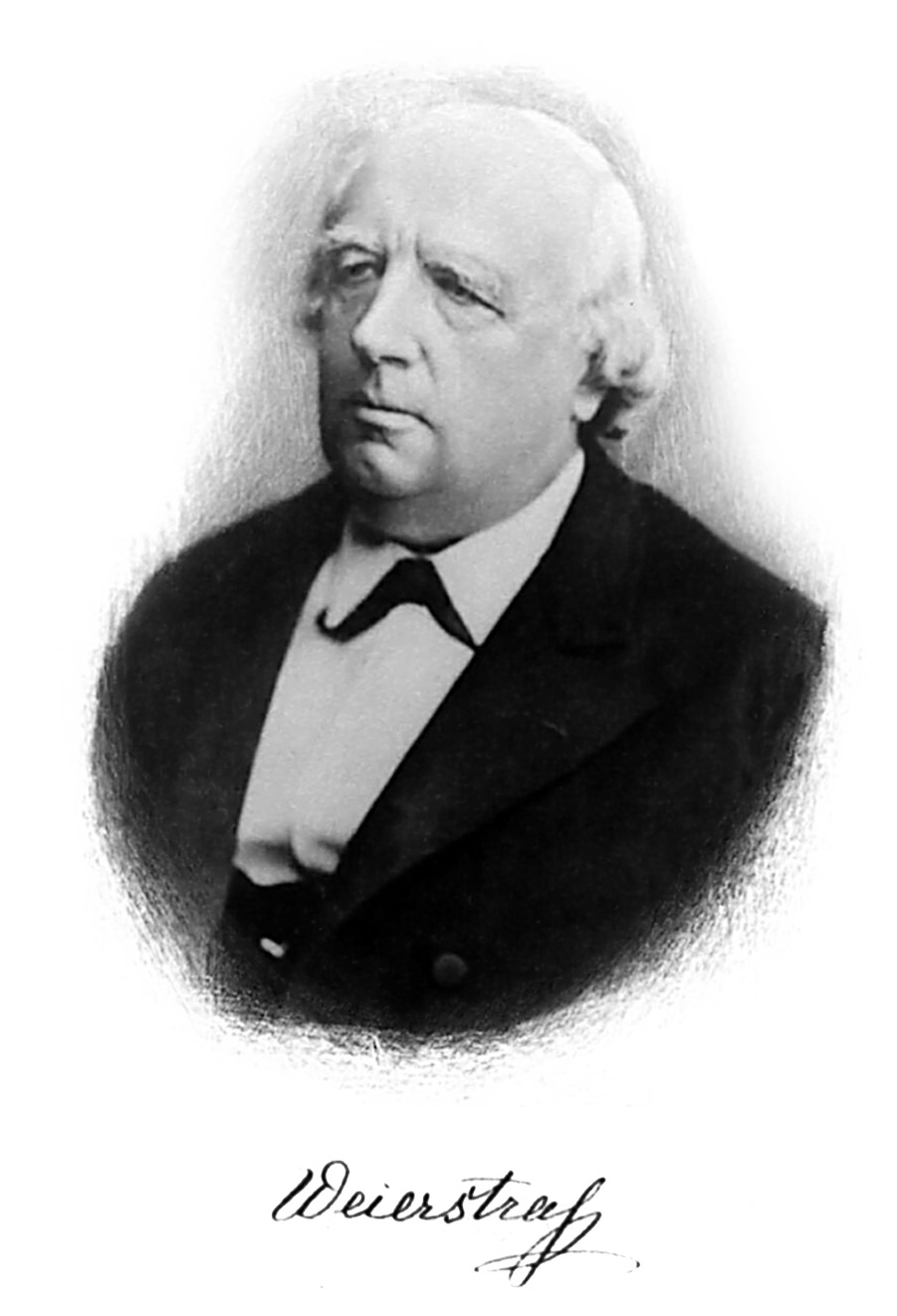
Karl Theodor Wilhelm Weierstrass (1815–1897) was the quiet school-teacher who forced mathematicians to stop waving their hands. Where earlier writers relied on geometric intuition—“a curve is obviously continuous if you can draw it without lifting your pen”—Weierstrass demanded airtight logic. His counter-intuitive constructions, such as a function that is everywhere continuous but nowhere differentiable, shocked the 19th-century community and showed that intuition must be anchored in ε-δ rigor. The tools he forged—uniform convergence, uniform continuity, the Bolzano–Weierstrass theorem—became the grammar of every modern analysis course.Weierstrass’s influence reaches far beyond the lecture hall. His insistence on arithmetical foundations inspired the arithmetization of analysis program, led to modern set theory, and supplied Hilbert with the axiomatic spirit that shaped 20th-century mathematics. If today we can speak of “a proof acceptable in ZFC” without blinking, it is largely because Weierstrass taught us to distrust geometric pictures and to trust only what can be built from the integers upward.
History/Background
Born in Ostenfelde, Westphalia, on 31 October 1815, Weierstrass entered the University of Bonn in 1834 to study law—his father’s wish. Four years of beer, fencing, and clandestine mathematics later, he left without a degree. A second attempt at Münster brought him under the influence of Christof Gudermann, who introduced him to elliptic functions. Leaving university again without certification, Weierstrass spent 14 years teaching at small Prussian gymnasia: mathematics by day, physics on Thursday, botany when the weather was nice, and gymnastics on Saturdays. Nights were his own; by candlelight he wrote memoirs that eventually reached Leopold Kronecker and the Berlin Academy. The 1854 paper “Zur Theorie der Abelschen Functionen” caused such a sensation that the University of Königsberg awarded him an honorary doctorate and the Royal Polytechnic School in Berlin created a chair for him. From 1856 until his retirement in 1892 he held court in Berlin, attracting students like Cantor, Hölder, Killing, and Mittag-Leffler, who carried the Weierstrassian spirit to every mathematical capital.Key Information
- ε-δ definition of limit: Weierstrass replaced the vague “approaches” with the quantified ritual ∀ε>0 ∃δ>0 such that 0<|x–a|<δ ⇒ |f(x)–L|<ε, turning limits into algebra and banishing infinitesimals until Robinson resurrected them a century later.- Uniform convergence: He distinguished pointwise from uniform convergence, proved that the uniform limit of continuous functions is continuous, and showed that power series converge on compact sets inside their radius of convergence.
- Nowhere-differentiable function: In 1872 he presented
f(x)=Σ_{n=0}^{∞} bⁿ cos(aⁿπx) with 0
a curve so jagged that at no point does a tangent exist—demolishing the myth that continuity implies differentiability “almost everywhere.”
- Weierstrass factorization theorem: Every entire function can be written as an infinite product over its zeros, the complex analogue of factoring polynomials.
- Extremal properties: The Weierstrass extreme-value theorem guarantees that a continuous real-valued function on a closed bounded interval attains both a maximum and a minimum—an indispensable tool in optimization theory.
- Elliptic functions: He unified the earlier work of Abel and Jacobi with his ℘-function, defined by
℘(z)=1/z²+Σ_{ω≠0}(1/(z–ω)²–1/ω²),
where ω runs through the periods; this function satisfies the differential equation
(℘′)²=4℘³–g₂℘–g₃,
an equation that encodes every elliptic curve.
- Approximation theorem: The Stone–Weierstrass theorem, generalized from his original 1885 result, shows that polynomials are dense in the space of continuous functions on a compact interval—justifying numerical methods from Taylor series to neural-network regression.