




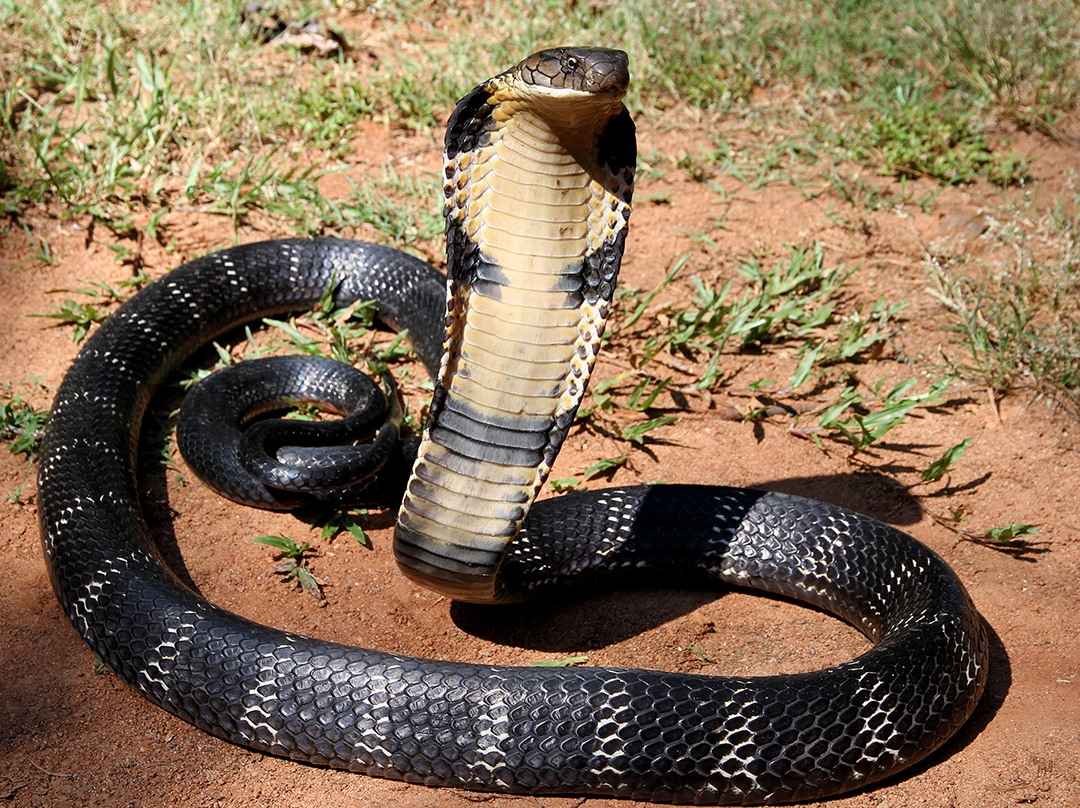
King Cobra
SUMMARY: The king cobra is a massive, venomous snake species complex endemic to Asia, renowned for its impressive length and elusive nature.
Overview
The king cobra (Ophiophagus hannah) is a serpent of legend, captivating the imagination of people around the world with its striking appearance and formidable reputation. Despite its fearsome reputation, this magnificent creature is a vital component of its ecosystem, playing a crucial role in maintaining the balance of nature. As a member of the Elapidae family, the king cobra is not a true cobra, but rather a distinct genus that has evolved to thrive in a variety of environments across Asia.
The king cobra's impressive physical attributes make it a standout among its peers. Reaching lengths of up to 5.85 meters (19.2 feet), it is the world's longest venomous snake, with a weight that can exceed 10 kilograms (22 pounds). Its slender, elongated body is perfectly adapted for hunting and navigating through dense vegetation, allowing it to strike with deadly precision. The king cobra's striking appearance is characterized by its glossy, black scales, which are often adorned with a distinctive white or yellowish coloration on the hood.
History/Background
The king cobra has a long and storied history, with records of encounters dating back to ancient times. In Hindu mythology, the king cobra is revered as a sacred creature, associated with the god Shiva. In Southeast Asia, the king cobra is often considered a symbol of good fortune and prosperity. Despite its cultural significance, the king cobra has long been feared and persecuted by humans, leading to a decline in its population and a loss of habitat.
Key Information
* Distribution: The king cobra is found in a wide range of habitats, from tropical rainforests to dry deciduous forests, across the Indian subcontinent, Southeast Asia, and Southern China.
* Diet: The king cobra is a carnivorous snake, feeding on a variety of small mammals, birds, and other reptiles.
* Venom: The king cobra's venom is highly toxic, capable of killing a human being within 45 minutes if left untreated.
* Habitat: King cobras are arboreal, spending most of their time in trees and undergrowth.
* Reproduction: Female king cobras give birth to live young, typically between 20-30 snakes per litter.
Significance
The king cobra plays a vital role in maintaining the balance of its ecosystem, serving as a top predator and regulating the populations of small mammals and birds. Its presence also has a significant impact on the local food chain, with many other species relying on it as a source of food. Unfortunately, the king cobra is threatened by habitat loss, hunting, and the pet trade, leading to a decline in its population and a loss of genetic diversity.
INFOBOX:
- Name: King Cobra (Ophiophagus hannah)
- Type: Venomous Snake
- Date: Ancient Times
- Location: Asia
- Known For: Longest Venomous Snake in the World
TAGS: King Cobra, Venomous Snake, Asia, Elapidae, Habitat Loss, Conservation, Ecology, Snake, Venom, Wildlife


