




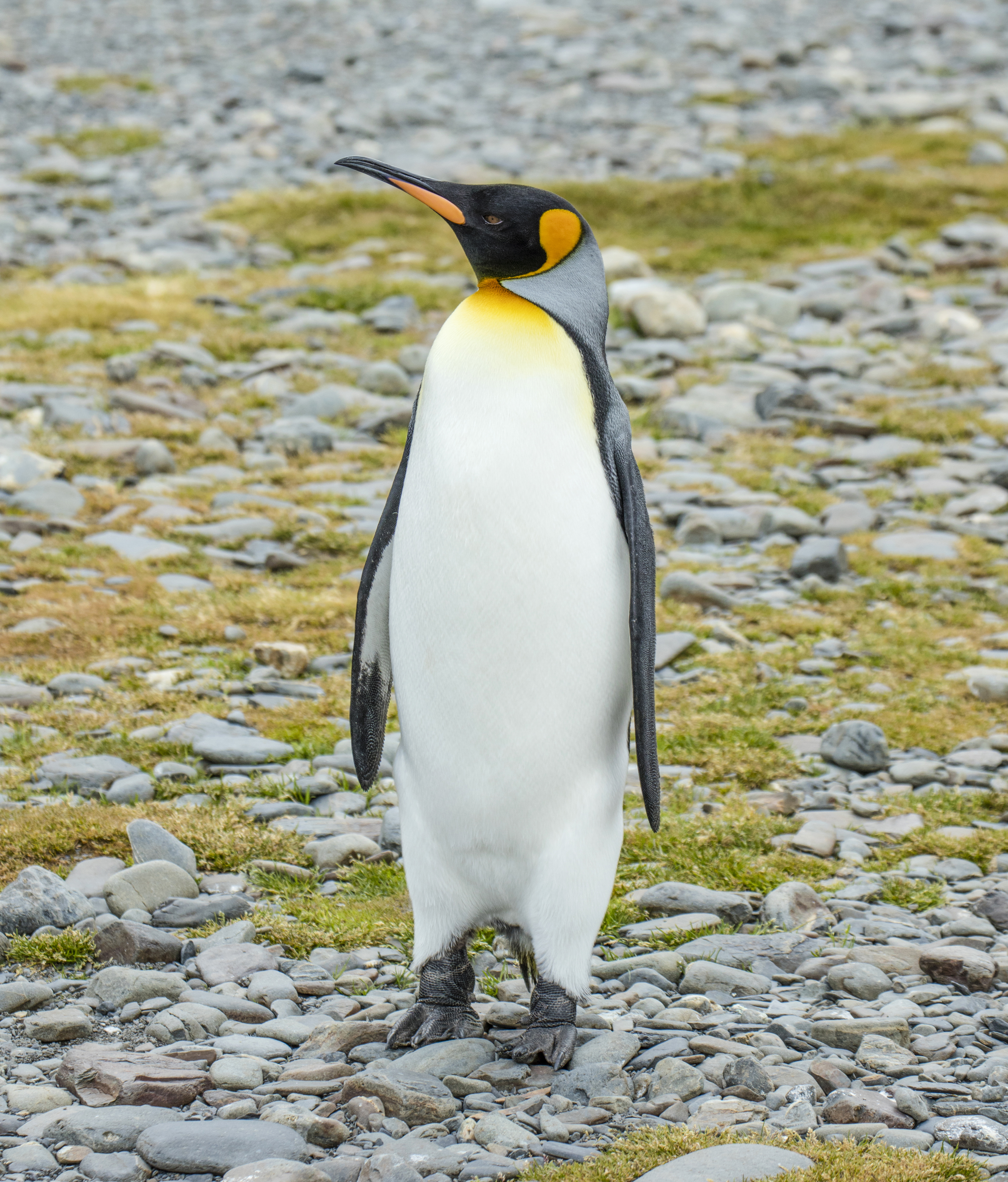
King Penguin
SUMMARY: The king penguin is a large, charismatic penguin species found in the Southern Ocean, known for its distinctive yellow patches and vibrant social behavior.
Overview
The king penguin (Aptenodytes patagonicus) is a majestic bird species that inhabits the sub-Antarctic islands and surrounding waters of the Southern Ocean. It is the second-largest penguin species, reaching heights of up to 38 inches (97 cm) and weighing up to 35 pounds (15.9 kg). The king penguin's distinctive yellow patches on its chest, white belly, and black feathers make it a striking sight, particularly when it stands upright on land. These birds are highly social creatures, often gathering in large colonies to breed, feed, and raise their young.
King penguins are incredibly agile swimmers, capable of reaching speeds of up to 25 miles per hour (40 km/h) in the water. They feed on a diet rich in fish, krill, and squid, which they catch while diving to depths of up to 250 feet (76 meters). Their unique feathers, which are densely packed and water-repellent, help to conserve heat and maintain buoyancy in the cold ocean waters. On land, king penguins use their powerful flippers to propel themselves forward, often sliding on their bellies to reach their nesting sites.
History/Background
The king penguin's evolutionary history dates back to the Paleocene epoch, around 60 million years ago. Fossil records suggest that these birds evolved from a common ancestor with the emperor penguin, and their distinct physical characteristics developed over time as they adapted to their unique environment. The king penguin's range expanded during the Pleistocene epoch, when the Antarctic ice sheet retreated, allowing them to colonize new islands and coastal regions.
Key Information
- Habitat: King penguins inhabit the sub-Antarctic islands and surrounding waters of the Southern Ocean, including the Falkland Islands, South Georgia, and the Antarctic Peninsula.
- Diet: King penguins feed on a diverse diet of fish, krill, squid, and other marine animals.
- Breeding: King penguins breed in large colonies, often numbering in the tens of thousands, and form long-term monogamous relationships.
- Conservation Status: The king penguin is listed as Near Threatened on the IUCN Red List, due to declining populations and habitat degradation.
- Lifespan: King penguins can live up to 20-30 years in the wild, although their average lifespan is around 15-20 years.
Significance
The king penguin plays a vital role in maintaining the balance of the Southern Ocean ecosystem. As a key predator, they help to regulate the populations of fish, krill, and other marine animals. Additionally, their unique feathers and adaptations have inspired scientific research and technological innovations, such as the development of water-repellent materials and insulation systems.
INFOBOX:
- Name: King Penguin (Aptenodytes patagonicus)
- Type: Bird species
- Date: Paleocene epoch (60 million years ago)
- Location: Sub-Antarctic islands and surrounding waters of the Southern Ocean
- Known For: Distinctive yellow patches, vibrant social behavior, and unique adaptations to the cold ocean environment
TAGS: King Penguin, Penguin, Southern Ocean, Sub-Antarctic Islands, Conservation, Biodiversity, Marine Biology, Wildlife, Ecology


