




**
Overview
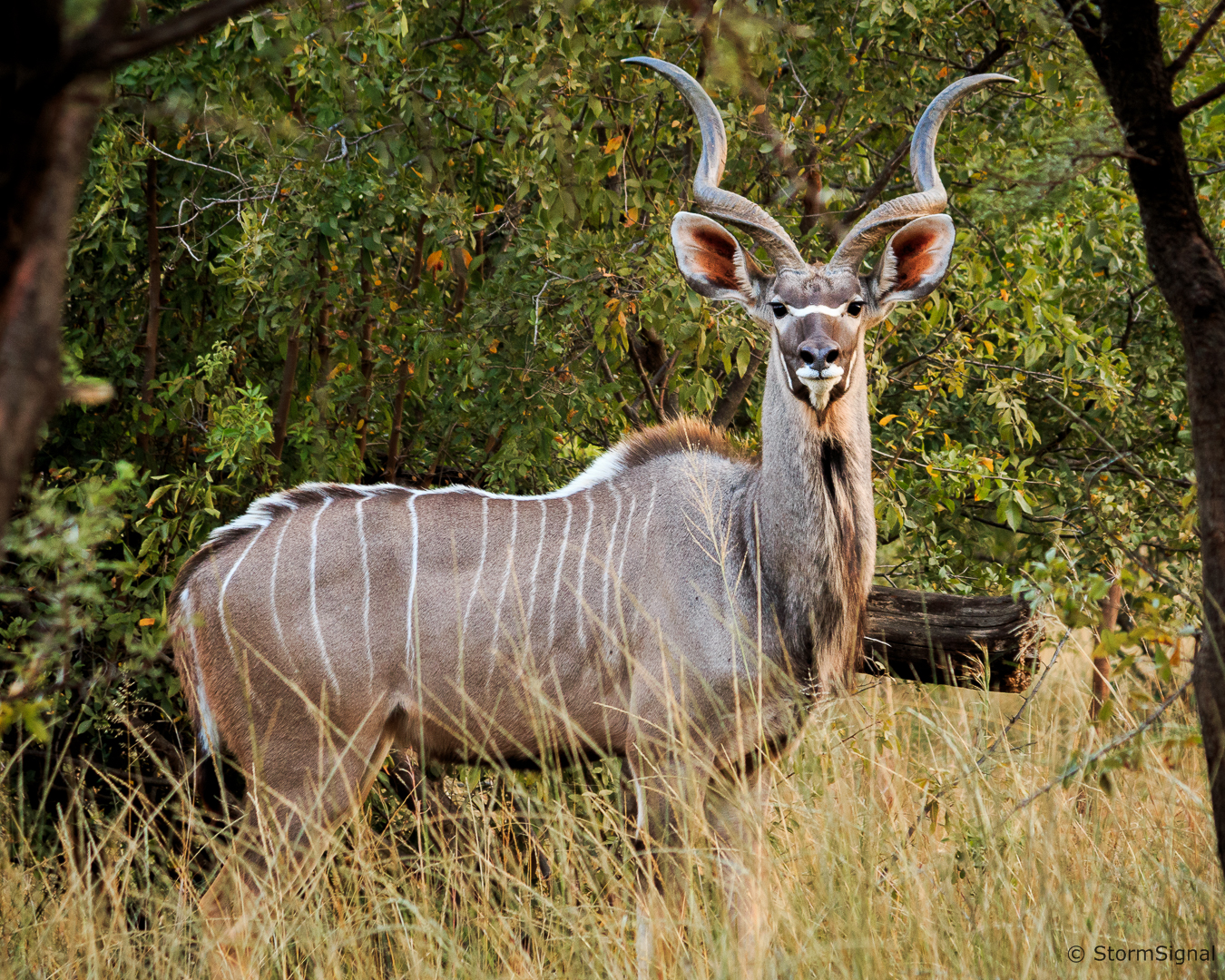
The kudu belong to the genus Tragelaphus, a group of medium‑to‑large African antelopes distinguished by their vertical white stripes, shaggy manes, and impressive, tightly coiled horns. The two extant species occupy overlapping but distinct ranges across eastern, southern, and parts of central Africa. The Greater kudu (T. strepsiceros) is the larger of the pair, standing up to 1.5 m at the shoulder and weighing as much as 300 kg. Its coat is a rich chocolate brown marked with thin white vertical stripes that break up its outline in the dappled light of woodland and savanna. The Lesser kudu (T. imberbis), sometimes called the “imberbis” for its relatively hairless face, is more modest in size—about 1.2 m tall and 150 kg—and sports a denser, darker coat with broader stripes that aid camouflage in the denser forest thickets of eastern Africa.Both species are browsers, feeding primarily on leaves, shoots, and fruits of acacia, mopane, and other woodland trees. Their diet shifts seasonally: during the wet season they indulge in succulent foliage, while the dry months see them relying on bark and twigs. Kudu are crepuscular, most active at dawn and dusk, and they possess keen eyesight and hearing that help them evade predators such as lions, leopards, and hyenas. Their characteristic “bong” alarm call—a deep, resonant bellow—can travel several kilometres across the bush, warning conspecifics of danger.
History/Background
The scientific recognition of kudu dates back to early 19th‑century European exploration. John Edward Gray formally described the Greater kudu in 1826, assigning it the name Antilope strepsiceros before it was re‑classified under Tragelaphus. The Lesser kudu received its description a decade later, in 1835, by William Ogilby, who noted its comparatively smoother facial region, hence the epithet “imberbis” (Latin for “beardless”). Fossil evidence suggests that the Tragelaphus lineage diverged from other bovids roughly 5–7 million years ago, adapting to the mosaic of forest and savanna that characterizes much of sub‑Saharan Africa. Colonial hunting in the late 1800s and early 1900s dramatically reduced kudu numbers, prompting the first organized conservation measures in the 1930s, when protected areas such as Kenya’s Masai Mara and Tanzania’s Serengeti were established. Post‑World War II wildlife management programs introduced regulated hunting quotas and community‑based conservancies, allowing populations to rebound in many regions.Key Information
- Taxonomy: Tragelaphus imberbis (Lesser kudu) and Tragelaphus strepsiceros (Greater kudu). - Physical traits: Horns can reach 1.5 m in length; the Greater’s horns coil up to three full turns, while the Lesser’s make two. Both sexes possess horns, though males’ are larger and more robust. - Habitat: Mixed woodland, riverine forests, and open savanna; the Lesser prefers denser, higher‑altitude forest, whereas the Greater thrives in open bushveld and mopane woodlands. - Reproduction: Breeding is seasonal, often linked to the onset of rains. Gestation lasts ~240 days, producing a single calf that hides for the first 2–3 weeks. - Conservation status: Both species are listed as Least Concern by the IUCN, but local populations face pressures from habitat fragmentation, poaching for meat and horns, and competition with livestock. - Cultural importance: In many East African societies, kudu horns are prized ceremonial objects, symbolizing strength and status. Their striking appearance also makes them a flagship species for ecotourism, drawing wildlife enthusiasts to national parks across the continent.Significance
Kudu serve as indicator species for the health of woodland ecosystems; their presence signals intact canopy cover and a balanced predator‑prey dynamic. Their browsing helps regulate vegetation growth, promoting biodiversity by preventing any single tree species from dominating. Economically, kudu attract high‑value photographic tourism, generating revenue for local communities and incentivizing habitat protection. Moreover, the species’ resilience—recovering from historic over‑exploitation—offers a hopeful narrative for African wildlife conservation, illustrating how science‑guided management and community involvement can reverse declines. Ongoing research into kudu genetics and movement ecology informs broader strategies for maintaining connectivity across fragmented landscapes, a critical step in safeguarding Africa’s megafauna against climate change and human encroachment.INFOBOX:
- Name: Kudu (Tragelaphus spp.)
- Type: African antelope (bovid)
- Date: First described 1826 (Greater) / 1835 (Lesser)
- Location: Eastern, southern, and parts of central Africa
- Known For: Long, spiraled horns and striking vertical striping
TAGS: Kudu, Antelope, African Wildlife, Conservation, Savanna Ecosystems, Mammalogy, Biodiversity, Ecotourism


