Overview
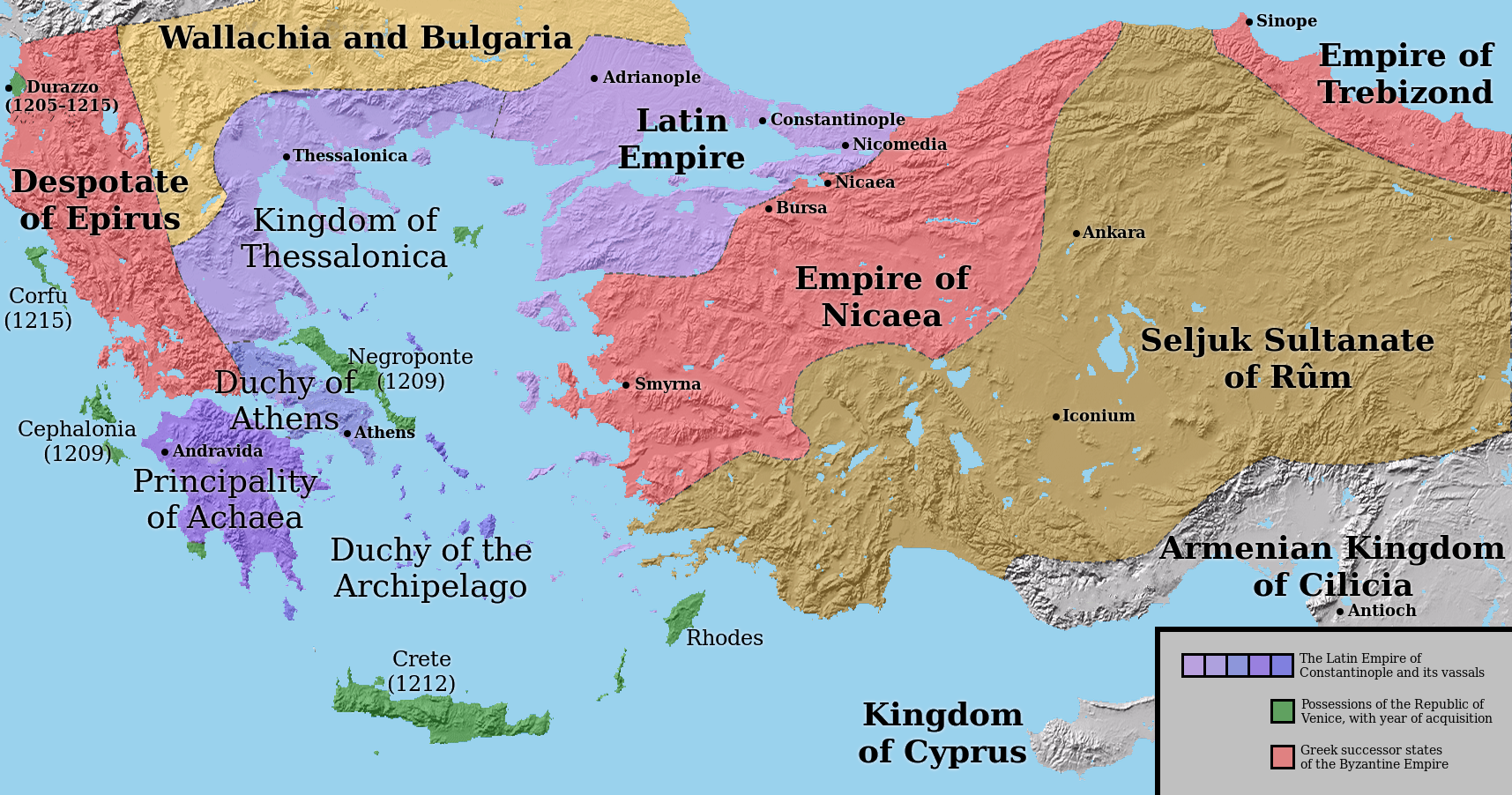
When Venetian war-galleys and French knights crashed through Constantinople’s sea-walls in April 1204, they did more than sack the richest city in Christendom; they rewrote the map of the medieval world. Out of the spoils the victors forged a novel polity: the Latin Empire of Constantinople, a feudal, Catholic super-structure intended to replace the millennium-old Byzantine Roman Empire. In theory it was the legitimate continuator of Rome, ruled by a Latin Emperor crowned in St. Sophia and endorsed by the Pope. In practice it was a brittle crusader edifice, perched precariously amid Greek, Bulgarian, and Turkish enemies, hemorrhaging money and legitimacy for nearly six decades until Byzantine refugees retook the city in 1261.The empire’s existence illuminates the contradictions of the crusading ideal. Marketed as a holy war to recover Jerusalem, the Fourth Crusade was diverted—first to Zara, then to Constantinople—by commercial ambition, personal vendettas, and Venetian geopolitics. The Latin Empire thus became both the climax and the graveyard of the crusading movement in the East: a spectacular triumph that instantly turned into a cautionary tale about over-extension, cultural arrogance, and the limits of military conquest.
History/Background
The road to 1204 began decades earlier. After the Third Crusade, Pope Innocent III called for a new expedition to reclaim Jerusalem, but insufficient French nobles answered. Venice offered transport for 33,000 men; only 12,000 arrived. To pay the balance Doge Enrico Dandolo diverted the fleet to the Adriatic port of Zara (a Christian city), then to Constantinople, where a pretender, Alexios Angelos, promised huge subsidies if the crusaders restored his father to the Byzantine throne. Once inside the walls, Alexios was murdered, the populace turned hostile, and the crusaders seized the opportunity to storm the city.On 13 April 1204 Constantinople fell. A partition treaty—the so-called Partitio terrarum imperii Romaniae—had already carved the Byzantine world into spheres of influence: Venice claimed strategic islands and harbors; Boniface of Montferrat took Thessalonica; Baldwin of Flanders was elected Emperor. Baldwin I was crowned in Hagia Sophia on 16 May 1204, and the Latin Empire was born. Yet large swaths of Anatolia and the Balkans remained outside Latin control, held by three Greek successor states—Nicaea, Epirus, and Trebizond—each claiming to be the true Rome.
Chronic cash shortages forced every Latin emperor to mortgage the crown jewels (literally) to Venetian bankers. When Baldwin II (r. 1228-1261) traveled across Europe in 1237-1240 begging aid, he left his own son as collateral in Venice. Meanwhile the Nicene Emperor Michael VIII Palaiologos forged an alliance with Genoa, built a fleet, and on 25 July 1261 slipped into Constantinople while the Latin garrison was absent. Baldwin fled; the Latin Empire vanished almost overnight, though titular claimants lingered in exile until the 14th century.