Overview
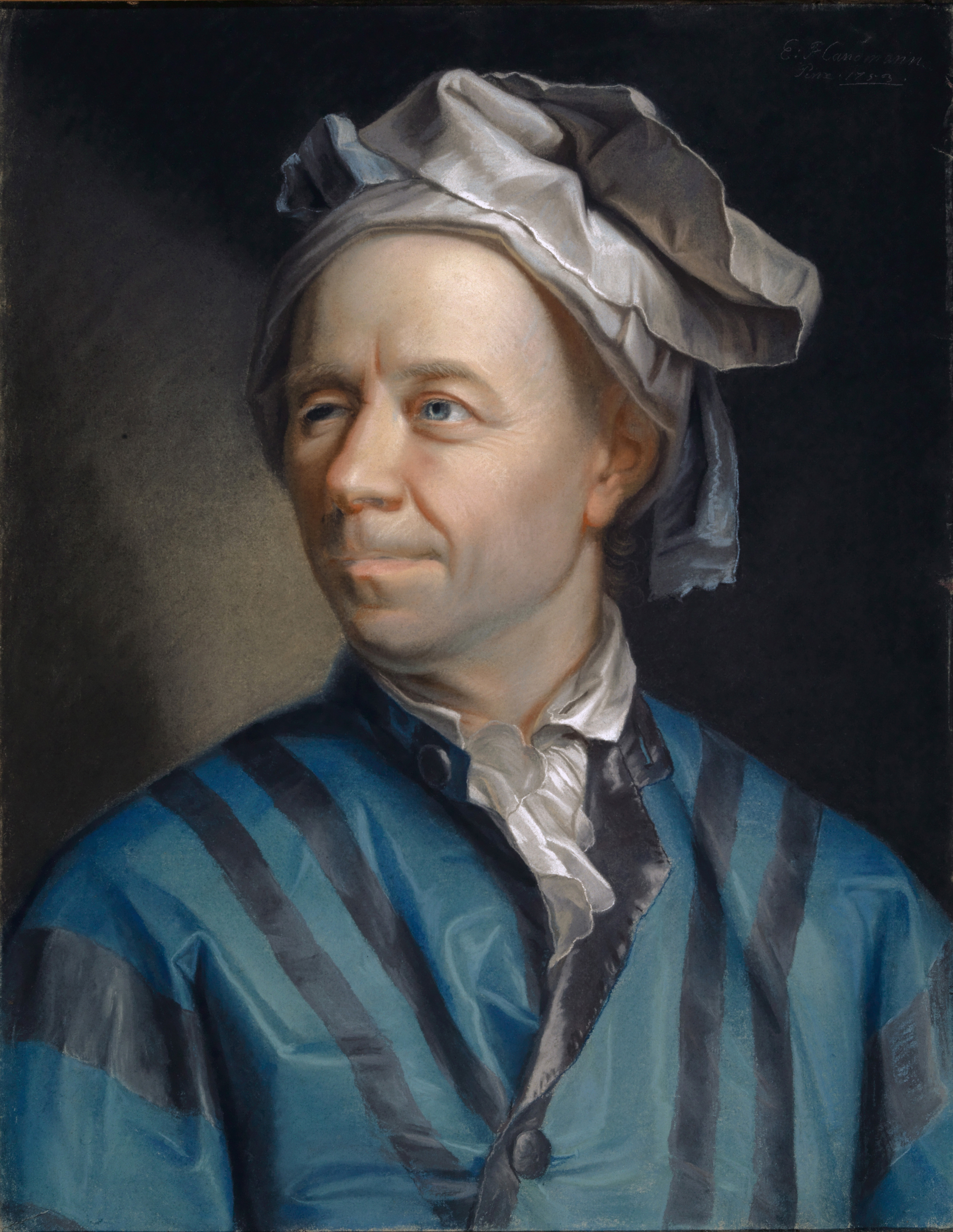
In 1727 a 20-year-old Swiss prodigy boarded a sleigh for the two-month winter trek to St. Petersburg; by the time he died 56 years later, Leonhard Euler had written more pages of published mathematics than any single human in history. His 866 books and papers—averaging one 50-page memoir every week while he was alive—contain the Euler characteristic that topologists use to classify shapes, the Euler identity e^{iπ}+1=0 that poll after poll crowns “the most beautiful equation,” and the Euler-Lagrange equations that let engineers optimize everything from roller-coaster loops to Mars-rover trajectories. Blind for the last 17 years of his life, he dictated memoirs faster than his assistants could fetch fresh chalk.
Euler’s genius lay in turning the vague into the inevitable. He gave us the very notion of a function f(x), the symbol π for the circle constant, the letter i for √–1, and the summation sign Σ. When the city of Königsberg asked whether one could stroll across all seven bridges without retracing steps, Euler stripped away every stone and tree and answered the deeper question—thereby inventing graph theory and prefiguring network science. From the flutter of a violin string to the wobble of the Moon, Euler’s mathematics turned physical puzzles into permanent notation.
Background & Origins
Born 15 April 1707 in Basel to a Calvinist pastor and the daughter of another, Euler grew up in nearby Riehen. His father, Paul, a student of the great Jacob Bernoulli, tutored him in Latin and geometry before bedtime; by age 13 Leonhard entered the University of Basel, graduating at 16 with a master’s in philosophy. A Sunday sermon he wrote at 11 on the history of Atlantis so impressed the faculty that they fast-tracked him to theology—until Jacob’s brother Johann Bernoulli recognized the boy’s gift for infinitesimal calculus and tutored him privately. The Bernoulli clan later secured him a post at the fledgling St. Petersburg Academy (1727), where he arrived with “a head full of theorems and a pocket empty of rubles.”
Major Achievements & Milestones
Introduction of the function concept (1734): In Commentarii Academiae Scientiarum Imperialis Petropolitanae Euler defined a function as “an analytic expression composed in any way whatsoever” and introduced the f(x) notation we still use.
Solution of the Basel problem (1735): Euler proved that 1 + ¼ + 1⁄9 + 1⁄16 + … = π²⁄6, a result so unexpected that the 28-year-old became an overnight celebrity across European academies.
Euler’s polyhedron formula (1758): For any convex polyhedron, V – E + F = 2; this tiny equation launched topology and underlies modern 3-D graphics engines.
Timeline
- 1707: Born in Basel, Swiss Confederacy
- 1727: Appointed professor of physiology at St. Petersburg Academy (yes, physiology—mathematics chairs were full)
- 1734: Marries Katharina Gsell; they eventually have 13 children
- 1741: Accepts Frederick the Great’s invitation to Berlin Academy
- 1766: Returns to St. Petersburg at Catherine the Great’s urging
- 1771: Loses remaining eyesight after cataract surgery; dictates 400+ memoirs from memory
- 1783: Dies of a brain hemorrhage while playing with a grandson, age 76
Impact & Legacy
Euler’s fingerprints are everywhere. Every time your phone corrects for Doppler shift in GPS signals, it uses Euler angles to rotate orbital frames. Every JPEG compression calls on Euler’s formula e^{iθ}=cosθ+i sinθ to split images into frequencies. Cryptographers rely on Euler’s totient theorem to secure online banking; chemists use the Euler characteristic to predict fullerene stability; musicians tune pianos with equal temperament, an Euler-approved compromise between harmony and key freedom. His insistence on clear notation—π, i, e, sin, cos, Σ—turned algebra from rhetorical prose into symbolic reasoning, accelerating every science that counts.
Records & Notable Facts
- Most prolific mathematician: 866 works; next competitor (Cauchy) has 789 fewer.
- Posthumous productivity: Half his output appeared after he died.
- Memory feat: Recited the entire 12-book Aeneid from heart and could state on which line and page any given word appeared.
- Blind innovation: Once remarked that losing sight freed him from “the tyranny of blackboard and chalk.”
> “Mathematicians have tried in vain to this day to discover some order in the sequence of prime numbers, and I have reason to believe that this is a mystery into which the human mind will never penetrate.” —Leonhard Euler, 1751