




**
Overview
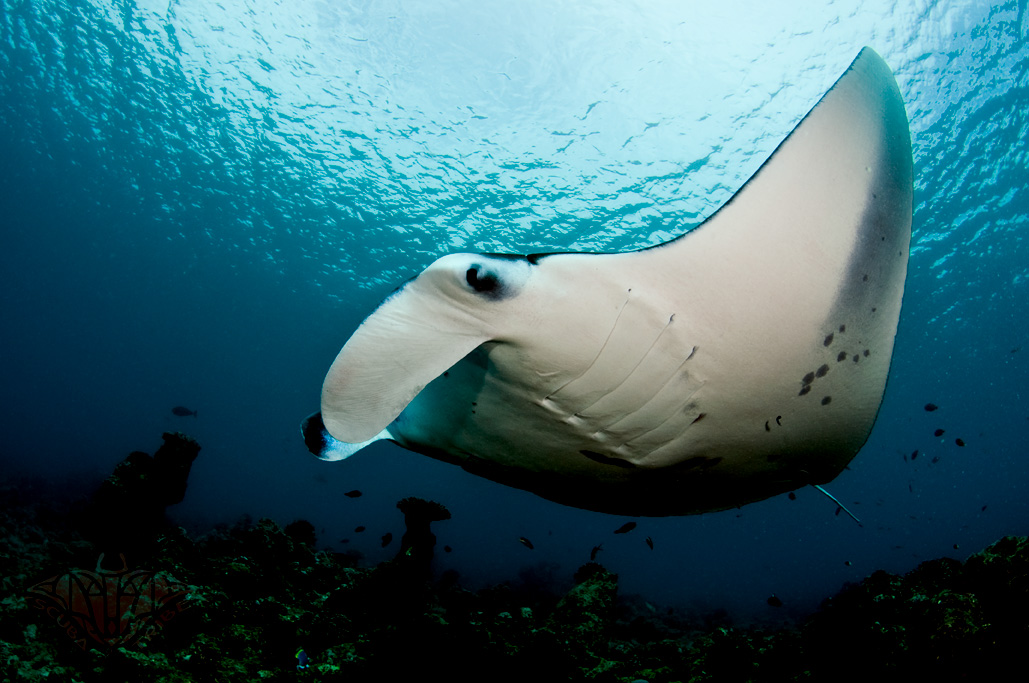
Manta rays are among the most iconic and visually striking members of the order Myliobatiformes, placed within the family Myliobatidae. Unlike most rays that glide close to the seabed, mantas are pelagic, spending the majority of their lives in the water column where they perform elegant, wing‑like flaps with their triangular pectoral fins. Their horn‑shaped cephalic fins unfurl like a pair of antennae, channeling plankton‑laden water into a large, forward‑facing mouth that can open to a width of nearly a meter.Three species are currently recognized: _Manta birostris_ (the giant oceanic manta), which can reach a wingspan of up to 7 m (23 ft); _Manta alfredi_ (the reef manta), the smallest at 5.5 m (18 ft); and the recently described _Manta yarae_, attaining 6 m (20 ft). All three share a sleek, dark dorsal surface marked by subtle white spots, a pattern that can be used like a fingerprint for individual identification. Their bodies are powered by a high brain‑to‑body mass ratio, the highest recorded among fish, granting them advanced sensory perception and social cognition—traits highlighted by successful mirror‑self recognition tests.
History/Background
The scientific journey of manta rays began in the late 18th century when Georg Johann Reinhold Forster first described Manta birostris in 1795. For decades, mantas were lumped together under a single species, but morphological and genetic studies in the early 2000s revealed distinct lineages. In 2018, a comprehensive phylogenetic analysis split the genus, leading to the formal description of _Manta alfredi_ and the later discovery of _Manta yarae_ in 2022, named after the Yara people of the Caribbean who have long revered these creatures.Historically, mantas were hunted for their gill plates, prized in traditional Asian medicine, and for their meat in coastal communities. The rise of eco‑tourism in the 1990s shifted public perception, turning many regions into sanctuary zones where divers gather to witness the gentle giants’ aerial displays. International protection followed: the Convention on International Trade in Endangered Species (CITES) listed all manta species in Appendix II in 2013, and the IUCN Red List now classifies M. birostris as Endangered and M. alfredi as Vulnerable.
Key Information
- Taxonomy: Genus Mobula; Species: M. birostris, M. alfredi, M. yarae. - Size: Wingspans range from 5.5 m to 7 m; weight can exceed 1,350 kg. - Morphology: Triangular pectoral fins, horn‑shaped cephalic fins, forward‑facing mouth, lack of a stinger (unlike many rays). - Brain: Approx. 1 g brain mass, yielding a brain‑to‑body ratio of ~0.001 %—high for fish. Demonstrated self‑recognition in mirror tests, indicating complex cognition. - Feeding: Filter‑feed on zooplankton and small fish; can process up to 300 L of water per hour. - Reproduction: Ovoviviparous; females give birth to a single pup after a gestation of 12–13 months; low fecundity makes populations vulnerable. - Migration: Some individuals travel thousands of kilometers between feeding grounds and cleaning stations, where they allow remoras and cleaner fish to remove parasites. - Conservation Threats: By‑catch in pelagic longlines, targeted gill‑plate fisheries, habitat degradation of cleaning stations, and climate‑driven plankton shifts.Significance
Manta rays serve as keystone species in pelagic ecosystems. Their filter‑feeding helps regulate plankton populations, indirectly influencing carbon cycling and the health of coral reefs downstream. Their migratory routes connect disparate marine habitats, making them valuable sentinels for ocean health; changes in their distribution often signal shifts in productivity or water temperature.From a cultural standpoint, mantas inspire awe and reverence across coastal societies, fostering community‑based conservation initiatives that blend traditional knowledge with modern science. Ecotourism centered on manta sightings generates sustainable income for remote island economies, providing a powerful incentive to protect these animals and their habitats.
Scientifically, the high cognitive abilities of mantas challenge long‑standing assumptions about fish intelligence, opening new research avenues into vertebrate consciousness and social learning. Their capacity to pass the mirror test places them alongside select mammals and birds, prompting ethical discussions about their treatment in fisheries and captivity.
Overall, protecting manta rays safeguards not only a charismatic marine megafauna but also the broader integrity of oceanic food webs, climate regulation processes, and the cultural heritage of peoples who share the seas with them.
INFOBOX:
- Name: Manta Ray (Mobula spp.)
- Type: Large pelagic cartilaginous fish (ray)
- Date: First described 1795; modern taxonomic split 2018‑2022
- Location: Tropical and subtropical oceans worldwide; frequent at cleaning stations and reef edges
- Known For: Enormous wingspan, high brain‑to‑body ratio, mirror‑self recognition, graceful filter‑feeding
TAGS: marine biology, cartilaginous fish, conservation, ecotourism, animal cognition, pelagic ecosystems, endangered species, oceanic megafauna


