Overview
Between roughly 3100 and 1100 BCE the island of Crete nurtured a dazzling urban society whose frescoed palaces, vast trading networks and confident artistic style set the benchmark for later European cultures. Sir Arthur Evans, the British archaeologist who first uncovered the labyrinthine palace at Knossos in 1900, coined the term “Minoan” after the legendary King Minos, but the civilization knew no single ruler; instead it consisted of semi-independent palace-states that shared language, religion and economic interests. Energetic wall-paintings of leaping bull-dancers, sophisticated multi-storey architecture and the earliest known European scripts—Cretan Hieroglyphic and Linear A—testify to a culture at once playful, theocratic and commercially astute.The Minoans commanded the Aegean by ship rather than by sword. Their merchant flotillas ferried Cretan olive oil, wine, timber and finely crafted prestige goods to Egypt, the Levant, Anatolia and the Cyclades, returning with copper, tin, ivory and ideas. Secure behind their “wooden walls,” they developed a remarkably unfortified lifestyle, suggesting that naval power and ritual authority sufficed to keep rivals at bay. The result was a cosmopolitan court culture whose influence radiated throughout the Aegean and, via the later Mycenaeans, into the mainstream of Greek myth and memory.
History/Background
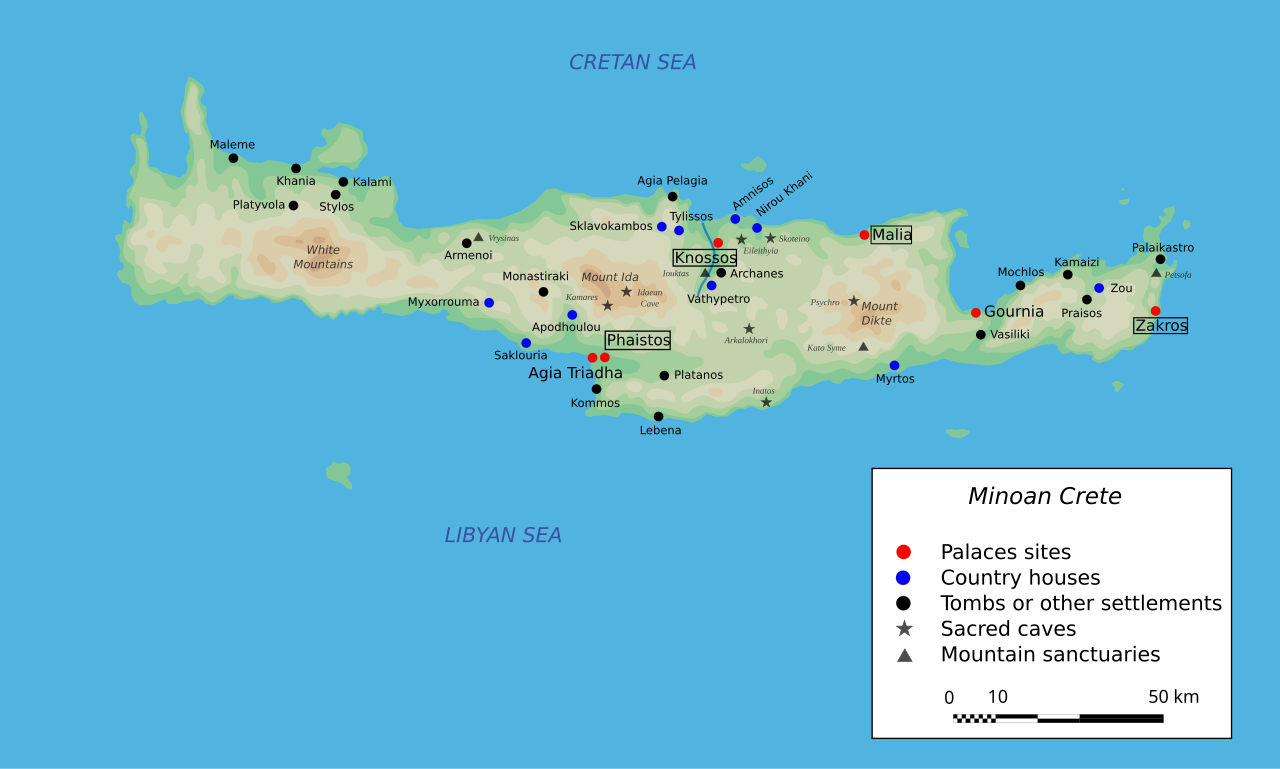
The civilization unfolds in four archaeological phases: Early Minoan (EM, c. 3100–2100 BCE) saw village farming communities evolve into ranked societies with long-distance trade; Middle Minoan (MM, c. 2100–1700 BCE) witnessed the rise of the first palaces at Knossos, Phaistos, Malia and Zakros, the development of writing, and the eruption of the Thera volcano (c. 1628 BCE) which disrupted but did not destroy the culture; Late Minoan (LM, c. 1700–1420 BCE) produced the apogee of fresco art and the zenith of sea-power; Final Minoan (LM III, c. 1420–1100 BCE) records increasing Mycenaean Greek presence on Crete, the conversion of Linear A into the Greek syllabary Linear B, and the eventual eclipse of palatial society around 1100 BCE.Key Information
- Palaces: Knossos (the largest, covering 20 000 m²), Phaistos, Malia, Zakros and Galatas served as administrative, religious and economic hubs built around a central court. Advanced ashlar masonry, light-wells and extensive storerooms reveal complex bureaucracies that measured produce, collected tribute and organized large-scale craft production.- Art: Vivid frescoes depict religious rituals, maritime scenes, goddesses surrounded by animals and the famous bull-leaping acrobats. Pottery progresses from patterned EM wares to the polychrome Kamares style and finally to the exuberant Marine Style of LM I, with octopuses, dolphins and nautiluses curling around vessel surfaces.
- Religion: Evidence points to a female-centered deity (Snake Goddess, Dove Goddess) and associated male consorts; peak sanctuaries (e.g., Juktas) and cave shrines (e.g., Psychro) received pilgrim offerings. Ritual objects—bull rhyta, double axes (labrys), sacral knots—suggest ceremonies of fertility and renewal.
- Writing & Administration: Cretan Hieroglyphic (c. 2000 BCE) and Linear A (c. 1700 BCE) remain undeciphered; both were used for palace accounting. Around 1450 BCE Mycenaean Greeks adapted Linear A into Linear B to record an early form of Greek, providing Europe’s first readable writing.
- Technology: Multi-storey buildings with terracotta water pipes, flush toilets and sophisticated port installations at Katsamba and Amnisos reveal engineering prowess. The Minoan “ship” was a sleek, sail-driven merchant galley capable of carrying 20–30 tonnes of cargo.
- Economy: Palace centers controlled textile, pottery and metallurgical workshops; vast storerooms held amphorae of wine, oil and grain. Administrative tablets record flocks of sheep numbered in the tens of thousands, implying large-scale wool production for export.
- Gender roles: Frescoes show women in open-fronted dresses participating in public spectacles; some scholars argue for a comparatively high female status, though clear political titles remain elusive.