




**
Overview
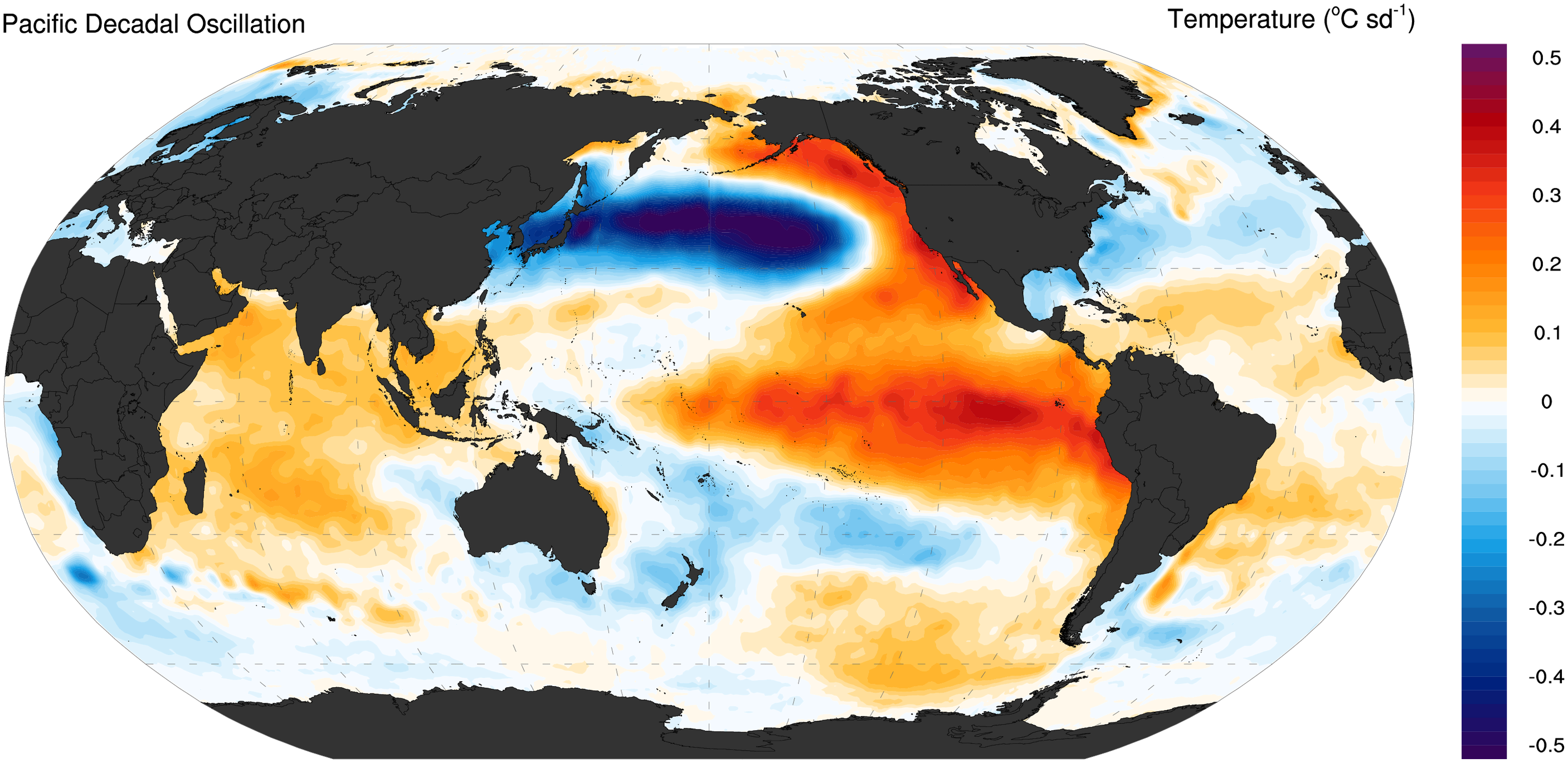
The Pacific Decadal Oscillation is a robust, recurring pattern of ocean‑atmosphere climate variability centered over the mid‑latitude Pacific basin. It is most clearly expressed as alternating bands of warm (positive) and cool (negative) sea‑surface temperature (SST) anomalies north of 20° N. While the PDO shares some characteristics with the El Niño‑Southern Oscillation (ENSO), its temporal scale is much longer, persisting for interannual to interdecadal periods and often modulating the background state on which ENSO events play out.During a positive PDO phase, the western Pacific experiences cooler SSTs while the central‑to‑eastern Pacific warms, leading to milder coastal air temperatures along the U.S. West Coast, reduced upwelling, and altered precipitation patterns. Conversely, a negative PDO phase brings cooler conditions to the eastern Pacific, stronger upwelling, and colder, stormier weather along the same coastline. These temperature shifts cascade through the marine food web, affecting plankton productivity, fish distribution, and ultimately the salmon production regimes that are vital to both commercial fisheries and Indigenous communities.
The PDO’s amplitude is irregular, with periods of strong, coherent swings interspersed with quieter intervals. Its influence extends beyond the ocean, modulating continental surface‑air temperatures, winter snowfall, and even wildfire risk across the western United States and parts of Canada. Because of its broad reach, the PDO is a key focus for climate scientists, resource managers, and policymakers seeking to anticipate and mitigate climate‑driven impacts.
History/Background
The concept of a decadal Pacific climate mode emerged in the early 1990s when researchers applied empirical orthogonal function (EOF) analysis to long‑term SST records. In 1999, Mantua, Wallace, and colleagues formally identified the PDO as a distinct pattern separate from ENSO, publishing the seminal paper that defined its spatial structure and temporal behavior. Subsequent reconstructions using proxy data (tree rings, sediment cores) pushed the PDO’s documented history back to the late 19th century, revealing a series of polarity reversals around 1925, 1947, and 1977. The latter two reversals coincided with dramatic shifts in North Pacific salmon catches, prompting intensive interdisciplinary studies linking oceanography, fisheries biology, and climate science.Since its discovery, the PDO has been incorporated into climate model ensembles and seasonal forecasting systems. Advances in satellite remote sensing and Argo float networks have refined our understanding of the underlying mechanisms, highlighting the role of subsurface ocean heat content, wind‑stress curl, and the Pacific Meridional Mode in driving the oscillation. Ongoing research continues to debate whether the PDO is a true internal mode of the climate system or a manifestation of stochastic atmospheric forcing amplified by oceanic memory.
Key Information
- Spatial domain: Primarily the North Pacific Ocean north of 20° N, extending from the Asian coast to the western Americas. - Temporal scale: Dominant periodicities of 15–30 years, with superimposed interannual variability. - Phases: Positive (warm eastern Pacific, cool western Pacific) vs. negative (cool eastern Pacific, warm western Pacific). - Detection: Calculated via the leading EOF of monthly SST anomalies after removing the global mean and ENSO signal. - Ecological impact: Alters upwelling intensity, nutrient availability, and the distribution of key species such as Pacific salmon, sardine, and anchovy. - Climatic influence: Modulates winter storm tracks, coastal temperature gradients, and precipitation patterns from Alaska to California. - Economic relevance: Affects fisheries revenue, timber growth rates, and energy demand for heating/cooling in the western U.S. - Recent trends: The PDO entered a negative phase in the early 2010s, persisting through the 2020s, with implications for cooler coastal waters and heightened storm activity.Significance
Understanding the PDO is essential for anticipating climate‑driven changes in a region that supports dense human populations, critical habitats, and valuable natural resources. Its modulation of salmon production directly ties to food security and cultural heritage for coastal Indigenous peoples, while its influence on coastal temperature and precipitation informs water‑resource planning, wildfire management, and renewable‑energy forecasting. Moreover, the PDO serves as a natural laboratory for studying decadal climate variability, offering insights that improve long‑range climate projections and help disentangle human‑induced warming from natural oscillations. As climate change intensifies, tracking PDO behavior will be pivotal for adaptive management strategies that safeguard both ecosystems and economies across the Pacific rim.INFOBOX:
- Name: Pacific Decadal Oscillation
- Type: Climate/Oceanic Oscillation
- Date: First identified 1999 (historical record extends to late 1800s)
- Location: North Pacific Ocean, north of 20° N
- Known For: Multi‑decadal shifts in sea‑surface temperature that drive regional climate and marine ecosystem changes
TAGS: climate variability, oceanography, Pacific Ocean, sea‑surface temperature, salmon fisheries, decadal oscillation, ENSO interaction, environmental impact


