




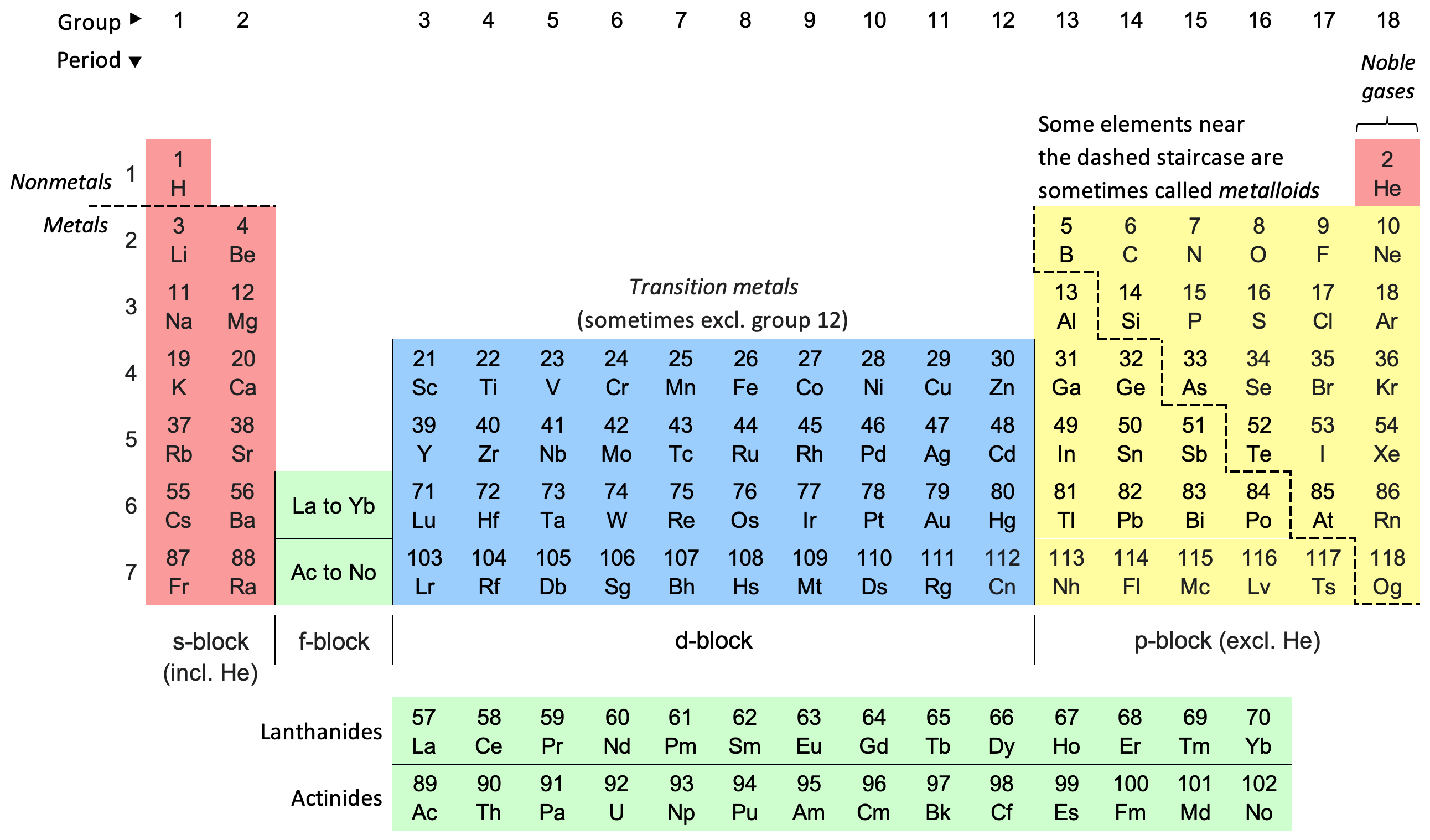
Overview
The periodic table, or periodic table of the elements, is a tabular arrangement of chemical elements ordered by atomic number, electron configuration, and recurring chemical properties. First published in 1869 by Russian chemist Dmitri Mendeleev, it remains one of the most iconic achievements in science. The table’s structure—divided into rows (periods) and columns (groups)—reflects the periodic law: when elements are arranged by atomic number, their properties exhibit predictable trends. Today, it contains 118 confirmed elements, from hydrogen (atomic number 1) to oganesson (118), with four added in 2016.The table is segmented into four blocks (s, p, d, f) based on electron orbital filling, and elements in the same group often share chemical traits. For example, Group 1 alkali metals are highly reactive, while Group 18 noble gases are inert. Its predictive power allowed Mendeleev to forecast the existence and properties of undiscovered elements like gallium and germanium. Beyond chemistry, the periodic table underpins physics, engineering, and biology, making it a universal language of science.
Background & Origins
Efforts to classify elements began in the 18th century. French chemist Antoine Lavoisier listed 33 "elements" in 1789, though many were compounds. In 1864, John Newlands proposed the "law of octaves," noting repeating patterns every eight elements—a precursor to the periodic table. However, German scientist Lothar Meyer and Mendeleev independently developed more robust systems in the 1860s.Mendeleev’s 1869 table was revolutionary. He left gaps for unknown elements and adjusted atomic weights when data conflicted with trends. His predictions, such as "eka-aluminum" (later gallium) and "eka-silicon" (germanium), were confirmed by discoveries in the 1880s, validating his approach. In 1913, Henry Moseley refined the table by arranging elements by atomic number (protons), resolving inconsistencies in Mendeleev’s version.
Major Achievements & Milestones
Dmitri Mendeleev’s Periodic Table (1869): Published in Zurnal Russkogo Fiziko-Khimicheskogo Obshchestva, Mendeleev’s table predicted elements like gallium (discovered in 1875) and germanium (1886).Atomic Number Arrangement (1913): Moseley’s X-ray experiments proved that elements should be ordered by atomic number, not atomic weight, clarifying anomalies like iodine’s placement before tellurium.
Synthesis of Transuranic Elements (1940–present): The first transuranic element, neptunium (93), was created in 1940. This opened the door to synthesizing elements beyond uranium, culminating in the 2016 addition of nihonium (113), moscovium (115), tennessine (117), and oganesson (118).
Timeline
- 1789: Antoine Lavoisier lists 33 "elements." - 1869: Dmitri Mendeleev publishes the first periodic table. - 1894: William Ramsay discovers noble gases, expanding the table. - 1913: Henry Moseley reorders elements by atomic number. - 1940: Neptunium, the first transuranic element, is synthesized. - 2016: IUPAC officially names four new elements (113–118). - 2019: The periodic table celebrates its 150th anniversary as a UNESCO World Heritage item.Impact & Legacy
The periodic table is indispensable in education, research, and industry. It guides the discovery of new materials, from superconductors to pharmaceuticals. Its cultural impact is profound: it appears in art, literature, and even the European Space Agency’s periodic table of space. The table also symbolizes international collaboration, with elements named after scientists (einsteinium), countries (americium), and locations (seaborgium).Records & Notable Facts
- The most reactive element is fluorine (Group 17), while the least reactive is helium (Group 18). - Oganesson (118) is the heaviest and most recently named element, synthesized in 2002. - Technetium (43) was the first artificially created element, discovered in 1937.> "The discovery of the periodic law has filled me with particular satisfaction, for it has revealed the internal connection which binds the elements together."
> — Dmitri Mendeleev, 1871




