



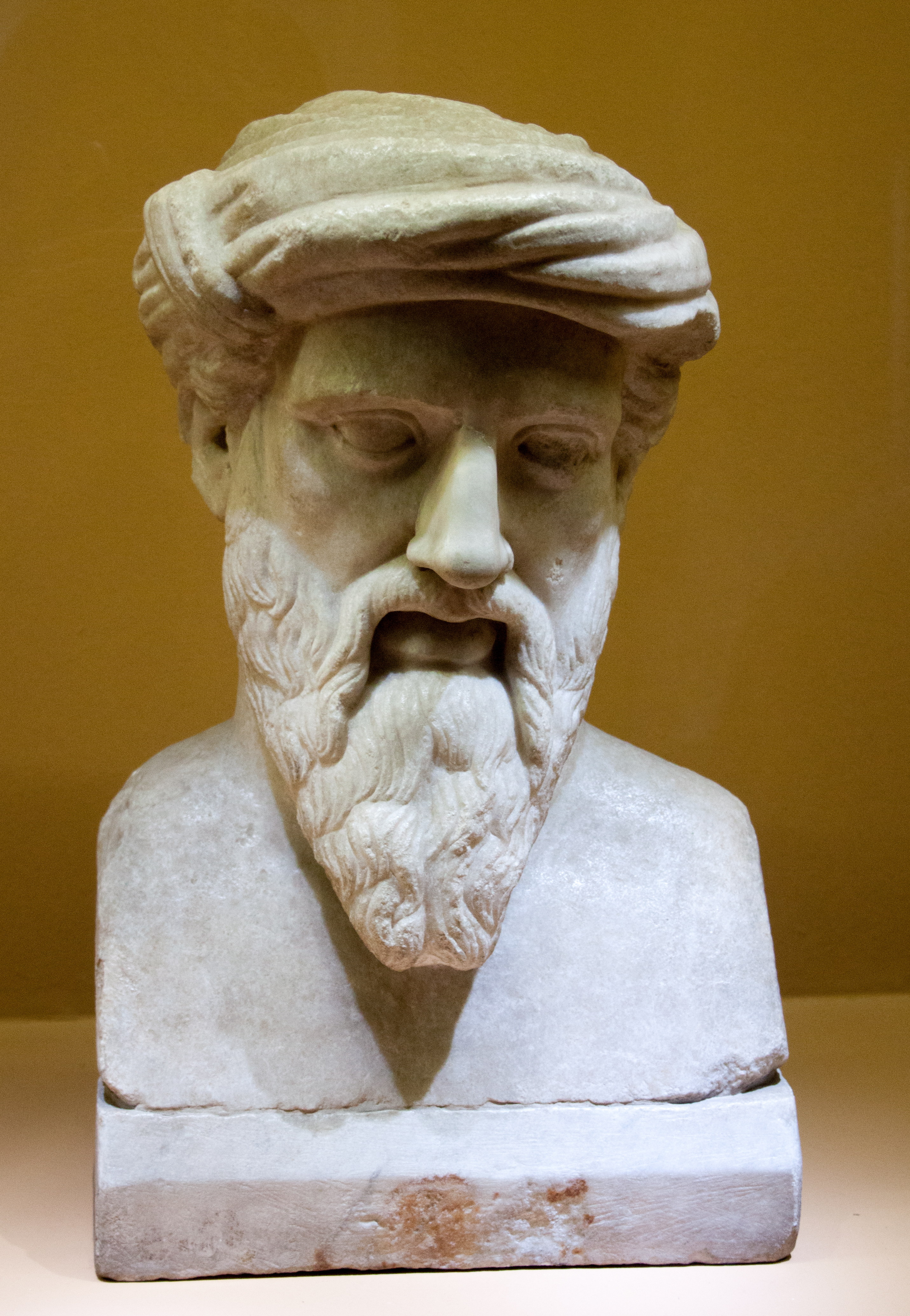

Overview
Picture a man whose very name is a password to every geometry classroom on Earth, yet whose personal life is so cloaked in secrecy that scholars still argue over whether he was a single genius or an entire movement. That is Pythagoras of Samos, the ancient Ionian Greek philosopher who, around 530 BC, sailed to the Italian colony of Croton and founded a commune whose initiates swore oaths of silence, shared all possessions, and believed that “all is number.” His teachings—equal parts rigorous proof and ecstatic revelation—became the intellectual bedrock for Plato, Aristotle, and, through them, the whole edifice of Western thought.
Modern historians debate almost every biographical detail, but the consensus is startling: by combining strict rational inquiry with religious discipline, Pythagoras created the world’s first multidisciplinary university. Mathematics, astronomy, music theory, medicine, and ethics were studied as a single unified cosmos expressed through ratios and harmonies. The ripple effects reach from Euclidean geometry to Newtonian physics, from Bach’s counterpoint to Einstein’s relativity.
Background & Origins
Pythagoras was born on the prosperous island of Samos around 570 BC, when the Aegean Sea was a highway of ideas between Egypt, Babylon, and the rising Greek city-states. His father, Mnesarchus, was a gem-engraver or merchant; his mother, Pythais, claimed descent from the island’s founder. Travel was in the blood: ancient sources agree that the young polymath crossed the Mediterranean to study with Phoenician priests, Chaldean star-readers, and Egyptian temple geometers. These journeys—historians place them between 550 and 535 BC—exposed him to the 3-4-5 triangle used by Egyptian rope-stretchers and the Babylonian tablet Plimpton 322, which lists Pythagorean triples centuries before his birth.
Returning to Samos, Pythagoras reportedly clashed with the island’s tyrant Polycrates and, seeking freedom to experiment with communal living, migrated westward. Around 530 BC he landed in Croton (modern Crotone), a thriving Achaean colony in Magna Graecia whose gymnasia and harbors buzzed with traders, athletes, and philosophers. There he founded the Pythagorean brotherhood, a semi-monastic society whose members wore white woolen robes, observed silence for five years, and practiced vegetarianism—rituals designed to purify the soul for abstract contemplation.
Major Achievements & Milestones
Discovery of the Pythagorean Theorem (c. 520 BC): Although Babylonians knew special cases, Pythagoras produced the first general proof that in any right triangle the square on the hypotenuse equals the sum of the squares on the other two sides: a² + b² = c². The proof appears in Euclid’s Elements I.47, attributed to the Pythagorean school.
Harmonic Ratios & Music Theory (c. 515 BC): Experimenting with a monochord, Pythagoreans discovered that pleasing musical intervals correspond to simple whole-number ratios: octave 2:1, fifth 3:2, fourth 4:3. This insight fused mathematics and aesthetics, birthing the quantitative study of acoustics.
Communal School at Croton (c. 510 BC): The brotherhood admitted women on equal terms—unprecedented in the Greek world—and pooled property so members could devote themselves to scholarship. Their curriculum included geometry, astronomy, music, gymnastics, and ethical dialectic, making it the earliest known integrated liberal-arts program.
Timeline
- c. 570 BC: Born on Samos, Ionia.
- c. 550–535 BC: Travels to Egypt and Babylon, absorbing arithmetic and astronomy.
- c. 530 BC: Migrates to Croton, founds the Pythagorean school.
- c. 510 BC: School reaches peak influence; Pythagorean legislators elected in southern Italian cities.
- c. 495 BC: Dies in Metapontum, Lucania, according to most ancient accounts.
Impact & Legacy
Pythagoras matters because he turned mathematics from a bookkeeping tool into a spiritual quest. The idea that abstract ratios govern both musical harmony and planetary motion—“the music of the spheres”—inspired Johannes Kepler to search for cosmic harmonies and led Isaac Newton to write Principia Mathematica in the same deductive style as the Pythagorean proofs. Even the very word “theory” (θεωρία) meant “a viewing” for Pythagoreans: to theorize was to behold eternal patterns behind sensory flux.
Culturally, his school’s egalitarian admission of women resurfaced in Plato’s Republic, while their vegetarianism prefigured modern ethical environmentalism. The secretive, number-obsessed brotherhood also became the template for medieval monastic orders and modern research labs where unpublished data are guarded until publication. Every time you tap a tuning fork, check a right angle with a carpenter’s square, or solve for the hypotenuse on a GPS chip, you are extending a 2,500-year-old Samian revolution.
Records & Notable Facts
- The Pythagorean theorem has been proved in more than 300 distinct ways—more than any other theorem in mathematics.
- Pythagoreans were forbidden to eat beans, possibly because black-and-white fava beans reminded them of the soul’s potential reincarnation into human or plant life.
- The tetractys—a triangular figure of ten dots arranged in four rows—was their sacred symbol, so holy that initiates swore oaths “by the discoverer of the tetractys, our friend and leader.”
> “There is geometry in the humming of the strings; there is music in the spacing of the spheres.”
> —attributed to Pythagoras by later Neoplatonists


