Overview
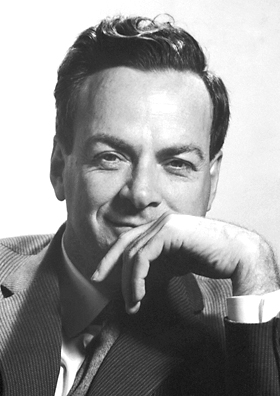
Richard Phillips Feynman transformed our understanding of reality itself. Born in 1918, this Bronx-born genius didn't just win the Nobel Prize—he reinvented how physicists think about everything from electrons to superfluid helium. His Feynman diagrams—those elegant squiggles that look like child's doodles—actually encode the mathematical machinery governing the universe's fundamental particles. When he wasn't calculating how light interacts with matter at the quantum level, he was picking locks at the Manhattan Project, seducing women in Rio de Janeiro, or teaching himself to play frangipani rhythms on Brazilian drums.
What made Feynman extraordinary wasn't just his physics—though his work on quantum electrodynamics (QED) remains the most accurate theory in science, predicting electron properties to one part in a trillion. It was his insistence that nature's deepest truths should be explainable to anyone willing to listen. As he famously declared, "If you can't explain it to a freshman, you don't really understand it." This philosophy made him the 20th century's greatest science communicator, inspiring millions through books like Surely You're Joking, Mr. Feynman! and his legendary introductory physics lectures at Caltech.
Background & Origins
Richard Phillips Feynman entered the world on May 11, 1918, in Far Rockaway, Queens, to Jewish immigrant parents Melville, a sales manager, and Lucille, a homemaker who had dreamed of becoming a doctor. Young Richard's scientific awakening came at age 11 when a friend asked him: "You know, you can do algebra with electricity?" This simple question sparked a lifelong obsession with understanding how things work. By 15, he'd taught himself calculus and was repairing radios throughout his neighborhood, earning the nickname "the boy who fixes radios by thinking."
At MIT, Feynman initially declared mathematics as his major before switching to physics, graduating in 1939 with a perfect score on the graduate physics entrance exam—an unprecedented achievement. Princeton offered him a graduate fellowship, but with a catch: as Feynman later recalled, "They wrote me a letter saying that they normally wouldn't give fellowships to Jews, but in my case they would make an exception." At Princeton, under John Archibald Wheeler, he developed his revolutionary path integral formulation of quantum mechanics, proposing that particles take every possible path simultaneously—a mind-bending concept that would later earn him the Nobel Prize.
Major Achievements & Milestones
Path Integral Formulation (1942): While completing his PhD thesis, Feynman developed an entirely new way to think about quantum mechanics. Instead of particles following single trajectories, he showed they explore all possible paths simultaneously, with each path weighted by a complex amplitude. This approach, though mathematically equivalent to Schrödinger's wave equation, provided deeper insights into quantum behavior and became essential for modern quantum field theory.
Manhattan Project (1943-1945): At Los Alamos, the 25-year-old Feynman led the theoretical division's computing section, overseeing IBM punched-card calculations for the atomic bomb. He famously cracked safes containing classified documents for sport, later explaining: "I got a reputation for being able to open safes, which was completely false. I could only open safes whose owners had been careless." His wife Arline, hospitalized with tuberculosis, died in June 1945 while he worked on the bomb—a tragedy that profoundly shaped his humanistic worldview.
Quantum Electrodynamics (1948): Feynman's greatest scientific triumph came with his reformulation of QED, the theory describing how light interacts with matter. His Feynman diagrams—simple line drawings where straight lines represent electrons and wavy lines represent photons—turned nightmarish calculations into intuitive visual recipes. These diagrams predicted the electron's magnetic moment to unprecedented accuracy: 1.00115965246 Bohr magnetons, matching experiment to 12 decimal places.
Superfluid Helium Theory (1954): Feynman explained the bizarre behavior of liquid helium-4 below 2.17 Kelvin, where it flows without viscosity through the tiniest channels. He showed this superfluidity emerges from quantum mechanical effects operating on a macroscopic scale, with helium atoms forming a coherent quantum state.
Parton Model (1968): When experiments at SLAC revealed surprising behavior inside protons, Feynman proposed they contained point-like constituents he called "partons"—later identified as quarks and gluons. This insight proved crucial for developing quantum chromodynamics, the theory of strong nuclear forces.
Timeline
- 1918: Born May 11 in Far Rockaway, New York
- 1939: Graduates MIT, publishes first paper on molecular forces
- 1942: Receives Princeton PhD, marries Arline Greenbaum
- 1943: Joins Manhattan Project at Los Alamos
- 1945: Arline dies of tuberculosis; Trinity test succeeds
- 1948: Presents QED reformulation at Pocono Conference
- 1950: Joins Caltech faculty, begins 35-year tenure
- 1952: Marries Mary Louise Bell (divorced 1956)
- 1960: Marries Gweneth Howarth, has son Carl
- 1965: Shares Nobel Prize with Schwinger and Tomonaga
- 1968: Proposes parton model for proton structure
- 1979: Publishes Surely You're Joking, Mr. Feynman!
- 1986: Serves on Challenger disaster investigation commission
- 1988: Dies February 15 in Los Angeles of cancer
Impact & Legacy
Feynman's influence extends far beyond his Nobel Prize. His Feynman Technique—learn by teaching, identify gaps, simplify, and repeat—has become a cornerstone of modern pedagogy. His insistence on scientific integrity, exemplified by his declaration that "The first principle is that you must not fool yourself—and you are the easiest person to fool," remains the gold standard for researchers. The Feynman Lectures on Physics, initially delivered to Caltech freshmen in 1961-63, continue selling 100,000+ copies annually, introducing new generations to physics with unparalleled clarity.
Perhaps his greatest legacy lies in demonstrating that profound scientific insight and playful curiosity aren't incompatible. Whether explaining why rubber bands work through molecular vibrations or demonstrating the Challenger O-ring failure with a glass of ice water, Feynman showed that understanding nature deepens rather than diminishes its wonder. As he once reflected: "Nature uses only the longest threads to weave her patterns, so each small piece of her fabric reveals the organization of the entire tapestry." This vision—that nature's deepest truths are simultaneously simple and profound—continues inspiring scientists to look beyond equations to the elegant reality they describe.