




**
Overview
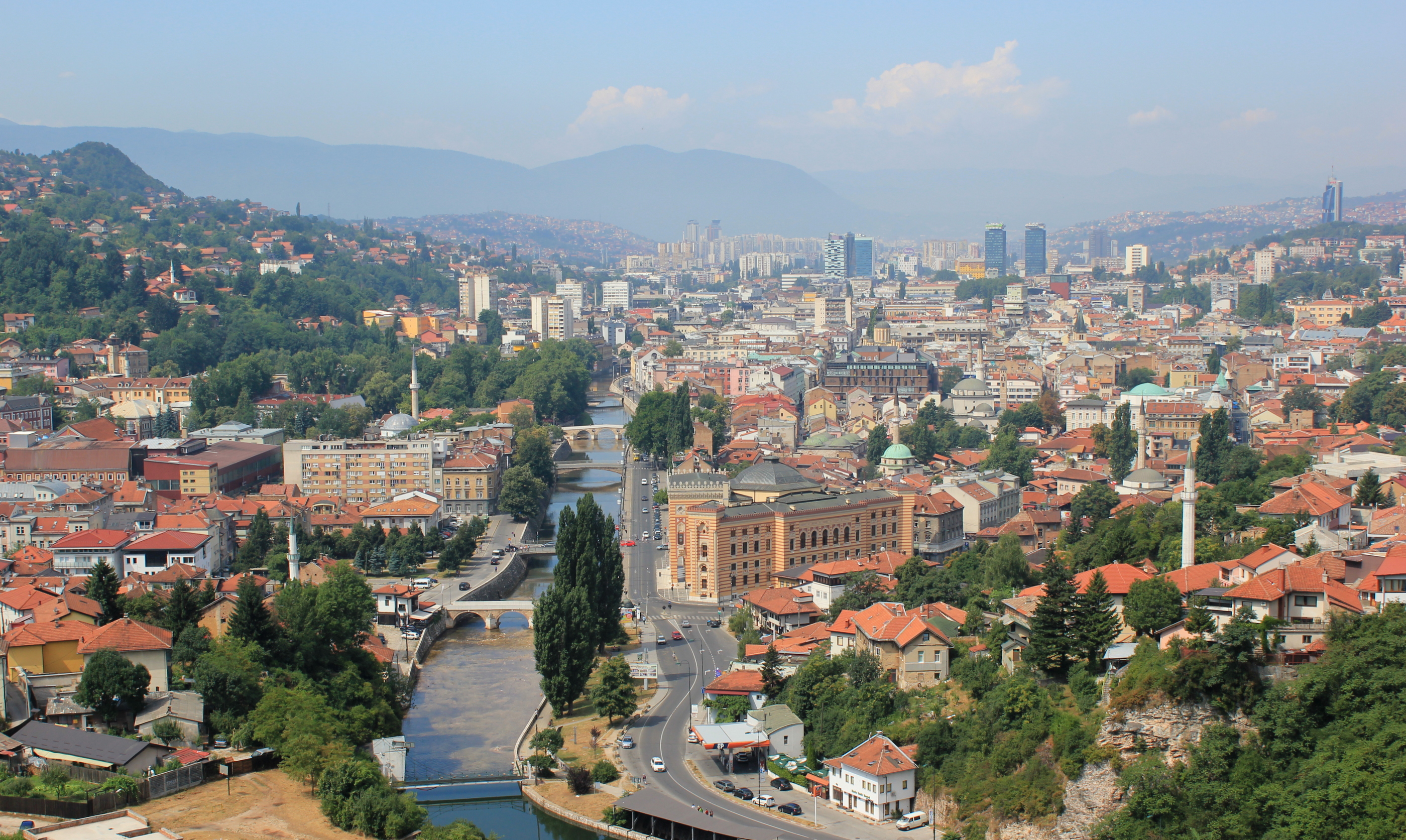
Sarajevo, the capital and largest city of Bosnia and Herzegovina, lies at the crossroads of East and West in the Sarajevo Valley of the Dinaric Alps. With 275,524 residents within its administrative limits and 413,593 in the broader Sarajevo Canton, it is a bustling metropolis that balances a compact urban core with sprawling hillside neighborhoods. The Miljacka River threads through the city, its banks lined with Ottoman bazaars, Austro‑Hungarian boulevards, and modern cafés, creating a vivid tapestry of architectural styles that reflect centuries of cultural interchange.The city’s geography—situated at an elevation of roughly 500 m (1,640 ft) and hemmed in by mountains such as Trebević, Bjelašnica, and Jahorina—has shaped both its climate and its character. Winters are crisp and snowy, making Sarajevo a premier destination for winter sports, while summers are mild, inviting festivals, street markets, and riverfront promenades. Its strategic position in the Balkans has historically rendered Sarajevo a gateway between the Ottoman Empire and Central Europe, a role that continues to influence its multilingual, multi‑religious populace.
History/Background
Sarajevo’s origins trace back to 1461, when the Ottoman general Isa-Beg Ishaković founded a fortified settlement called Vrhbosna. The city quickly grew into a vibrant Islamic cultural centre, featuring mosques, hammams, and the famed Baščaršija bazaar. In 1878, following the Congress of Berlin, Austro‑Hungarian administration took over, ushering in a wave of European urban planning, stone‑paved streets, and neoclassical buildings. This dual heritage earned Sarajevo the nickname “the Jerusalem of Europe,” reflecting its historic coexistence of Muslims, Orthodox Christians, Catholics, and Jews.The 20th century cemented Sarajevo’s global profile. In 1914, the assassination of Archduke Franz Ferdinand by Gavrilo Princip—a Bosnian Serb nationalist—sparked World War I. Decades later, the city hosted the 1984 Winter Olympics, showcasing its alpine surroundings and modern infrastructure. However, the breakup of Yugoslavia brought tragedy: from 1992 to 1996, Sarajevo endured the longest siege of a capital city in modern warfare, resulting in extensive damage, loss of life, and a profound humanitarian crisis. Post‑war reconstruction has transformed the city into a symbol of resilience and reconciliation.
Key Information
- Population (2023): 275,524 (city proper); 413,593 (Sarajevo Canton) - Area: 141.5 km² (54.6 sq mi) for the city; 1,276 km² for the canton - Elevation: ~500 m (1,640 ft) above sea level - River: Miljacka, 21 km long, runs through the historic centre - Languages: Bosnian, Croatian, Serbian (official); English widely spoken in tourism - Religious sites: Gazi Husrev‑Bey Mosque, Cathedral of the Sacred Heart, Sarajevo Synagogue, Old Orthodox Church - Cultural institutions: National Museum of Bosnia and Herzegovina, Sarajevo Film Festival, Sarajevo Summer Festival - Transport: International Airport (SJJ), Sarajevo‑Tram network, major railway hub linking Belgrade, Zagreb, and Split - Economy: Services (government, education, tourism), manufacturing (metal, textiles), growing IT sectorSignificance
Sarajevo’s importance extends far beyond its size. As a political capital, it houses the Presidency of Bosnia and Herzegovina, the Parliament, and numerous international diplomatic missions, making it a focal point for post‑war governance and European integration. Culturally, the city embodies a rare interfaith harmony, where a single street can host a mosque, a church, and a synagogue within minutes’ walk—an everyday testament to its pluralistic legacy.The 1984 Winter Olympics placed Sarajevo on the world stage, promoting winter tourism that still thrives on the nearby ski resorts of Bjelašnica and Jahorina. Conversely, the Siege of Sarajevo has become a powerful symbol of civilian endurance, inspiring countless works of literature, film, and humanitarian advocacy. The city’s post‑conflict reconstruction—marked by restored historic façades, new cultural venues, and a vibrant café culture—demonstrates how societies can rebuild while honoring their layered past.
Today, Sarajevo is a living laboratory for scholars of urban resilience, multicultural coexistence, and transitional justice. Its universities attract students from across the Balkans, while its festivals draw artists worldwide, reinforcing its role as a cultural bridge between East and West. In an era of increasing geopolitical tension, Sarajevo’s story of survival, dialogue, and renewal offers a hopeful blueprint for cities confronting division and change.
INFOBOX:
- Name: Sarajevo
- Type: Capital city / Cultural hub
- Date: Founded 1461 (modern capital since 1992)
- Location: Sarajevo Valley, Bosnia and Herzegovina, Balkans
- Known For: Ottoman‑Austro‑Hungarian heritage, 1984 Winter Olympics, longest siege of a capital city, multicultural coexistence
TAGS: Bosnia and Herzegovina, Capital cities, Balkans, History, Culture, Tourism, Olympics, Siege


