




**
Overview
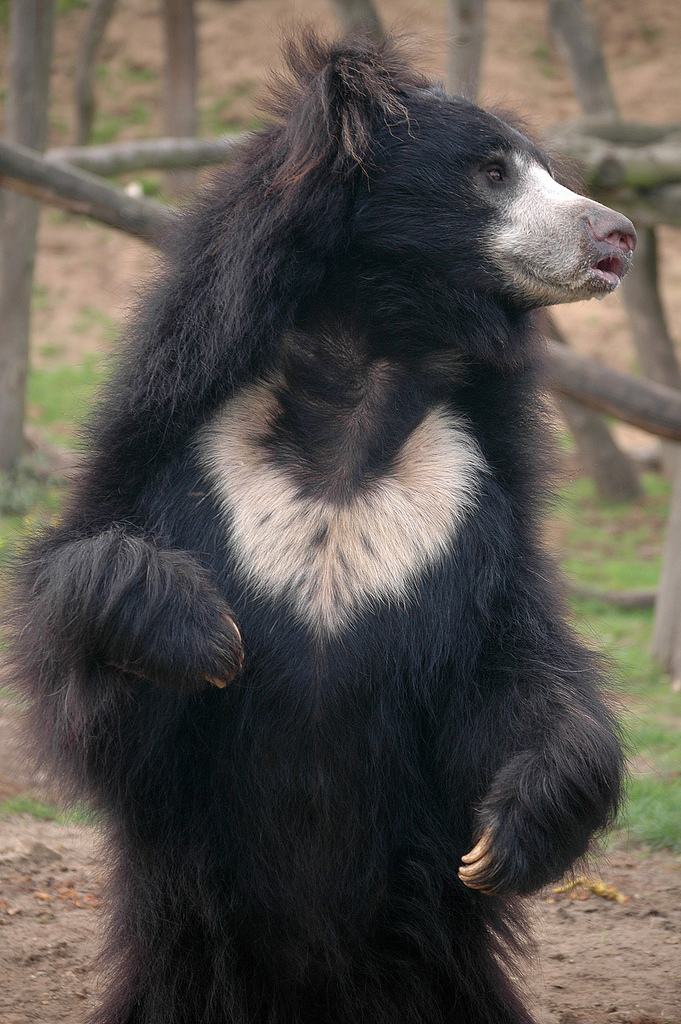
The sloth bear, often called the Indian bear, is a medium‑sized ursid distinguished by its shaggy black coat, a distinctive white or yellowish “V”‑shaped mark on the chest, and a long, mobile snout adapted for probing insect nests. Unlike its more carnivorous relatives, this bear has evolved a diet that is myrmecophagous—primarily feeding on ants, termites, and a variety of seasonal fruits. Its powerful forelimbs and long, curved claws allow it to tear open termite mounds, while a specialized, papillae‑lined palate filters out insects from the ingested material.
Sloth bears inhabit a mosaic of forest types across India, Sri Lanka, Bangladesh, and Nepal, ranging from dry deciduous woodlands to moist tropical forests and even scrub‑savanna edges. They are largely solitary, with females accompanied only by cubs, and are primarily nocturnal, a behavioral adaptation that reduces encounters with humans and diurnal predators. Their vocal repertoire includes a characteristic “huff‑snort” used for communication and a surprisingly loud, resonant roar that can travel several kilometers in dense forest.
History/Background
The taxonomic journey of the sloth bear began in the early 19th century when British naturalist John Edward Gray described the species as Ursus ursinus in 1825. Subsequent morphological studies highlighted its unique dentition—reduced molars and enlarged premolars—prompting Murray to erect the monotypic genus Melursus in 1844. Fossil records are sparse, but molecular clock analyses suggest that Melursus diverged from the common ancestor of the Asian black bear (Ursus thibetanus) and the sun bear (Helarctos malayanus) roughly 5–7 million years ago, coinciding with the uplift of the Himalayas and the expansion of tropical forests in South Asia.In the colonial era, sloth bears were captured for use in “bear-baiting” and as exotic curiosities, leading to a precipitous decline in some local populations. The first concerted conservation effort emerged in the 1970s with the establishment of Project Tiger’s peripheral zones, which inadvertently protected sloth bear habitats. The species was formally listed as Vulnerable on the IUCN Red List in 2008, reflecting ongoing threats from habitat fragmentation, poaching for body parts, and human‑bear conflict in agricultural landscapes.
Key Information
- Scientific name: Melursus ursinus - Size: Adults weigh 55–115 kg; shoulder height 70–100 cm. - Diet: Up to 70 % insects (ants, termites); seasonal fruits such as mango, jackfruit, and berries supplement protein and carbohydrate intake. - Reproduction: Gestation lasts ~210 days; litters typically consist of one cub, occasionally two. Cubs remain with the mother for 2–3 years, learning foraging techniques. - Habitat: Prefers mixed deciduous‑evergreen forests, but also occupies scrub, grassland, and plantation edges. Elevational range from sea level to 1,500 m. - Conservation status: IUCN Vulnerable; population trend decreasing. Major threats include deforestation for agriculture, road expansion, and retaliatory killings. - Behavioral adaptations: Nocturnal activity, strong olfactory sense, and the ability to stand on hind legs to reach higher termite mounds.Significance
The sloth bear plays a pivotal ecological role as a seed disperser and insect population regulator. By consuming large quantities of termites and ants, it helps maintain soil aeration and nutrient cycling, indirectly supporting forest health. Its fruit consumption facilitates the spread of seeds across fragmented landscapes, aiding forest regeneration. Moreover, the species serves as an umbrella species; protecting sloth bear habitats safeguards a host of co‑occurring flora and fauna, from elusive leopards to endemic orchids.Culturally, the sloth bear features in folklore across the subcontinent, symbolizing strength and resilience. Its charismatic yet misunderstood nature offers a compelling platform for community‑based conservation programs that blend traditional knowledge with modern wildlife management. Successful mitigation of human‑bear conflict—through measures such as electric fencing, beehive fences, and compensation schemes—demonstrates how coexistence can be achieved, providing a model for other large carnivore conservation initiatives.
INFOBOX:
- Name: Sloth bear (Melursus ursinus)
- Type: Mammal – Ursidae (bear family)
- Date: Described scientifically in 1825 (Gray)
- Location: Indian subcontinent – India, Sri Lanka, Bangladesh, Nepal, Bhutan (historical)
- Known For: Unique myrmecophagous diet and solitary nocturnal habits
TAGS: sloth bear, Melursus ursinus, Indian wildlife, myrmecophagy, vulnerable species, conservation, seed dispersal, human‑wildlife conflict


