




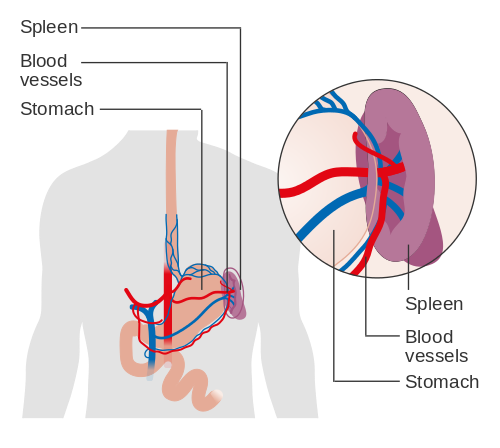
Spleen
SUMMARY: The spleen is a vital organ found in almost all vertebrates, acting primarily as a blood filter and playing a crucial role in the immune system.
Overview
The spleen is a vital organ found in almost all vertebrates, including humans, and is located in the upper left region of the abdomen, beneath the diaphragm. It is a soft, spongy, and highly vascular organ, weighing approximately 150 grams in adults. The spleen is similar in structure to a large lymph node and is composed of two main types of tissue: red and white pulp. The red pulp is responsible for filtering the blood, removing old or damaged red blood cells, and recycling the iron from these cells. The white pulp, on the other hand, is composed of lymphoid cells and plays a key role in the immune system, helping to defend the body against infections.
The spleen performs several important functions, including filtering the blood, storing red blood cells, and acting as a reservoir for immune cells. It also plays a role in the production of antibodies and the activation of immune cells, such as T-cells and B-cells. In addition, the spleen helps to remove pathogens, such as bacteria and viruses, from the blood and prevents them from entering the bloodstream. The spleen is also involved in the production of blood cells, including red blood cells, white blood cells, and platelets.
History/Background
The spleen has been known to humans for thousands of years, with ancient civilizations recognizing its importance in the body. The Greek physician Hippocrates (460-370 BCE) is credited with being the first to describe the spleen in detail, noting its role in filtering the blood and storing red blood cells. The Roman physician Galen (129-216 CE) also wrote extensively on the spleen, describing its structure and function in detail. In the Middle Ages, the spleen was believed to be responsible for a range of diseases, including melancholy and epilepsy. It wasn't until the 17th century that the spleen was recognized as a vital organ, playing a crucial role in the immune system.
Key Information
* Location: The spleen is located in the upper left region of the abdomen, beneath the diaphragm.
* Function: The spleen acts primarily as a blood filter, removing old or damaged red blood cells and recycling the iron from these cells.
* Structure: The spleen is composed of two main types of tissue: red and white pulp.
* Size: The spleen weighs approximately 150 grams in adults.
* Blood supply: The spleen receives its blood supply from the splenic artery and returns blood to the body through the splenic vein.
* Lymphatic system: The spleen is connected to the lymphatic system, helping to defend the body against infections.
Significance
The spleen plays a crucial role in the immune system, helping to defend the body against infections and diseases. It also plays a key role in the production of blood cells, including red blood cells, white blood cells, and platelets. The spleen is also involved in the removal of pathogens, such as bacteria and viruses, from the blood. In addition, the spleen helps to regulate the amount of red blood cells in the body, removing old or damaged cells and recycling the iron from these cells.
INFOBOX:
- Name: Spleen
- Type: Organ
- Date: Ancient civilizations recognized the importance of the spleen
- Location: Upper left region of the abdomen
- Known For: Filtering the blood and storing red blood cells
TAGS: spleen, blood filter, immune system, lymphatic system, red blood cells, white blood cells, platelets, blood cells, organ.



