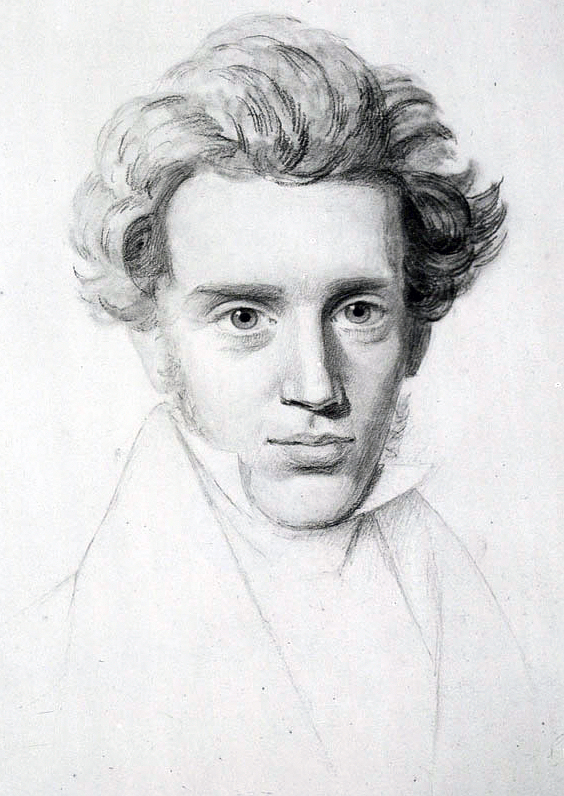
Overview
Søren Aabye Kierkegaard stands as the enigmatic “father of existentialism,” yet throughout his life he styled himself simply as “a singular individual” writing to disturb comfortable Christians. Prolific, poly-pseudonymous, and deliberately paradoxical, he produced twenty-odd major works—ranging from lyrical meditations to satirical polemics—between 1843 and 1855. His constant theme: lived, passionate inwardness outweighs doctrinal systems and institutional pieties. Against the rationalist optimism of Hegel, Kierkegaard championed the irreducible drama of personal choice, dramatizing how every human being must appropriate ethical and religious truth in time, fear, trembling, and love.
Kierkegaard’s authorship is famously double-edged. Signed texts such as Works of Love expound Christian ethics, while parallel pseudonymous writings—Johannes Climacus, Johannes de silentio, Vigilius Haufniensis—stage contrasting life-views for the reader to confront. This “maieutic” method (Socratic midwifery) refuses to hand over conclusions; instead, readers are compelled to confront their own existence, freedom, and responsibility before God. The result is a body of work that fuses philosophy, psychology, devotional literature, and social criticism into a unique genre of “existential communication.”
History/Background
Born in Copenhagen (5 May 1813) to a wealthy hosier whose pietism and perceived divine punishment colored the household, Kierkegaard was the youngest of seven. His father’s melancholy and the early deaths of five siblings seeded the son’s lifelong preoccupation with sin, guilt, and mortality. After theological studies at the University of Copenhagen, Kierkegaard broke an engagement with Regine Olsen (1841), an event that crystallized his conviction that solitary vocation and ethical transparency sometimes collide. Between 1843 (
Either/Or) and 1846 (
Concluding Unscientific Postscript) he produced an astonishing burst of pseudonymous texts, followed by signed Christian discourses and the
Attack upon Christendom (1854-55). He died in hospital (11 Nov 1855) after a spinal collapse, refusing final communion from Denmark’s established church.
Key Information
-
Stages of Life-View: Kierkegaard maps three “spheres of existence”—the aesthetic (pleasure-seeking), the ethical (duty-bound), and the religious (faith beyond rational ethics). Each stage is not merely conceptual but a qualitative mode of choosing oneself.
-
Anxiety & Despair: In
The Concept of Anxiety and
The Sickness unto Death he anticipates modern psychology, defining anxiety as “the dizziness of freedom” and despair as misrelation between the finite/infinite or self’s refusal to ground identity in God.
-
Leap of Faith: Faith is not intellectual assent but a passionate commitment that embraces the paradox of the eternal entering time (Christ) and trusts the “absurd” possibility beyond reason’s closure.
-
“Truth is Subjectivity”: Objective uncertainty held in passionate inwardness constitutes highest truth for the existing individual, a thesis that profoundly influenced 20th-century existentialists.
-
Critique of Mass Culture: He coined “the public” as an abstract phantom leveling genuine individuality, foreseeing modern media and herd mentality.
-
Stylistic Devices: Irony, parables, diaries, and pseudonymous masks create “indirect communication,” forcing readers to appropriate truth existentially rather than theoretically.
Significance
Kierkegaard’s insistence that authentic existence demands personal appropriation reshaped philosophy, theology, literature, and psychotherapy. His analyses of dread, authenticity, and the “single individual” prefigure Heidegger’s
Dasein, Sartre’s radical freedom, and Tillich’s ontological theology. Protestant neo-orthodoxy (Barth, Brunner) borrowed his critique of cultural religion, while secular existentialists secularized his categories of choice and despair. Psychologists from Carl Jung to Rollo May integrate his phenomenology of anxiety into therapeutic practice. Contemporary ethicists mine
Works of Love for a relational model that binds self-emptying love to equality and neighbor responsibility. Across disciplines, Kierkegaard remains the paradigmatic thinker of subjectivity, showing that the gravest philosophical problem is not what we know but who we decide to become.