




**
Overview
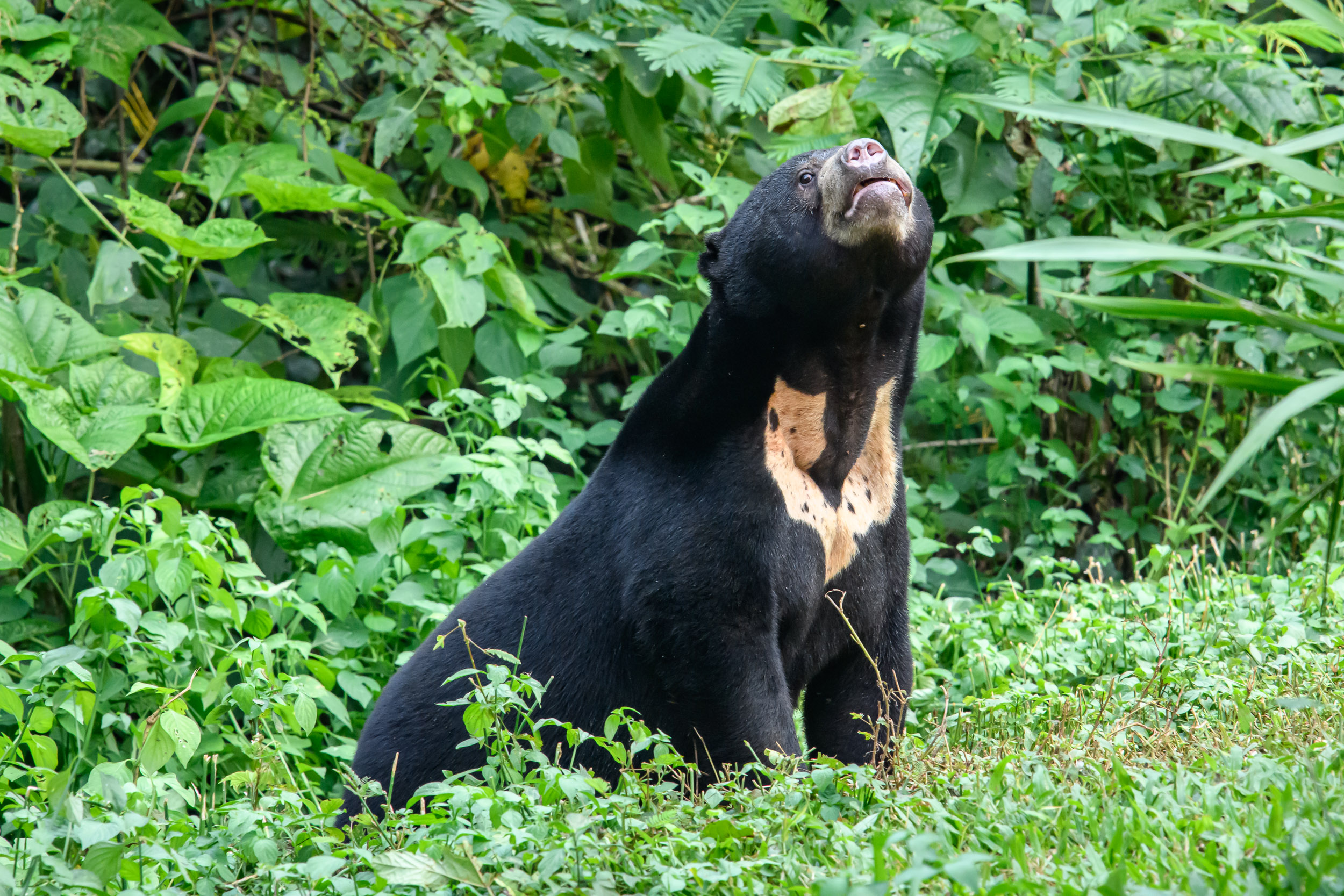
The sun bear is a compact, stockily built member of the family Ursidae, standing just under 70 cm (28 in) at the shoulder and weighing between 25–65 kg (55–143 lb). Its anatomy reflects a life spent climbing and foraging in the canopy: large, plantigrade paws equipped with strongly curved claws, a short snout, and small, rounded ears that reduce snagging on foliage. The fur is typically short and jet‑black, though regional variants may appear greyish or reddish; the most striking feature is the bright orange‑to‑cream “sunburst” patch on the chest, from which the species derives its common name.Primarily nocturnal, sun bears are omnivorous opportunists. Their diet includes ripe figs, honey, insects (especially termites and ants), small vertebrates, and occasional carrion. The powerful forelimbs and elongated claws enable them to tear open rotting logs and termite mounds, while a long, extensible tongue—up to 20 cm (8 in)—extracts honey and insects from narrow crevices. Socially, they are largely solitary, with overlapping home ranges that are defended through scent marking and vocalizations such as low growls and hisses.
Habitat loss, poaching for bile and the illegal pet trade, and conflict with humans have placed the sun bear on the IUCN Red List as Vulnerable. Conservation programs across Malaysia, Indonesia, Thailand, and Myanmar focus on habitat protection, anti‑poaching patrols, and community education to mitigate human‑bear encounters.
History/Background
The sun bear was first described scientifically by Thomas Stamford Raffles in 1821, who placed it in the monotypic genus Helarctos—a name derived from Greek “helios” (sun) and “arktos” (bear). Early naturalists noted its unusual size and behavior, distinguishing it from the larger Asian black bear (Ursus thibetanus) and the sloth bear of the Indian subcontinent.Throughout the 19th and early 20th centuries, sun bears were hunted for their meat, fur, and especially their bile, which is used in traditional Asian medicine. The expansion of rubber and palm‑oil plantations in the mid‑20th century accelerated habitat fragmentation, pushing populations into ever‑smaller forest patches. By the 1990s, conservationists recognized the species’ rapid decline, prompting the first coordinated Sun Bear Conservation Action Plan in 1999, which outlined habitat corridors, captive‑breeding protocols, and community‑based monitoring.
Recent genetic studies (2018–2023) have revealed three distinct subspecies corresponding to the Sundaic, Indochinese, and Bornean regions, underscoring the need for region‑specific management strategies.
Key Information
- Scientific name: Helarctos malayanus - Size: 60–70 cm at shoulder; 25–65 kg body mass. - Distinctive feature: Bright orange‑cream chest patch (“sunburst”). - Diet: Fruit, honey, termites, ants, small mammals, carrion. - Reproduction: Mating occurs year‑round; gestation ~95 days; litters of 1–2 cubs. - Lifespan: Up to 25 years in the wild, longer in captivity. - Habitat: Lowland and hill tropical rainforests, peat swamps, and mangroves across Malaysia, Indonesia, Thailand, Myanmar, Laos, Vietnam, and Cambodia. - Conservation status: IUCN Vulnerable; population trend decreasing. - Threats: Deforestation, illegal hunting for bile and pet trade, human‑bear conflict, climate‑induced habitat shifts. - Conservation actions: Protected area networks, anti‑poaching units, community‑based ecotourism, and ex‑situ breeding programs at institutions such as the Sun Bear Conservation Centre in Sabah, Malaysia.Significance
The sun bear serves as an umbrella species for Southeast Asian lowland forests; protecting its habitat safeguards countless other taxa, from orangutans to countless invertebrates. Its role as a seed disperser—particularly for figs and other large‑fruiting trees—helps maintain forest regeneration and structural complexity. Moreover, the bear’s unique foraging behavior, especially honey extraction, offers insights into mammalian adaptations for exploiting high‑energy resources in dense canopies.Culturally, the sun bear appears in folklore across the region, symbolizing strength and resilience. Its striking chest patch has inspired local art and tourism, providing economic incentives for communities to preserve forested landscapes. By focusing conservation resources on the sun bear, NGOs and governments can address broader environmental challenges such as illegal logging, biodiversity loss, and climate change, making the species a linchpin for sustainable development in the Indo‑Malayan biodiversity hotspot.
INFOBOX:
- Name: Sun Bear (Helarctos malayanus)
- Type: Mammal – Smallest bear species
- Date: First described 1821
- Location: Tropical forests of Southeast Asia (Malaysia, Indonesia, Thailand, Myanmar, Laos, Vietnam, Cambodia)
- Known For: Smallest bear, distinctive orange‑cream chest patch, powerful forelimbs for honey and termite extraction
TAGS: Sun bear, Ursidae, Southeast Asia, conservation, tropical forest, wildlife biology, endangered species, mammalogy


