




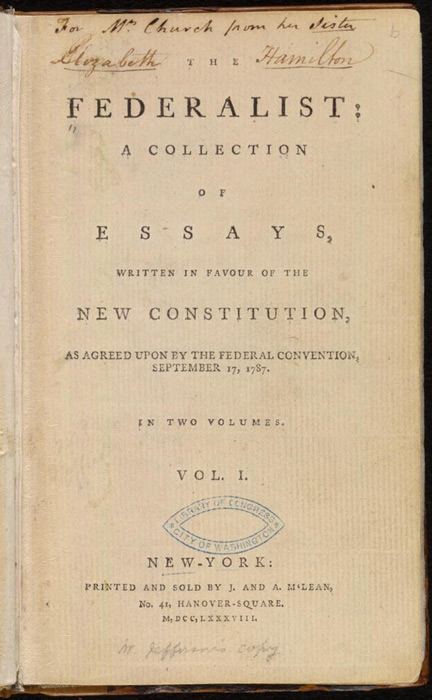
The Federalist Papers are a series of eighty‑five essays published between 1787 and 1788 that argue in favor of the newly drafted United States Constitution. Written by Alexander Hamilton, James Madison, and John Jay under the collective pseudonym “Publius,” the essays were originally printed in New York newspapers and later compiled into a single volume. The papers address the weaknesses of the Articles of Confederation, explain the proposed structure of the federal government, and respond to contemporary anti‑federalist criticisms. Though intended for a 18th‑century audience, the essays have become a foundational source for constitutional interpretation and are frequently cited by courts, scholars, and policymakers.
The Federalist essays were instrumental in shaping public opinion during the ratification debates in the state conventions, particularly in New York, where the essays were most widely read. Over time, the collection acquired its modern name in the nineteenth century, and its influence expanded beyond the original political purpose to become a central component of American legal and political thought.
Historical context and purpose
The Constitutional Convention of 1787 produced a document that replaced the Articles of Confederation, but the new Constitution required approval by nine of the thirteen states to become operative. Opposition coalesced around concerns that the proposed government would be too centralized, threaten individual liberties, and lack adequate checks on power. In response, Federalist supporters organized a coordinated campaign to persuade skeptical citizens and state legislators.Hamilton, Madison, and Jay—each a prominent figure in the revolutionary era—agreed to write a series of persuasive essays that would articulate the philosophical underpinnings and practical benefits of the Constitution. Their work was intended to counter the anti‑federalist pamphlets circulating at the time, such as those by Patrick Henry, George Clinton, and the “Letters from the Federal Farmer.” By publishing the essays in the Independent Journal and the New‑York Packet, the authors aimed to reach a broad readership and to provide a systematic defense of the proposed government.
Authorship and publication
The three authors contributed in varying proportions: Hamilton wrote 51 essays, Madison 29, and Jay 5. Hamilton’s prolific output reflects his belief that a strong central government was essential for national stability, while Madison’s contributions focus on the separation of powers and the system of checks and balances. Jay’s essays, the first three in the series, address foreign affairs and the need for a unified diplomatic posture.The essays were released anonymously, with each installment signed only by “Publius,” a reference to the Roman consul Publius Valerius Publicola, a symbol of republican virtue. The anonymity allowed the arguments to be judged on their merits rather than on the authors’ personal reputations. The first essay appeared on October 27, 1787; the final one, “The Same Subject Continued,” was published on May 28, 1788. In 1788 the essays were collected and printed in a single volume titled The Federalist, which was later reissued in multiple editions.
Content and major themes
The Federalist Papers cover a wide range of topics, organized into 14 distinct groups that correspond to the sections of the Constitution. Key themes include:* Federalism – Essays such as No. 23 and No. 39 explain the division of authority between national and state governments, arguing that a strong central government is compatible with state sovereignty.
* Separation of powers – Papers No. 47, No. 48, and No. 51 articulate the necessity of distinct legislative, executive, and judicial branches to prevent tyranny.
* Checks and balances – Madison’s No. 51 famously describes how each branch “has a will of its own” and can check the others, ensuring that “ambition must be made to counteract ambition.”
* Republicanism and representation – In No. 10 and No. 14, Madison discusses the dangers of factionalism and argues that a large republic can better control the “mischiefs of faction.”
* Judicial review – While the term does not appear, No. 78 anticipates the power of the judiciary to invalidate unconstitutional laws, laying groundwork for later Supreme Court doctrine.
The essays also address practical concerns such as taxation, the standing army, the executive veto, and the Bill of Rights. Although the original Constitution did not include a Bill of Rights, several Federalist essays (e.g., No. 84) argue that the Constitution’s structure already protects individual liberties, a position that later proved contentious during the ratification process.
Influence on ratification and constitutional interpretation
The Federalist Papers were circulated among delegates to state ratifying conventions, most notably in New York, where the essays were read aloud and debated. Their systematic exposition of the Constitution’s design helped persuade a majority of New York delegates, leading to the state’s ratification on July 26, 1788. Similar influence was felt in other states, where the essays were referenced in pamphlets, speeches, and newspaper editorials.In the centuries that followed, the Federalist Papers became a primary source for interpreting the Constitution. The U.S. Supreme Court has cited the essays in landmark decisions, including Marbury v. Madison (1803), McCulloch v. Maryland (1819), and United States v. Lopez (1995). Justice Antonin Scalia famously described the papers as “the most persuasive evidence” of the framers’ intent, though scholars caution that the essays reflect the views of only three of the sixty‑six delegates.
Legacy and modern scholarship
The collection’s reputation grew during the nineteenth century, when historians such as Henry St. John Graham and scholars of American political thought began to treat the essays as a cohesive work. In the twentieth century, the Federalist Papers were incorporated into university curricula, and new critical editions—most notably the 1961 The Federalist edited by Clinton Rossiter—provided annotated texts and historical context.Contemporary scholarship examines the Federalist Papers through various lenses: political theory, rhetorical analysis, and legal historiography. Recent studies explore the essays’ role in shaping early American party formation, their influence on the development of federalism in other nations, and the gendered language that reflects eighteenth‑century assumptions. Digital humanities projects have produced searchable databases, enabling quantitative analysis of word frequency and authorship attribution.
The Federalist Papers remain a touchstone for debates over constitutional meaning, federal authority, and the balance between liberty and order. Their continued citation in legal opinions, academic works, and public discourse underscores their enduring relevance to American governance.



