




**
Overview
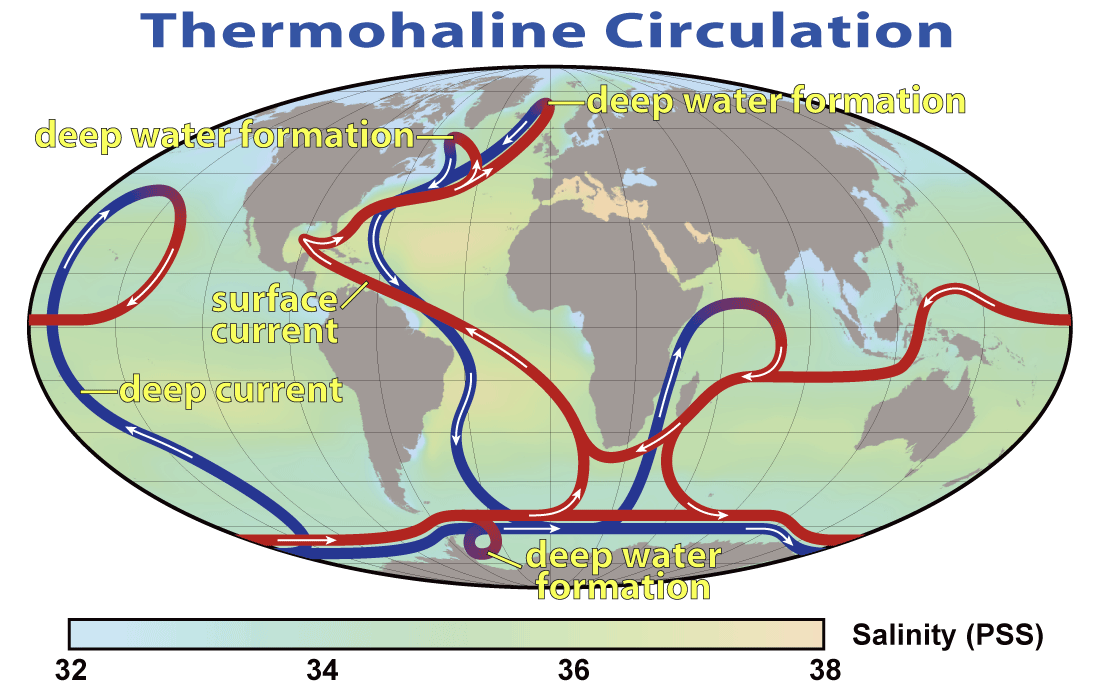
Thermohaline circulation (often abbreviated THC) constitutes the deep‑water component of the planet’s oceanic conveyor belt. While wind‑driven surface currents dominate the upper few hundred meters, THC operates through the density gradients that arise when surface waters are cooled or become saltier, causing them to sink and flow along the ocean floor. These sinking regions—most notably the North Atlantic near Greenland and the Southern Ocean around Antarctica—feed a slow but massive global loop that can take thousands of years to complete a full circuit.The term “thermohaline” fuses thermo‑ (temperature) and haline (salinity), the two primary controls on seawater density. Warm, low‑salinity water is light and remains near the surface, while cold, high‑salinity water becomes heavy enough to plunge to the abyssal plains. As water masses travel through the deep ocean, they gradually mix, exchange heat with the overlying layers, and eventually upwell in regions where surface waters are heated or freshened, restarting the cycle. This continuous exchange of heat, carbon, nutrients, and dissolved gases links distant marine habitats and regulates Earth’s climate on decadal to millennial timescales.
History/Background
The concept of a global oceanic conveyor belt emerged in the mid‑20th century. In 1933, Vagn Walfrid Ekman first described how wind stress could generate deep currents, but it was Walter Munk and Henry Stommel in the 1950s who introduced the idea that density‑driven flows could dominate the deep ocean. The seminal “global thermohaline circulation” model was formalized by Wally Broecker in 1970, who famously likened the system to a “global oceanic pump” and highlighted its role in transporting heat from the tropics to the poles.Subsequent decades saw the integration of THC into climate models. The IPCC reports of 1990 and 2001 underscored its sensitivity to anthropogenic warming, while the Argo float program (launched in 2000) began delivering real‑time temperature and salinity profiles that confirmed many theoretical predictions. In 2015, a landmark study using satellite gravimetry revealed a measurable slowdown in Atlantic deep‑water formation, sparking renewed research into how melting ice sheets might alter the circulation.
Key Information
- Driving forces: Surface heat loss, evaporation, precipitation, and ice formation/melt create spatial variations in temperature and salinity, establishing density gradients. - Major cells: The Atlantic Meridional Overturning Circulation (AMOC), the Southern Ocean overturning, and the Pacific deep‑water pathways are the primary components of THC. - Flow rates: Approximately 15–20 Sverdrups (1 Sv = 10⁶ m³ s⁻¹) of water move through the AMOC alone, comparable to the discharge of the Amazon River multiplied by a million. - Timescales: Deep‑water parcels can remain in the abyss for 1,000–2,000 years, while surface‑to‑deep exchange cycles operate on decadal scales. - Climate linkages: THC transports ~1 PW (petawatt) of heat poleward, moderating temperatures in Europe and North America; it also sequesters atmospheric CO₂ in the deep ocean for centuries. - Vulnerability: Freshwater influx from Arctic melt, Greenland ice sheet loss, and increased precipitation can reduce seawater density, potentially weakening or re‑routing the circulation.Significance
Thermohaline circulation is a climate regulator; its stability underpins the relatively mild climate of Northwestern Europe despite its high latitude. Disruptions could trigger abrupt climate shifts, such as the Younger Dryas event 12,000 years ago, when a rapid freshwater pulse is thought to have stalled the Atlantic overturning, plunging the Northern Hemisphere into a temporary ice age.Ecologically, THC distributes nutrients from the deep ocean to surface waters, fueling primary productivity that supports global fisheries. It also controls the oxygen minimum zones that shape marine species distributions. Understanding THC is therefore essential for climate prediction, sea‑level rise assessments, and sustainable resource management. As the planet warms, monitoring the circulation with autonomous floats, satellite gravimetry, and deep‑sea moorings becomes a priority for scientists and policymakers alike.
INFOBOX:
- Name: Thermohaline Circulation (Global Ocean Conveyor Belt)
- Type: Oceanic circulation system driven by density gradients
- Date: Conceptualized 1970 (Broecker’s model) – ongoing research
- Location: Global, with key formation zones in the North Atlantic and Southern Ocean
- Known For: Regulating Earth’s climate, transporting heat and carbon, and linking marine ecosystems
TAGS: oceanography, climate change, marine circulation, density-driven flow, Atlantic Meridional Overturning Circulation, global warming, carbon cycle, marine ecology


