Overview
The Zhou dynasty stretched across nearly eight centuries, an unrivaled longevity that allowed it to evolve from a hard-edged conquest regime into the intellectual crucible of classical China. Its founders, the Ji clan, claimed a Mandate of Heaven—moral authority granted by celestial forces—that not only justified their overthrow of the Shang but also introduced the idea that rulers serve at the pleasure of moral order rather than mere heredity. During the Western Zhou (c. 1046–771 BC) the kings commanded a feudal web of walled cities garrisoned by kinsmen, while bronze ritual vessels, grand suburban sacrifices, and a standardized royal calendar projected authority across the Yellow River heartland. After the court was forced eastward to Luoyang in 771 BC, real power fragmented among some 150 rivalrous states; yet the Zhou house survived symbolically, its calendar still used, its rituals still studied, and its once-obscure vassals—Qi, Jin, Qin, Chu—now the incubators of philosophy, commerce, and total war.Eastern Zhou (771–256 BC) is itself split into the Spring and Autumn period (771–476 BC), when aristocratic codes of chariot warfare and diplomatic courtesy masked slow central decline, and the Warring States era (475–256 BC), when mass infantry, iron weapons, and bureaucratic reform rendered the old rituals decorative. Out of this turbulence emerged the Hundred Schools: Confucius, Laozi, Mozi, Mencius, Sunzi, and the Legalists who would ultimately tutor the First Emperor of Qin. Thus the Zhou bequeathed not only the longest continuous dynastic narrative in world history but also the intellectual DNA of every subsequent Chinese empire.
History/Background
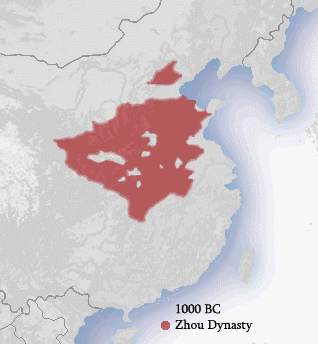
Proto-Zhou people were a mixed agrarian-pastoral group inhabiting the Wei River valley under Shang overlordship. King Wen (d. 1050 BC) quietly expanded irrigation, married strategically, and cast oracle-bone slogans that denounced Shang decadence. His son King Wu led the decisive battle of Muye (trad. 1046 BC) where Shang chariots defected and the last Shang ruler immolated himself. The regent Duke of Zhou consolidated the conquest by dispatching royal brothers to garrison key points—Yan near modern Beijing, Lu in Shandong, Wei in Hebei—creating a decentralized but kin-anchored polity. Bronze inscriptions of the Kang–Mu kings (c. 1000–950 BC) boast of campaigns against northern Gui-fang and southern Huaiyi, securing the North China Plain.In 771 BC the Quanrong killed King You at Mount Li; his son Pingwang fled east, inaugurating the Eastern Zhou. Royal domains shrank to a 200-li enclave around Luoyang, while former vassals became de facto kings. Yet the Zhou court still certified regional rulers, mediated succession disputes, and preserved ritual archives. By the fourth century BC the seven “warring states” had professionalized war: Qin introduced universal military service; Chu fielded million-man armies; Qi minted knife-coinage to fund siege engineers. The last Zhou king, Nanwang, died in 256 BC; his domain was annexed by Qin, whose king would proclaim himself First Emperor only thirty-five years later.