



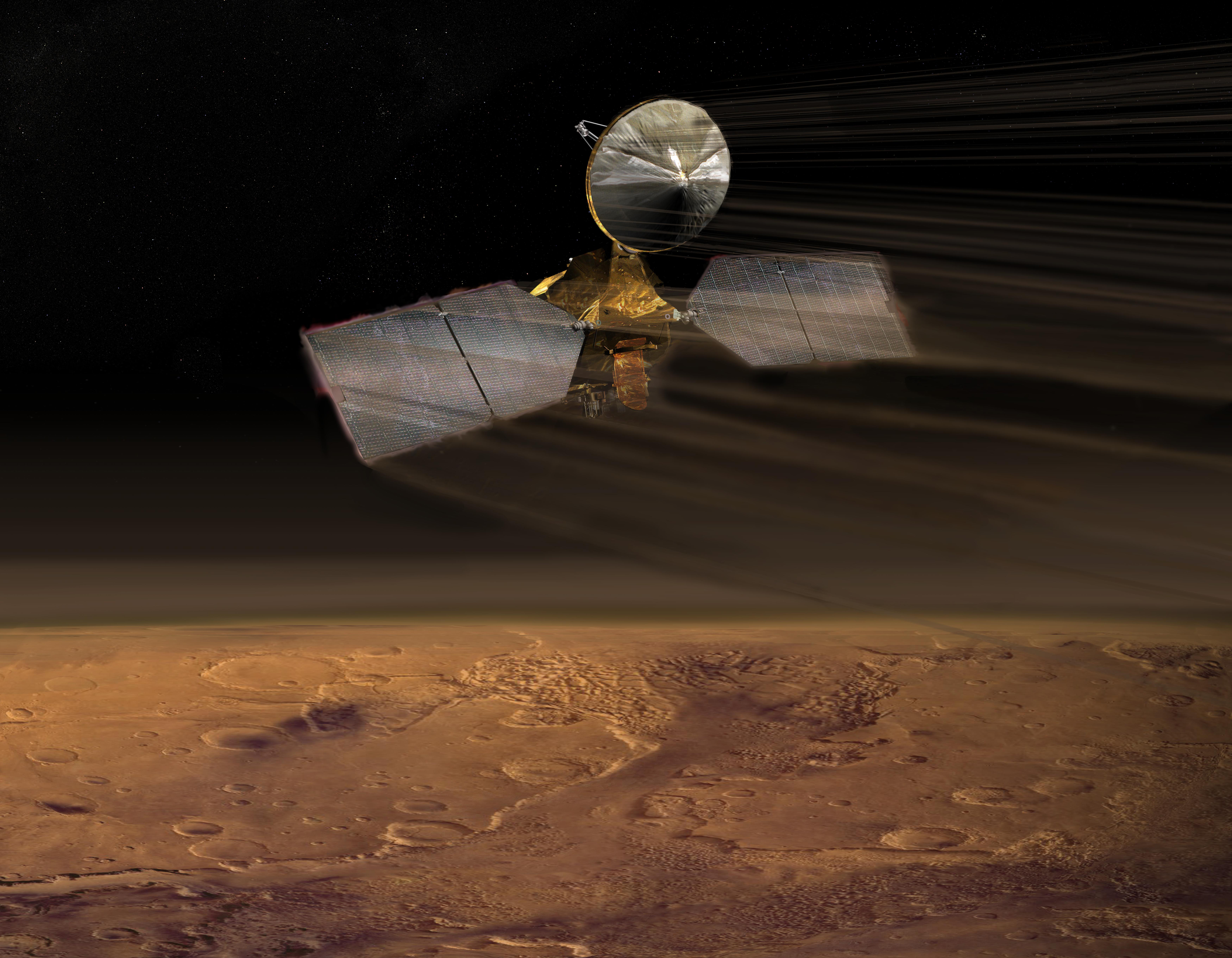

Aerobraking
SUMMARY: Aerobraking is a spaceflight maneuver that utilizes atmospheric drag to slow down a spacecraft and reduce its orbit, requiring less fuel than traditional propulsion methods.
Overview
Aerobraking is a crucial technique used in space exploration to reduce the high point of an elliptical orbit, making it possible for spacecraft to enter a stable, low-orbit trajectory around a celestial body with an atmosphere. This maneuver involves flying the spacecraft through the atmosphere at the low point of its orbit (periapsis), where atmospheric drag slows it down, gradually reducing its orbital velocity. By exploiting the atmospheric drag, aerobraking allows spacecraft to achieve a lower orbit without expending large amounts of fuel, which would be necessary using traditional propulsion methods.
Aerobraking is often used when a spacecraft requires a low orbit after arriving at a body with an atmosphere, such as a planet or moon. This technique is particularly useful for spacecraft that need to enter a stable orbit for scientific research, communication, or exploration purposes. By reducing the high point of the orbit, aerobraking enables spacecraft to achieve a more stable and efficient orbit, which is essential for extended missions.
History/Background
The concept of aerobraking dates back to the 1960s, when NASA scientists first proposed using atmospheric drag to slow down spacecraft. However, it wasn't until the 1990s that aerobraking became a viable technique for space exploration. The first successful aerobraking mission was the Mars Global Surveyor (MGS), which entered orbit around Mars in 1997. The MGS spacecraft used aerobraking to reduce its orbit from 6,500 km to 350 km, demonstrating the effectiveness of this technique.
Since then, aerobraking has been used in several space missions, including the Mars Reconnaissance Orbiter (MRO) and the Mars Science Laboratory (Curiosity Rover). These missions have successfully utilized aerobraking to enter stable orbits around Mars, enabling scientists to conduct extensive research and exploration.
Key Information
- Key Dates: 1960s (concept proposal), 1990s (first successful mission), 1997 (Mars Global Surveyor)
- Orbit Reduction: Aerobraking can reduce the high point of an elliptical orbit by up to 90%
- Fuel Savings: Aerobraking can save up to 90% of fuel compared to traditional propulsion methods
- Atmospheric Conditions: Aerobraking requires a specific atmospheric density and temperature profile to be effective
- Spacecraft Design: Aerobraking requires a spacecraft design that can withstand atmospheric drag and heat generated during entry
Significance
Aerobraking has revolutionized space exploration by providing a fuel-efficient method for entering stable orbits around celestial bodies with atmospheres. This technique has enabled scientists to conduct extensive research and exploration on Mars and other planets, expanding our understanding of the solar system. Aerobraking has also opened up new possibilities for space missions, allowing spacecraft to enter orbits that were previously inaccessible.
INFOBOX:
- Name: Aerobraking
- Type: Spaceflight maneuver
- Date: 1960s (concept proposal), 1990s (first successful mission)
- Location: Various celestial bodies with atmospheres (Mars, Venus, etc.)
- Known For: Fuel-efficient method for entering stable orbits around celestial bodies with atmospheres
TAGS: Spaceflight, Aerodynamics, Atmospheric Science, Space Exploration, Mars Exploration, Planetary Science, Spacecraft Design, Orbital Mechanics


