




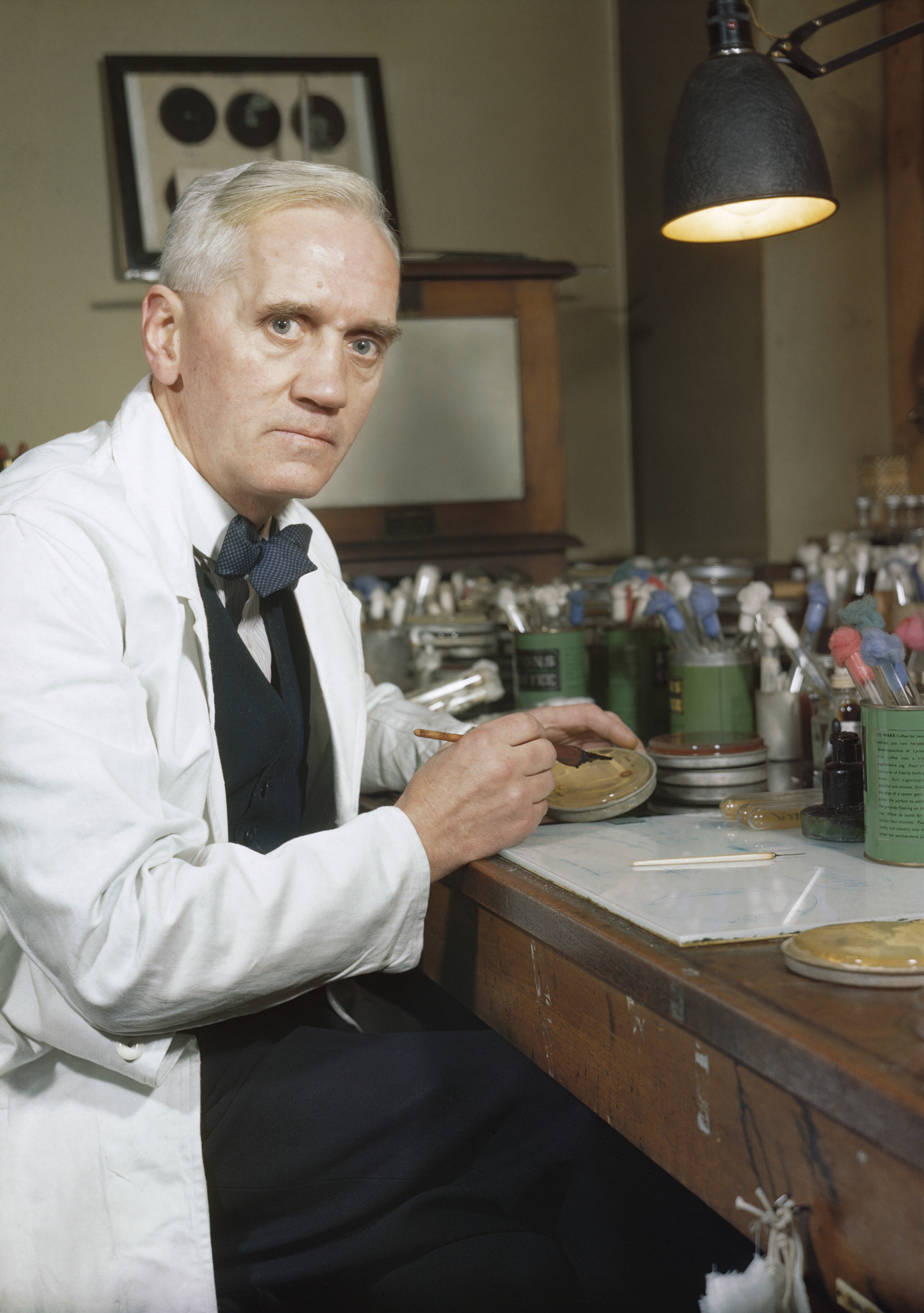
Alexander Fleming
Sir Alexander Fleming was a Scottish physician and microbiologist who discovered the first antibiotic substance, penicillin, in 1928. This groundbreaking discovery revolutionized the treatment of bacterial infections and saved countless lives. Fleming's discovery of penicillin, along with the work of Howard Florey and Ernst Chain, led to the development of penicillin as a medicine and earned him the 1945 Nobel Prize in Physiology or Medicine.
Fleming's discovery of penicillin was a serendipitous event that occurred when he observed that a mold, later identified as Penicillium rubens, had contaminated one of his bacterial cultures. The mold had produced a substance that killed off the surrounding bacteria, and Fleming realized the potential of this discovery. He isolated the substance, which he named penicillin, and began to study its properties and effects.
Fleming's work on penicillin was initially met with skepticism by the scientific community, but his discovery eventually gained recognition and led to further research and development. The development of penicillin as a medicine was a collaborative effort between Fleming, Florey, and Chain, who worked together to purify and standardize the substance. The first clinical trials of penicillin were conducted in 1941, and the results were nothing short of miraculous.
Early Life
Alexander Fleming was born on August 6, 1881, in Darvel, Ayrshire, Scotland, to Hugh and Sarah Fleming. He was the third of four children, and his family was of Scottish and Irish descent. Fleming's early life was marked by a strong interest in science and medicine, which was encouraged by his parents. He attended the Royal Polytechnic Institution in London, where he studied science and medicine, and later attended St. Mary's Hospital Medical School.
Career
Fleming's career as a microbiologist began in 1906, when he joined the Inoculation Department at St. Mary's Hospital in London. He worked under the supervision of Sir Almroth Wright, a renowned microbiologist, and began to develop his skills in the field. In 1914, Fleming joined the British Army Medical Corps and served in World War I, where he was stationed in France and Egypt. After the war, he returned to St. Mary's Hospital and continued his research in microbiology.
In 1928, Fleming made his groundbreaking discovery of penicillin, which he observed in one of his bacterial cultures. He isolated the substance and began to study its properties and effects, but his work was initially met with skepticism by the scientific community. It wasn't until the 1940s, when Florey and Chain began to work on purifying and standardizing penicillin, that the substance began to gain recognition as a medicine.
Legacy
Fleming's discovery of penicillin revolutionized the treatment of bacterial infections and saved countless lives. The development of penicillin as a medicine was a collaborative effort between Fleming, Florey, and Chain, and their work led to the creation of a new class of medicines known as antibiotics. Fleming's discovery also paved the way for further research in microbiology and the development of new treatments for infectious diseases.
Fleming was awarded the Nobel Prize in Physiology or Medicine in 1945, along with Florey and Chain, for his discovery of penicillin. He was also awarded numerous other honors and awards for his contributions to science and medicine, including the Copley Medal and the Royal Medal.
Personal Life
Fleming married Sarah McElroy in 1915, and the couple had one son, Robert. Fleming was a member of the Royal Society and served as its president from 1945 to 1948. He was also a fellow of the Royal College of Physicians and served as its president from 1943 to 1945.







