Overview
In barely a dozen years Alexander III of Macedon dismantled the 200-year-old Persian super-state, marched his army 22,000 km, and fused East and West into a new cosmopolitan world. Commanding from the front lines, he never lost a set-piece battle; instead he rewrote the playbook of siege-craft, logistics, and psychological warfare. Yet empire-building was only half the story. By planting Greek poleis from Alexandria in Egypt to Alexandria-Eschate (“Farthest”) in Tajikistan, he catalyzed the Hellenistic Age—three centuries in which Greek language, art, and science permeated Egypt, the Levant, Mesopotamia, and Iran. His premature death at 32 left a power vacuum that reshaped geopolitics, but the cultural networks he forged endured long after his bloodline failed.Background
Macedon, a rough highland kingdom north of Thessaly, had spent the reign of Philip II (359–336 BC) transforming from fractured backwater into the dominant military power of the Greek world. Philip’s phalanx—16-deep infantry armed with 5.5-m sarissa pikes—combined with an elite cavalry corps and siege engineers capable of reducing the toughest fortifications. Young Alexander, born in Pella in 356 BC, was immersed in this revolution: tutored first by Leonidas, then by Aristotle at Mieza, he absorbed Homer’s heroic ethos and the latest Ionian science. At 16 he governed Macedon while Philip campaigned; at 18 he led the left cavalry wing that shattered the Greek coalition at Chaeronea (338 BC). When Philip was assassinated in 336 BC, the 20-year-old king moved swiftly: he eliminated rivals, forced the Greek city-states—Thebes, Athens, Thessaly—back into the Corinthian League, and prepared the pan-Hellenic crusade against Persia that his father had planned.Key Facts
- 336 BC – Accession; destruction of Thebes (335 BC) secures Greek obedience
- 334 BC – Crosses Hellespont with 30,000 infantry & 5,000 cavalry; victory at Granicus River opens Asia Minor
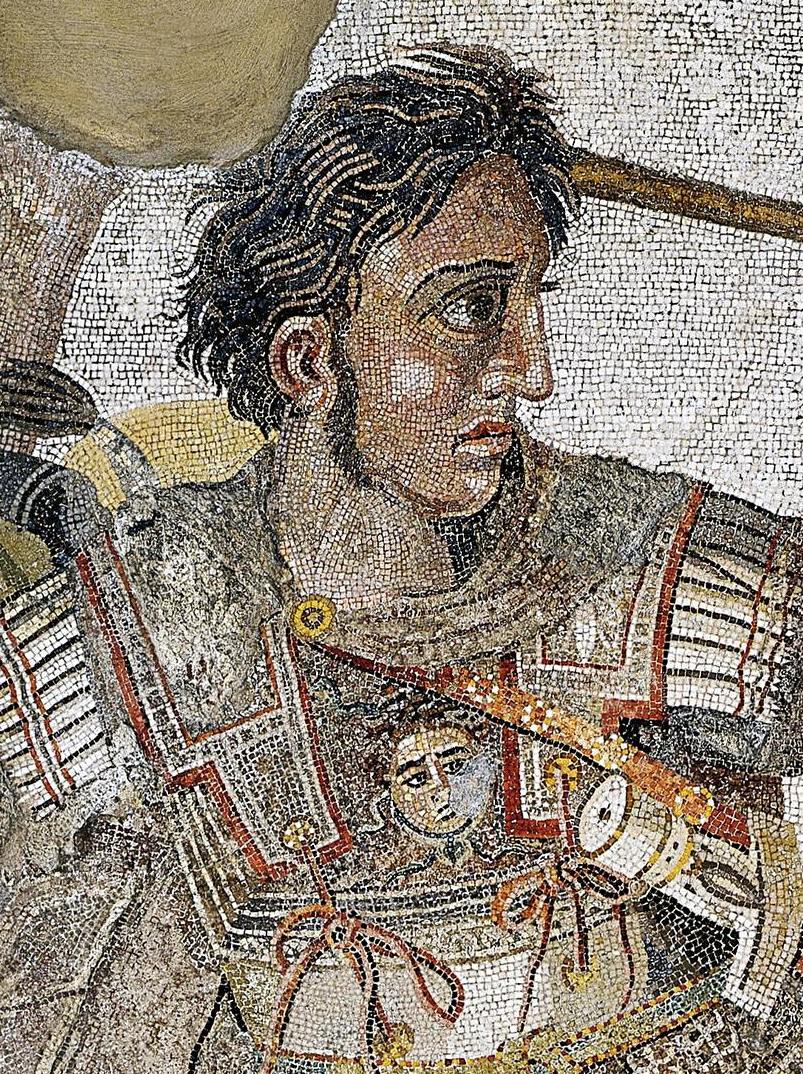
- 333 BC – Battle of Issus: first head-on clash with Darius III; Alexander’s oblique cavalry charge routs 100,000 Persians
- 332 BC – 7-month Siege of Tyre (island fortress linked by 1-km mole); Gaza falls; enters Egypt hailed as liberator
- 331 BC – Founds Alexandria; defeats Persia decisively at Gaugamela (1 October); Babylon, Susa, and Persepolis surrender
- 330–327 BC – Pursues Darius to Bactria and Sogdia; marries Roxana; adopts Persian dress and court ceremonial, provoking mutiny at Opis (324 BC)
- 326 BC – Hydaspes battle against Porus in Punjab; troops refuse to advance beyond Hyphasis (Beas) River
- 325 BC – Brutal Gedrosian desert march costs a third of the army; fleet under Nearchus sails from Indus to Persian Gulf
- 324 BC – Mass wedding at Susa; integrates 30,000 Persian “Successors” into phalanx
- 11 June 323 BC – Dies in Babylon aged 32; empire stretches 5.2 million km², 20% of world population
- 321–281 BC – Wars of the Diadochi fragment realm into Ptolemaic Egypt, Seleucid Asia, Antigonid MacedonImpact
Militarily, Alexander’s combined-arms tactics—heavy phalanx pinning the center, Companion cavalry striking at the decisive point—became the template taught at the academies of Pyrrhus, Hannibal, Caesar, and modern staff colleges. Politically, his fusion of Macedonian and Persian elites prefigured later hybrid empires (Roman, Ottoman, Mughal). Economically, the opening of sea routes between India and the Mediterranean spurred bullion flows, coin standardization, and the first truly trans-continental trade. Culturally, koine Greek emerged as the lingua franca from Sicily to the Hindu Kush, enabling the translation of Buddhist texts into Greek (the Greco-Buddhist art of Gandhara) and the transmission of Babylonian astronomy to the Mediterranean. Finally, the romance of Alexander—re-imagined in Persian, Arabic, Hebrew, and medieval European epics—became a mirror in which every age projected its ideals of heroic ambition and tragic hubris.
Tip: double-click any word in this article for an instant definition from the NerdDictionary.