
Overview
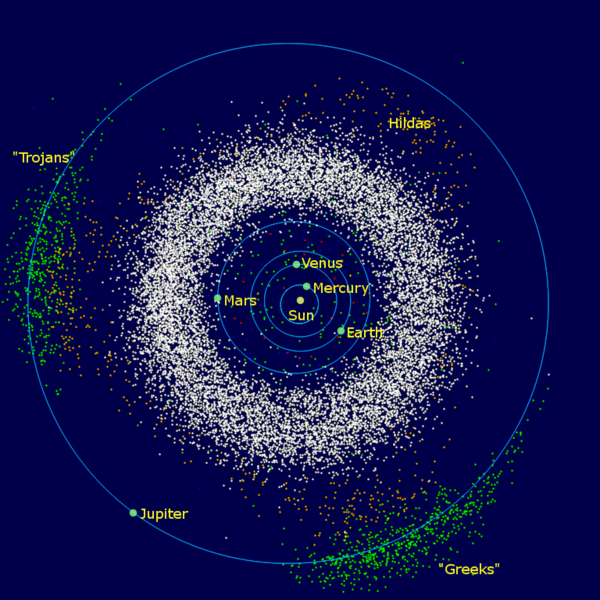
The asteroid belt is a vast, doughnut‑like region of the Solar System that lies roughly between the orbital paths of Mars (1.5 AU) and Jupiter (5.2 AU). Although it contains millions of objects ranging from dust‑sized particles to dwarf‑planet sized bodies such as Ceres, the belt is remarkably sparse; on average the distance between neighboring asteroids is about one million kilometres. This low density means that spacecraft can traverse the belt with negligible risk of collision, a fact that was dramatically demonstrated by the early Pioneer, Voyager, and later Dawn missions.The belt’s constituents are commonly referred to as asteroids, minor planets, or planetesimals. Their shapes are irregular, their compositions vary from metallic nickel‑iron to carbon‑rich silicates, and their surfaces bear the scars of billions of years of impacts. The total mass of the entire belt is estimated to be only about 4 % of the Moon’s mass, far less than the original protoplanetary material that once occupied this zone. Modern astronomers view the belt as a relic of the early Solar System—a snapshot of the building blocks that never coalesced into a full‑fledged planet.
The term main belt distinguishes this population from other asteroid groups such as the Trojan asteroids (sharing Jupiter’s orbit) and the Near‑Earth Asteroids (whose paths cross Earth’s orbit). The main belt’s inner edge is defined by the 1:4 orbital resonance with Mars, while its outer edge is set by the powerful 3:1 resonance with Jupiter, beyond which the gravitational influence of the gas giant clears material and creates the Kirkwood gaps.
History/Background
The existence of a “missing planet” between Mars and Jupiter was first hypothesized in the early 19th century when Giuseppe Piazzi discovered the first asteroid, Ceres, in 1801. Over the next few decades, a rapid succession of discoveries—Pallas (1802), Juno (1804), and Vesta (1807)—led to the notion that these objects were fragments of a destroyed planet. By the late 1800s, the term asteroid (Greek for “star‑like”) was coined to describe their point‑source appearance in telescopes.Advances in photographic plates and later CCD imaging in the 20th century expanded the catalog to thousands of bodies, revealing a size distribution that follows a power law: many small asteroids and few large ones. The Space Age provided the first close‑up observations; NASA’s Pioneer 10 (1972) and Voyager 1/2 (1977) sent back the first images of belt objects, confirming their irregular shapes and heavily cratered surfaces. The Galileo spacecraft’s 1991 flyby of Gaspra and NEAR Shoemaker’s 1998 landing on Eros marked the first in‑situ investigations. The most ambitious mission, Dawn, orbited Vesta (2011‑2012) and later Ceres (2015‑2018), delivering unprecedented compositional maps and confirming that the belt is a mixture of differentiated and primitive bodies.
Key Information
- Location: 2.1 AU – 3.3 AU from the Sun, forming a torus between Mars and Jupiter. - Population: Over 1 million cataloged asteroids > 1 km; estimates suggest billions of smaller fragments. - Mass: ≈ 4 × 10⁻⁴ M⊕ (≈ 0.04 % of Earth’s mass), dominated by Ceres (≈ 30 % of total belt mass). - Composition: Broadly divided into C‑type (carbonaceous, dark), S‑type (silicaceous, brighter), and M‑type (metallic) asteroids. - Dynamics: Shaped by resonances with Jupiter, especially the 3:1, 5:2, and 2:1 resonances that create the Kirkwood gaps; Yarkovsky thermal forces slowly drift smaller bodies into resonant zones, feeding the Near‑Earth population. - Exploration Milestones: 1972 – Pioneer 10 first spacecraft to cross the belt; 1991 – Galileo’s Gaspra flyby; 1998 – NEAR Shoemaker lands on Eros; 2011‑2018 – Dawn’s dual‑orbit mission to Vesta and Ceres. - Scientific Value: Provides clues to planetary accretion, differentiation, and the early Solar System’s temperature gradient; serves as a natural laboratory for impact physics and space resource assessment.Significance
Understanding the asteroid belt is essential for reconstructing the Solar System’s formative years. The belt’s compositional gradient—metal‑rich bodies nearer the Sun and carbon‑rich farther out—mirrors the temperature profile of the protoplanetary disk, supporting models of condensation sequences. Moreover, the belt acts as a reservoir of primitive material that has remained largely unaltered since the nebular epoch, offering a window into the chemistry that seeded the terrestrial planets.From a practical standpoint, the belt is a focal point for planetary defense and in‑situ resource utilization. Many Near‑Earth Asteroids are former belt members nudged into Earth‑crossing orbits by resonances; studying their origins improves impact‑risk assessments. Simultaneously, the abundance of metals and volatiles makes the belt a potential source of raw materials for future deep‑space missions, a concept explored in proposals for asteroid mining.
Finally, the belt’s cultural imprint—popularized by science‑fiction depictions of “asteroid fields” and the iconic image of a dense ring of rocks—has inspired generations to look outward. Its scientific richness, combined with its role in shaping both planetary science and emerging space economies, ensures that the asteroid belt will remain a cornerstone of astronomical research for decades to come.