Overview
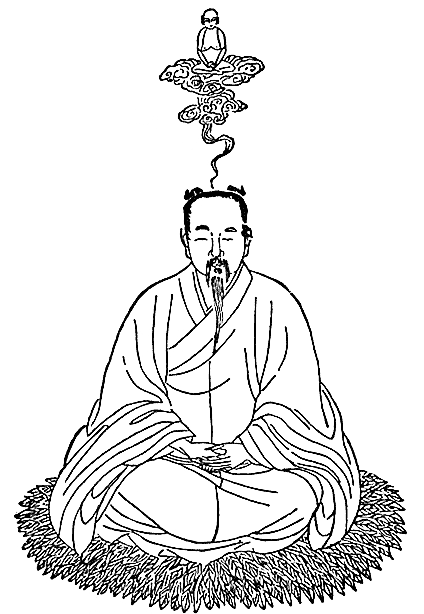
Across cultures and centuries mystics, shamans, and modern occultists have reported a singular, luminous feat: the power to slip free of the flesh and voyage beyond it. In esoteric terminology this willed out-of-body experience is called astral projection. The traveler is said to possess a duplicate anatomy—fluid, radiant, and responsive to thought alone—that can traverse walls, continents, or star-fields while the corporeal shell remains asleep or entranced. Encounters with discarnate intelligences, perusal of the “Akashic records,” and previews of one’s future physical death rank among the most frequently narrated exploits.
Western occult philosophy, drawing on Neo-Platonic and Hermetic sources, classifies the human being into a nest of ascending vehicles: the dense physical body, the etheric double (vital energy), the astral body (seat of emotion and desire), the mental body, and higher spiritual sheaths. Astral projection proper concerns the astral body’s temporary uncoupling from its denser counterparts. Techniques for achieving this uncoupling—trance, visualization, mantra, psycho-physical exhaustion followed by deliberate relaxation—form the backbone of practical occult curricula from the Theosophical Society to contemporary online “Phase” communities. Whether interpreted as a soul-journey, a brain-generated dissociative state, or a quantum non-locality event, the experience is consistently described as more vivid than ordinary dreaming and accompanied by the uncanny conviction that one is, for the moment, “more real than the real.”
Background
The lineage of intentional soul-travel reaches back to the priest-magicians of Egypt whose “ba” bird imagery prefigures the modern notion of a detachable second self. In ancient Greece the practice surfaces in the writings of Pythagoras and later in Plotinus’s Enneads, where the philosopher speaks of “the flight of the alone to the Alone.” Tibetan Buddhism’s “dream yoga” (milam) and the shamanic drum-journeys of Siberia and the Americas likewise cultivate deliberate displacement of awareness. Yet the conceptual scaffolding we now label “astral projection” crystallized only in the late nineteenth century when the Theosophical movement fused Eastern subtle-body theory with Western occult science. Helena Blavatsky’s 1888 tome The Secret Doctrine popularized the Sanskrit term linga sharira (designating the astral double) among European and American audiences hungry for empirical spirituality. By 1901 the Hermetic Order of the Golden Dawn had systematized rituals—complete with Qabalistic correspondences, Egyptian god-forms, and “Body of Light” techniques—capable, initiates claimed, of launching consciousness into supersensible worlds. The phrase “astral projection” itself entered print in the 1920s through Sylvan Muldoon and Hereward Carrington’s collaborative studies, culminating in 1929’s The Projection of the Astral Body, a work still cited by contemporary practitioners.
Key Facts
- c. 2600 BCE – Pyramid Texts describe the pharaoh’s “ba” ascending to the circumpolar stars.
- c. 500 BCE – Pythagoras allegedly demonstrates bilocation to friends in Metapontum and Tauromenium on the same day.
- 1888 – Blavatsky’s The Secret Doctrine coins modern usage of “astral body.”
- 1898 – The Golden Dawn’s “Ritual of the Body of Light” circulates among adepts.
- 1929 – Muldoon & Carrington publish case histories of 100 controlled projections.
- 1958 – Robert Monroe begins laboratory studies at the University of Virginia; 1971’s Journeys Out of the Body sells over 300,000 copies.
- 1970-73 – CIA’s Stargate Project quietly funds research into “remote viewing,” a protocol overlapping with astral projection claims.
- 1983 – International Academy of Consciousness founded in Portugal to investigate out-of-body phenomena under scientific controls.
- 2007 – Functional MRI scans of experienced projector “Alex T.” show parietal lobe deactivation consistent with autoscopic hallucination studies.
- 2020 – Global online “Phase” community claims 50,000+ practitioners exchanging daily success logs.
Impact
Astral projection functions as more than occult spectacle; it undergirds entire cosmologies. For theosophists it validated a multi-planar universe and a doctrine of reincarnation untethered to any single creed. Cold-war militaries pursued it as a potential intelligence-gathering tool, while 1960s counter-culture fused projection techniques with psychedelic exploration, birthing the New Age movement. Contemporary psychologists debate whether the phenomenon dissolves the mind-body boundary, offering a laboratory for studying consciousness without neuro-chemical interference, or merely dramatizes dissociative capacity under sensory deprivation. Meanwhile, hospice workers increasingly report terminal patients describing spontaneous OBEs that reduce death-anxiety, suggesting that the capacity to “step outside” the body may be hard-wired and therapeutically harnessed. Whether future neuroscience will translate these nocturnal voyages into verifiable data or relegate them to the twilight realm of subjective anomaly, astral projection endures as a testament to humanity’s refusal to be wholly contained by skin, space, or time.