




**
Overview
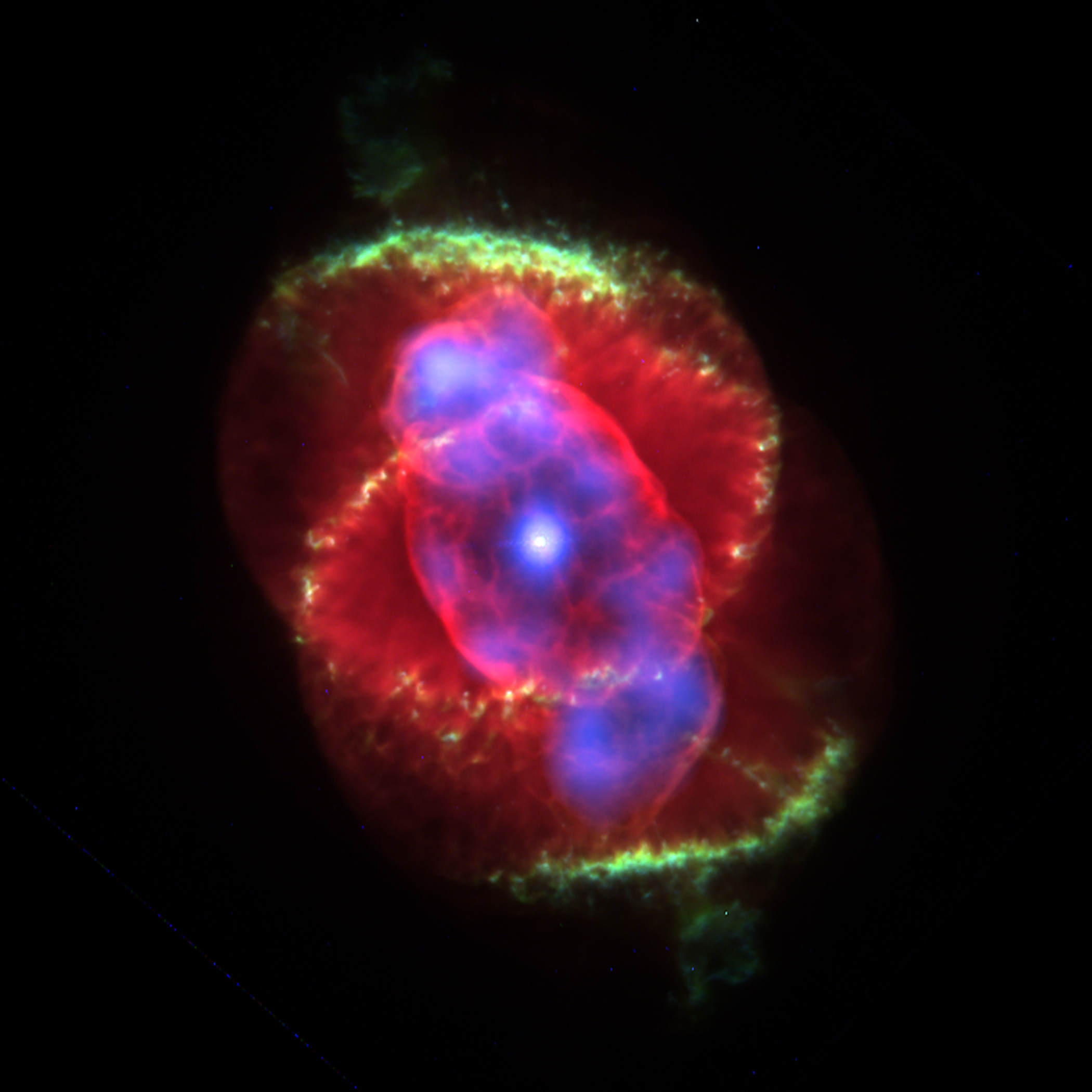
The Cat’s Eye Nebula, catalogued as NGC 6543, is a planetary nebula residing in the northern constellation Draco, roughly 3,300 light‑years from Earth. Its nickname derives from the eye‑shaped appearance of its bright inner core, surrounded by a series of concentric, almost dart‑board‑like rings that expand outward for nearly one light‑year. High‑resolution imaging—most famously from the Hubble Space Telescope (HST)—has revealed an astonishingly complex morphology: dense knots, high‑speed jets, filamentary bubbles, and delicate arcs that together trace the violent final breaths of a dying star. The nebula glows across the electromagnetic spectrum, from radio waves that map cool molecular gas to X‑ray emission that highlights shock‑heated plasma near the central star.At the heart of NGC 6543 lies a Wolf–Rayet (WR) central star, a rare, massive, and extremely hot remnant that has shed its outer layers at speeds exceeding 1,500 km s⁻¹. With an apparent magnitude of +11.4, the star is invisible to the naked eye but dominates the nebula’s ionization budget, bathing the surrounding gas in ultraviolet photons that cause it to fluoresce in vivid greens, reds, and blues. The nebular spectrum is dominated by emission lines of oxygen, nitrogen, helium, and hydrogen, a signature first identified in the 19th century and pivotal in establishing planetary nebulae as gaseous, not stellar, objects.
History/Background
The Cat’s Eye Nebula was first recorded by William Herschel on 15 February 1786, during his systematic sweep of the northern sky. Herschel noted its “planetary” appearance—a term that persisted despite the object’s true nature being far removed from planets. The nebula entered a new scientific era in 1864 when William Huggins, an English amateur astronomer, obtained its spectrum. Huggins’ analysis revealed bright emission lines, confirming that the nebula consisted of hot, low‑density gas rather than a collection of unresolved stars. This breakthrough helped cement the concept of planetary nebulae as a distinct evolutionary phase of low‑ to intermediate‑mass stars.The 20th century brought increasingly detailed observations. Early photographic plates hinted at a complex structure, but it was not until the Hubble Space Telescope captured images in the 1990s that the nebula’s full intricacy was unveiled. Subsequent observations with the Chandra X‑ray Observatory, Spitzer Space Telescope, and ground‑based radio interferometers have provided a multi‑wavelength portrait, allowing astronomers to map temperature gradients, chemical abundances, and dynamical motions within the nebula.
Key Information
- Designation: NGC 6543, also known as Cat’s Eye Nebula or PK 278+02 1. - Central Star: A Wolf–Rayet (WC‑type) star, temperature ≈ 80,000 K, mass ≈ 0.6 M☉, magnitude +11.4. - Distance: Approximately 3,300 light‑years (≈ 1 kpc). - Size: The bright inner shell spans ~ 0.3 light‑years; the outer halo extends to ~ 1 light‑year. - Morphology: Concentric rings, bipolar jets, filamentary knots, and a faint outer halo shaped by episodic mass‑loss events. - Spectral Range: Detected from radio (≈ 1 GHz) to X‑ray (≈ 2 keV); X‑ray emission traces hot gas at ~ 1 million K. - Discovery & Spectroscopy: Discovered 1786 (Herschel); first nebular spectrum 1864 (Huggins). - Research Highlights: Studies of shock fronts, chemical enrichment (enhanced nitrogen and carbon), and the role of binary interaction in shaping the nebula’s asymmetries.Significance
The Cat’s Eye Nebula serves as a benchmark for planetary‑nebula physics. Its well‑resolved structure provides a natural laboratory for testing models of stellar mass loss, wind‑wind interactions, and magnetohydrodynamic shaping. The presence of a Wolf–Rayet central star links the nebula to the broader class of massive‑star evolution, offering clues about how such stars shed their envelopes before ending as supernovae or white dwarfs. Moreover, the nebula’s multi‑wavelength data set has driven advances in instrumentation calibration, from HST’s optical cameras to Chandra’s X‑ray detectors.Historically, the nebula’s early spectroscopic study helped overturn the misconception that planetary nebulae were unresolved star clusters, paving the way for modern astrophysics to recognize them as transient, gaseous shells ejected by dying stars. Its iconic Hubble images have also captured public imagination, illustrating how complex and beautiful the death throes of stars can be, and inspiring generations of amateur and professional astronomers alike.
INFOBOX:
- Name: Cat’s Eye Nebula (NGC 6543)
- Type: Planetary Nebula
- Date: Discovered 15 February 1786 (spectroscopy 1864)
- Location: Constellation Draco, ~ 3,300 light‑years from Earth
- Known For: Intricate concentric rings, first planetary nebula with a gaseous spectrum, illuminated by a Wolf‑Rayet central star
TAGS: planetary nebula, Wolf‑Rayet star, Hubble Space Telescope, spectroscopy, Draco constellation, stellar evolution, nebular morphology, multi‑wavelength astronomy


