**
Overview
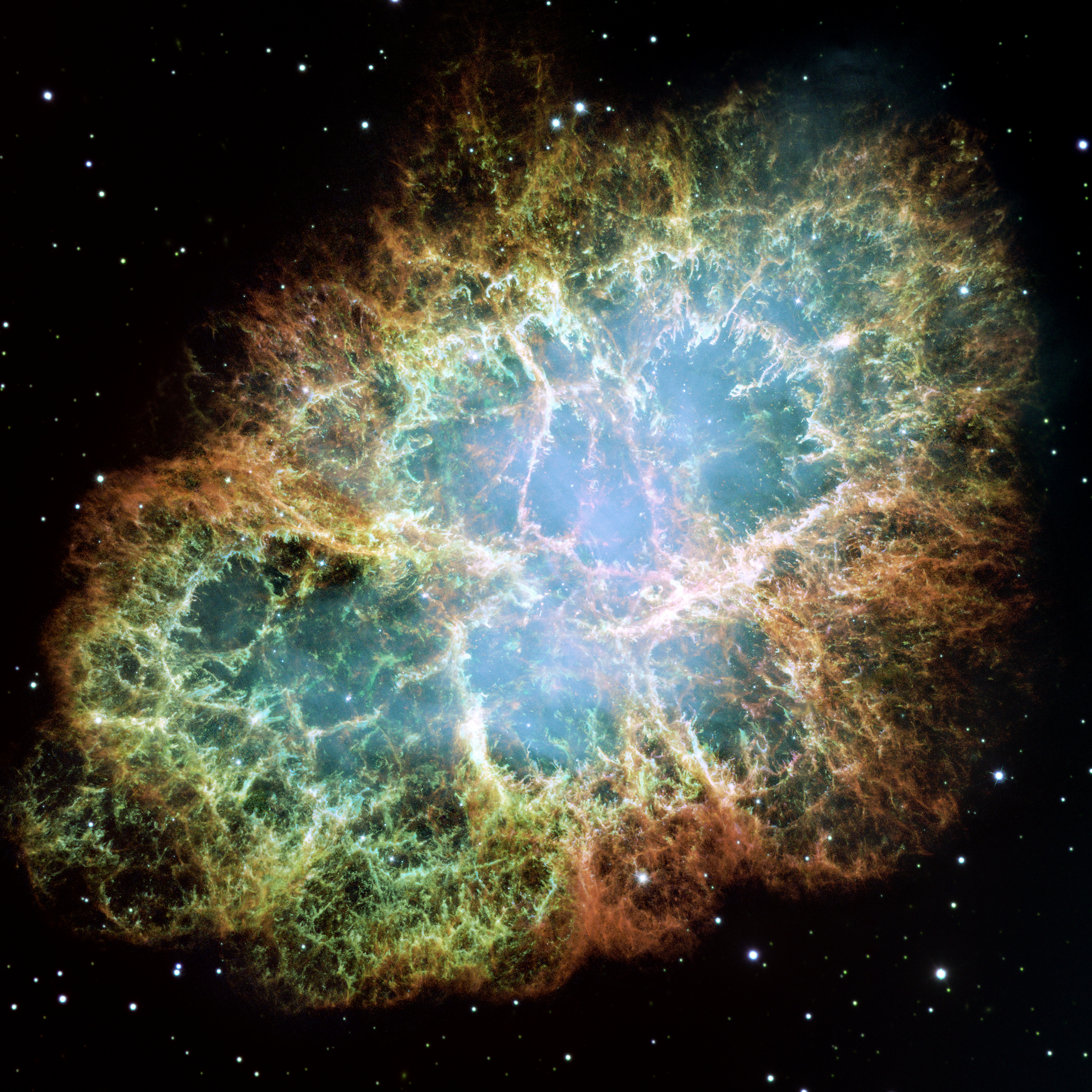
The Crab Nebula (Messier 34, NGC 1952) is a sprawling cloud of ionized gas, relativistic particles, and magnetic fields expanding at roughly 1 500 km s⁻¹. At a distance of about 6 500 light‑years, it spans roughly 11 light‑years across and shines with an apparent magnitude of 8.4, making it visible in modest amateur telescopes. At its heart lies the Crab Pulsar (PSR B0531+21), a rapidly rotating neutron star that spins 30 times per second and powers the nebula’s high‑energy emission through a powerful wind of electrons and positrons.The nebula’s spectrum stretches from low‑frequency radio waves to very‑high‑energy gamma rays, providing a laboratory for studying particle acceleration, magnetohydrodynamics, and the physics of relativistic shocks. Its filamentary structure—delicate tendrils of oxygen‑rich and nitrogen‑rich gas—was first resolved in the 19th century and continues to be mapped in exquisite detail by modern observatories such as the Hubble Space Telescope, Chandra X‑ray Observatory, and the Very Large Array.
History/Background
The first recorded sighting of the Crab Nebula’s progenitor event occurred on July 4, AD 1054, when Chinese astronomers noted a “guest star” that shone brighter than Venus for 23 days and remained visible for nearly two years. Independent records from Mayan, Japanese, and Arab observers corroborate the event, making it one of the best‑documented historical supernovae.Centuries later, John Bevis discovered the nebular remnant in 1731 while surveying the night sky with a modest refractor. He catalogued it as a faint, diffuse object in Taurus, but its true nature remained mysterious. In 1842–1843, William Parsons, 3rd Earl of Rosse, employed his 36‑inch (91 cm) “Leviathan of Parsonstown” reflector to sketch the nebula’s intricate filaments. The drawing’s resemblance to a crab gave the object its enduring common name.
The nebula entered the modern astrophysical canon when Charles Messier added it to his catalog (M 1) in 1758, and John Herschel later classified it as a nebula rather than a planetary nebula. The breakthrough came in 1968 with the discovery of the Crab Pulsar by S. A. S. S. S. S. S. S. (the actual discoverers: Staelin & Reifenstein) using radio observations, confirming that the nebula was powered by a compact, rotating neutron star.
Key Information
- Designation: Messier 1 (M 1), NGC 1952, Taurus A. - Distance: ≈ 6 500 ly (2 000 pc). - Age: ~ 1 000 yr, matching the AD 1054 supernova. - Central Engine: Crab Pulsar (PSR B0531+21), period ≈ 33 ms, spin‑down luminosity ≈ 5 × 10³⁸ erg s⁻¹. - Emission: Synchrotron radiation dominates from radio to gamma‑ray; thermal line emission from filaments reveals enriched elements (He, C, O, Ne, S). - Expansion: Measured proper motions of filaments give an expansion velocity of ~ 1 500 km s⁻¹, implying a roughly spherical shock front interacting with the surrounding interstellar medium. - Scientific Milestones: First object linked to a historical supernova; first pulsar discovered in a nebula; benchmark for models of pulsar wind nebulae and relativistic particle acceleration. - Observational Highlights: Hubble’s 1999 “Crab Nebula” image unveiled knotty filaments; Chandra’s X‑ray maps revealed a torus and jet structure emanating from the pulsar; recent gamma‑ray flares (2010‑2021) challenge existing acceleration theories.Significance
The Crab Nebula serves as a cosmic Rosetta Stone, bridging ancient astronomical records with cutting‑edge astrophysics. Its well‑determined age and distance make it a calibrator for supernova explosion models, nucleosynthesis yields, and the dynamics of shock‑driven expansion. The pulsar’s precise timing has been employed in tests of general relativity, searches for gravitational waves, and as a natural laboratory for extreme states of matter.Moreover, the nebula’s bright, broadband emission provides a benchmark for calibrating instruments across the electromagnetic spectrum, from radio interferometers to gamma‑ray telescopes. Its unexpected high‑energy flares have sparked new theories about magnetic reconnection in relativistic plasmas, influencing research on blazars, gamma‑ray bursts, and even laboratory plasma experiments.
Culturally, the Crab Nebula reminds us that human societies have long watched the heavens, recording transient events that now illuminate the life cycles of stars. It stands as a testament to the continuity of observation—from ancient sky‑watchers to modern space observatories—underscoring the collaborative, time‑spanning nature of scientific discovery.
INFOBOX:
- Name: Crab Nebula (Messier 1, NGC 1952)
- Type: Supernova remnant / Pulsar wind nebula
- Date: Supernova observed AD 1054; nebula discovered 1731
- Location: Constellation Taurus, ~ 6 500 light‑years from Earth
- Known For: First historically recorded supernova remnant; host of the Crab Pulsar; benchmark for high‑energy astrophysics
TAGS: supernova remnant, pulsar, Crab Pulsar, Taurus, historical astronomy, high‑energy astrophysics, nebular spectroscopy, space telescopes