
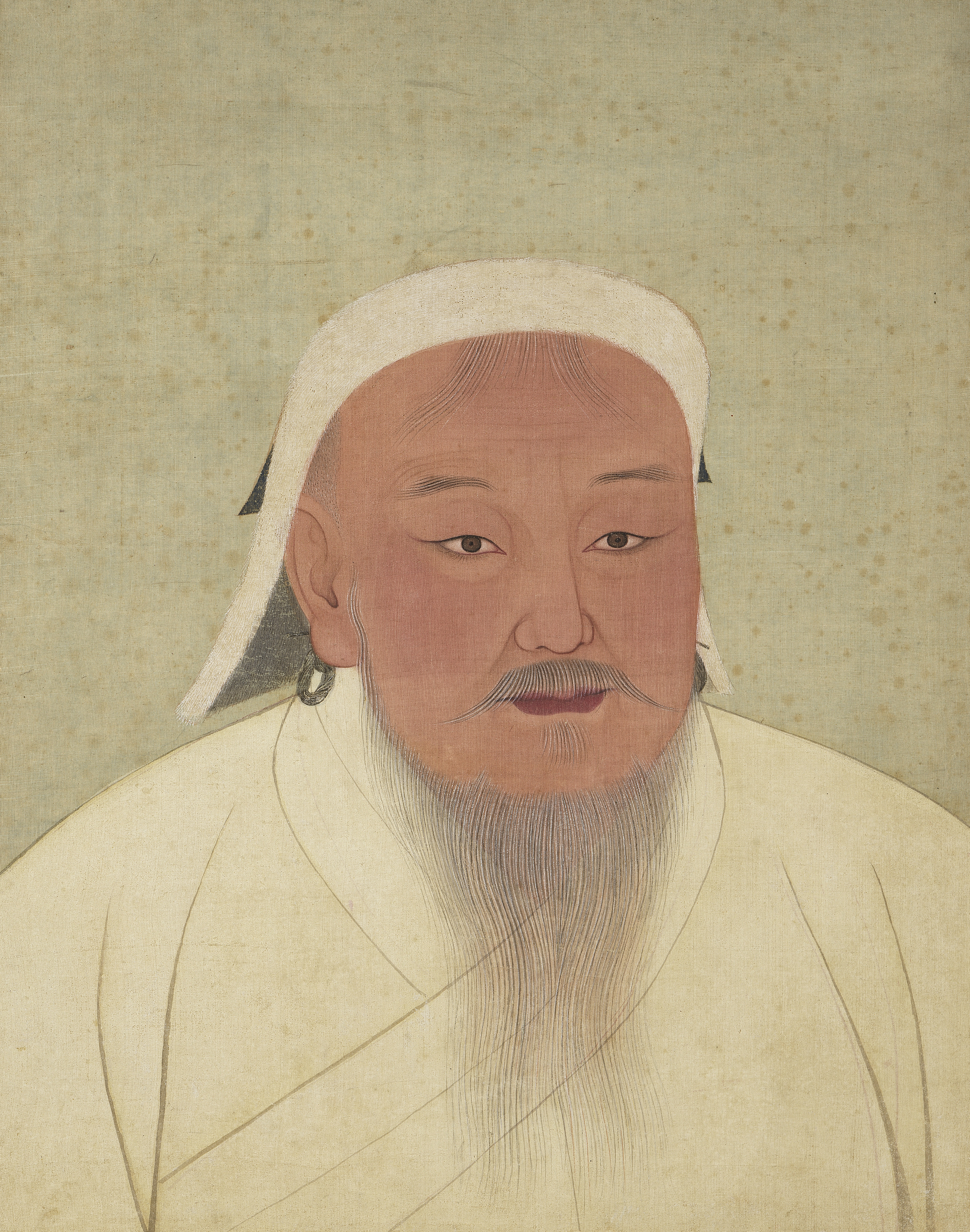
Overview
Between 1206 and his death in 1227, Genghis Khan welded quarrelling Mongol tribes into a war machine that conquered more territory in twenty-five years than Rome achieved in four centuries. At its 1279 peak, the Mongol Empire stretched 12 million square miles—from Korea to the Caspian—creating the first secure land-bridge between China, the Islamic world, and Europe. The Silk Road flourished, paper money, passports, and gunpowder travelled west, and plague later rode east, reshaping global demographics.
Yet the khan’s legacy is not merely blood. He codified the Yassa law code, promoted merit over aristocracy, and introduced relay stations that still underpin Asian postal systems. Modern DNA studies suggest 1 in 200 men carry his Y-chromosome—a biological empire that outlasted the political one.
Background & Origins
Born Temüjin (c. 1162) near the Onon River, he was the eldest son of Yesügei, a minor chieftain of the Borjigin clan. When rivals poisoned Yesügie (c. 1171), Temüjin’s family—his mother Hoelun, six siblings, and two half-brothers—was abandoned by their tribe, surviving on marmots and wild onions. Captured and enslaved at fifteen, Temüjin learned coalition-building by allying with Jamukha and the powerful Kerait khan, Toghrul. Marriage to Börte (c. 1178) brought the Onggirat tribe as allies; her 1187 kidnapping—and dramatic rescue—cemented his reputation for loyalty and ruthlessness.
Major Achievements & Milestones
Unification of Mongol Tribes (1206): At the kurultai of 1206, Temüjin was proclaimed “Genghis Khan” (Oceanic Ruler), ending two centuries of inter-tribal warfare.
Conquest of the Xi Xia (1209–10): First major siege using Chinese engineers and mangonels; forced tribute from the Tangut kingdom.
Fall of the Jin Dynasty (1211–15): Smashed 500,000-strong Jin armies, captured Zhongdu (modern Beijing) in 1215, and opened northern China to Mongol horsemen.
Khwarazmian Campaign (1219–21): Retaliated against the Shah’s murder of Mongol merchants; annihilated Samarkand, Merv, and Nishapur, creating a corridor into Persia.
Western Xia Campaign & Death (1226–27): Returned to crush the rebellious Xi Xia; died 25 August 1227, exact cause still debated—fall from horse, fever, or battle wound.
Timeline
- c. 1162: Birth on the banks of the Onon River.
- 1206: Proclaimed Genghis Khan; issues the Great Yassa law code.
- 1215: Capture of Zhongdu; secures northern China.
- 1221: Mongol scouts reach the Caspian Sea; Europe learns of the “Tartar” menace.
- 25 Aug 1227: Death during the siege of Yinchuan; burial site kept secret.
Impact & Legacy
Genghis Khan’s empire fractured into the Yuan Dynasty in China, the Golden Horde in Russia, the Chagatai Khanate in Central Asia, and the Ilkhanate in Persia—states that ruled 40 % of the world’s population into the 14th century. The pax Mongolica slashed travel time from Beijing to Baghdad from months to weeks; ideas like movable type, astronomical charts, and Buddhist texts crossed continents. Yet the same routes spread bubonic plague that killed 30–50 % of Europeans. Culturally, Mongol tolerance of trade, religion, and technology seeded the Renaissance and, via Tamerlane, the Mughal Empire in India. Modern Mongolia counts him as father of the nation; in Russia he is still feared; in China he is both conqueror and dynastic founder—a historical Rorschach test on horseback.
Records & Notable Facts
- Largest contiguous land empire in history: 12 million square miles.
- Personal “long-distance” arrow shot said to exceed 500 metres.
- Introduced relay stations every 25–30 miles; 1,400 were operational within a decade.
- Yassa code decreed death for lying to a superior—yet protected religious freedom.
- Modern Khalkha Mongolian language retains 8 % of his 13th-century vocabulary.
> “If my body dies, let my body die, but do not let the Mongol people die.”
> —attributed to Genghis Khan, c. 1225