




Overview
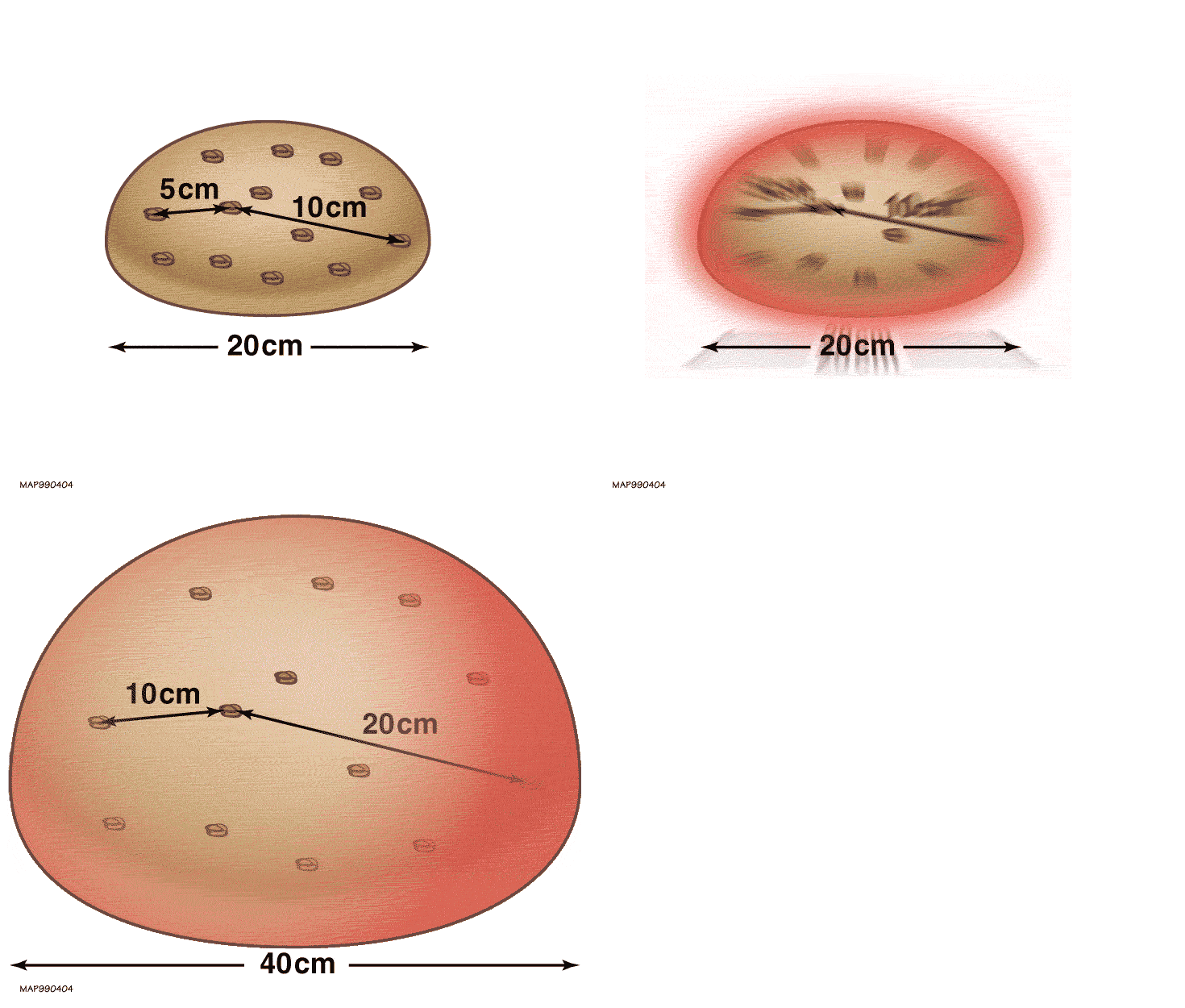
The Hubble constant (H₀) is a fundamental parameter in cosmology that expresses how quickly the universe is stretching apart at the present epoch. It appears in the linear relationship known as Hubble’s law (or the Hubble–Lemaître law), which states that a galaxy’s recessional velocity (v) is directly proportional to its proper distance (d) from the observer: v = H₀ × d. This simple equation encapsulates the dynamic nature of spacetime, turning the observed redshift of distant galaxies into a cosmic ruler. By measuring the redshift of a galaxy’s spectral lines and independently determining its distance—through standard candles like Cepheid variables or Type Ia supernovae—astronomers can calculate H₀ and thus infer the age, size, and fate of the universe.Because the expansion rate can evolve over cosmic time, the Hubble constant is defined for the present‑day universe (redshift z ≈ 0). Its units are typically kilometers per second per megaparsec (km s⁻¹ Mpc⁻¹), meaning that for every megaparsec (≈3.26 million light‑years) of separation, galaxies recede an additional H₀ kilometers per second. Modern measurements place H₀ in the range of 67–74 km s⁻¹ Mpc⁻¹, but a persistent tension between early‑universe (cosmic microwave background) and late‑universe (distance‑ladder) methods fuels active research.
History/Background
The story of the Hubble constant begins with Edwin Hubble’s 1929 paper, where he plotted galaxy redshifts against distances derived from Cepheid variables and uncovered a linear trend. Independently, Georges Lemaître had derived the same relation in 1927, embedding it within the framework of general relativity; the law is now rightly called the Hubble–Lemaître law. Early estimates of H₀ were wildly inaccurate—Hubble himself suggested ~500 km s⁻¹ Mpc⁻¹, implying a universe only a few billion years old, conflicting with geological evidence.The mid‑20th century saw refinements through better distance indicators and larger galaxy samples, gradually lowering H₀ to ~75 km s⁻¹ Mpc⁻¹. The launch of the Hubble Space Telescope (HST) in 1990 enabled precise Cepheid measurements in distant galaxies, culminating in the H₀ Key Project (1999) that reported H₀ = 72 ± 8 km s⁻¹ Mpc⁻¹. The turn of the millennium introduced cosmic microwave background (CMB) observations from the Wilkinson Microwave Anisotropy Probe (WMAP) and later Planck, which inferred H₀ ≈ 67 km s⁻¹ Mpc⁻¹ under the ΛCDM model. The emerging discrepancy—known as the “Hubble tension”—has become a central puzzle in contemporary cosmology.


