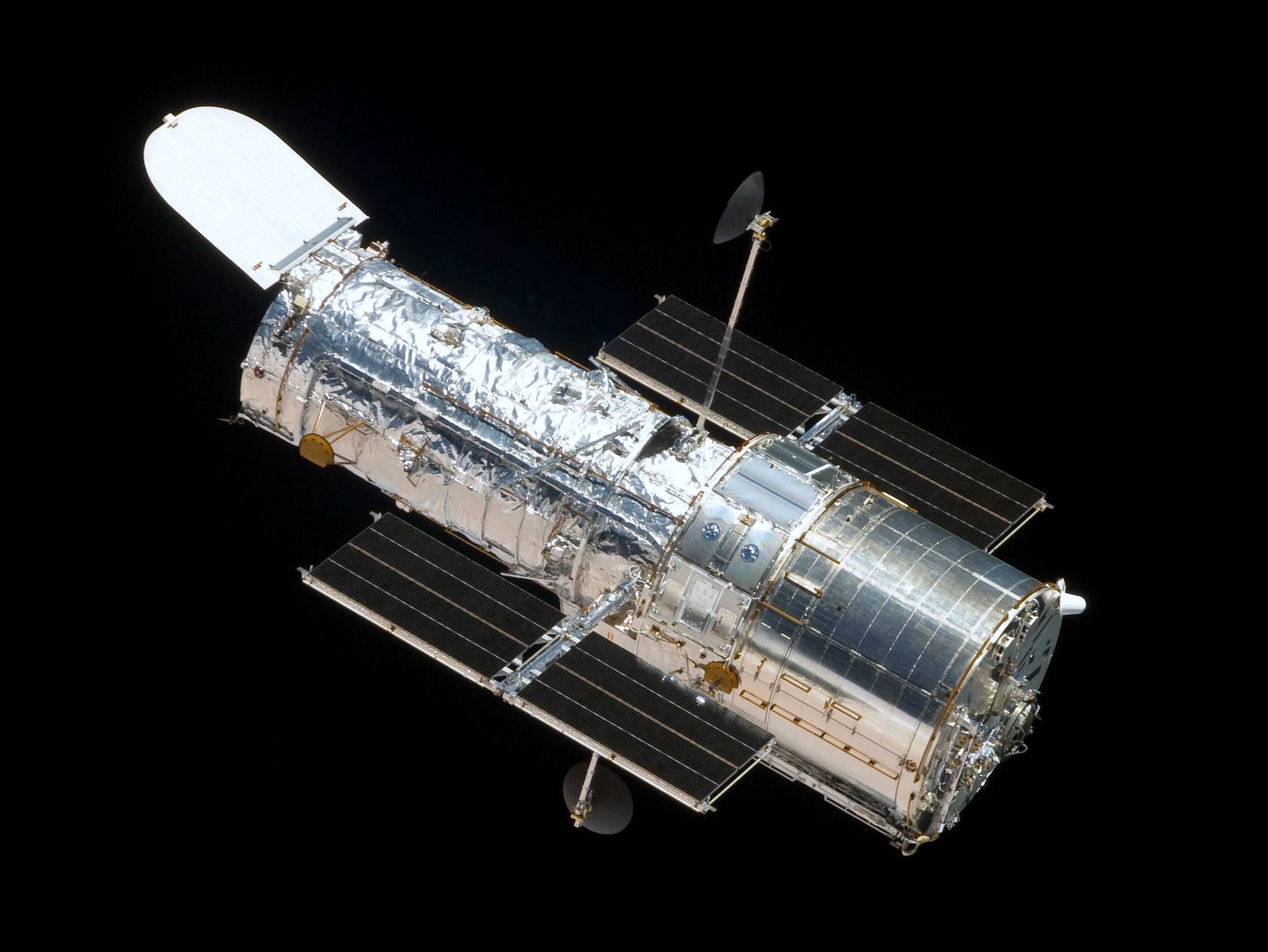
SUMMARY: The Hubble Space Telescope is a groundbreaking space telescope that has revolutionized our understanding of the universe, capturing breathtaking images and providing invaluable data to astronomers worldwide since its launch in 1990.
Overview
The Hubble Space Telescope is a collaborative project between NASA and the European Space Agency (ESA), named after the renowned American astronomer Edwin Hubble. Launched on April 24, 1990, aboard the Space Shuttle Discovery (STS-31), Hubble was designed to study the universe in unprecedented detail, with a primary focus on cosmology, stellar evolution, and galactic structure. This orbiting observatory has become an indispensable tool for astronomers, enabling the detection of distant galaxies, stars, and planets, and shedding light on the mysteries of the cosmos.
Hubble's remarkable capabilities are due in part to its orbital platform, which allows it to observe the universe in ultraviolet, visible, and near-infrared light. Its primary mirror, measuring 2.4 meters (7.9 feet) in diameter, is one of the largest ever constructed, collecting and focusing light from distant objects. The telescope's instrument suite includes a range of advanced cameras, spectrographs, and other instruments, which enable scientists to analyze the light from celestial objects in unprecedented detail.
Background & Origins
The concept of a space-based observatory dates back to the 1960s, but it wasn't until the 1970s that NASA began to develop the Hubble Space Telescope project in earnest. The telescope's design was influenced by the Astronomical Observing Facility (AOF), a proposed space-based observatory that was ultimately canceled due to budget constraints. The AOF's design, however, laid the groundwork for Hubble's development, and many of its key features were incorporated into the final design.
Major Achievements & Milestones
[Achievement 1] (1990): First Light - Hubble captured its first image of the Pleiades star cluster on May 20, 1990, marking the beginning of a new era in astronomical research.
[Achievement 2] (1995): Deep Field - Hubble observed the Hubble Deep Field (HDF), a region of the sky that has been studied extensively to understand the formation and evolution of galaxies.
[Achievement 3] (2004): Galaxy Evolution - Hubble's observations of galaxy evolution revealed that galaxies are constantly changing, with stars and gas being added and removed through mergers and other interactions.
Timeline
- 1990: Hubble is launched aboard the Space Shuttle Discovery (STS-31) on April 24th.
- 1995: Hubble observes the Hubble Deep Field (HDF) to study galaxy evolution.
- 2004: Hubble's observations of galaxy evolution reveal the dynamic nature of galaxies.
- 2009: Hubble captures the first-ever image of a galaxy merger.
- 2015: Hubble observes the first-ever image of a black hole at the center of the galaxy M87.
Impact & Legacy
The Hubble Space Telescope has revolutionized our understanding of the universe, providing a wealth of new insights into the formation and evolution of galaxies, stars, and planets. Its observations have led to a deeper understanding of the universe's cosmological parameters, including the Hubble constant, which describes the rate at which the universe is expanding.
Hubble's impact extends beyond the scientific community, inspiring generations of students and the general public with its breathtaking images and discoveries. The telescope's legacy will continue to shape our understanding of the universe for years to come, as it continues to operate and provide new insights into the mysteries of the cosmos.
Records & Notable Facts
> "The Hubble Space Telescope has been a game-changer for astronomy, providing a wealth of new insights into the universe's evolution and structure." - Dr. John Grunsfeld, NASA Astronaut and Hubble Space Telescope Mission Specialist.
INFOBOX:
- Full Name: Hubble Space Telescope
- Born: N/A
- Died: N/A
- Age: N/A
- Nationality: USA/ESA
- Occupation: Space Telescope
- Active Years: 1990-present
- Known For: Cosmology, Galaxy Evolution, Black Hole Observations
- Awards: NASA Distinguished Public Service Medal (1991)
- Spouse: N/A
- Children: N/A
- Height: N/A
- Net Worth: N/A
- World Records: Longest-operating space telescope (over 30 years)
- Championships: N/A
FACTS:
- Birth Date: N/A (type: date)
- Birth Place: N/A (type: location)
- Death Date: N/A (type: date)
- Career Start: 1990 (type: year)
- Peak Achievement: Galaxy Evolution Observations (2004) (type: achievement)
- Career Earnings: N/A (type: statistic)
- World Record: Longest-operating space telescope (over 30 years) (type: record)
- Famous Quote: > "The Hubble Space Telescope has been a game-changer for astronomy..." (type: quote)
- Fun Fact: Hubble has captured over 1.5 million images of the universe since its launch in 1990. (type: trivia)
- Legacy Stat: Over 30 years of continuous operation, with no signs of slowing down. (type: statistic)
TAGS: space telescope, hubble space telescope, cosmology, galaxy evolution, black hole observations, astronomy, space exploration, nasa, esa