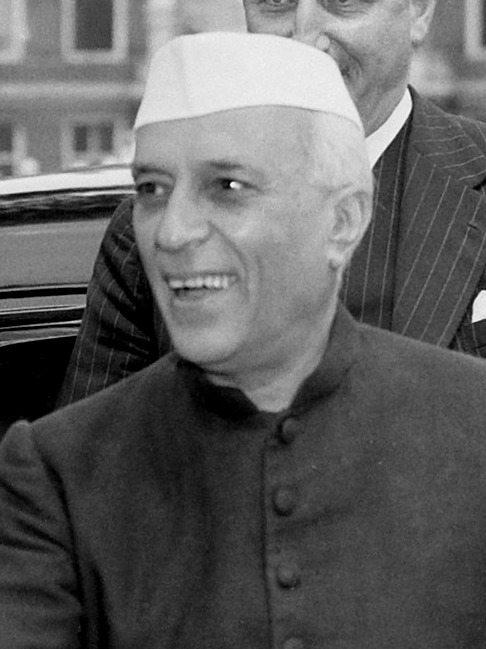
Jawaharlal Nehru—lawyer, scholar, and revolutionary—was the chief architect of modern, democratic, secular India and served as its first Prime Minister (1947-1964), shaping the nation’s institutions and global posture for generations.
Jawaharlal Nehru rose from an elite Kashmiri-Brahmin household to become the embodiment of post-colonial aspiration for nearly half a billion Indians. A magnetic orator and prolific writer, he translated the moral philosophy of the Indian National Congress into a concrete blueprint for a pluralistic, industrializing republic. As head of government he fused Westminster-style institutions with Fabian-socialist economics, championed scientific temper, and carved out a non-aligned foreign policy that kept the Cold War at arm’s length while securing development aid from both super-powers. His seventeen-year premiership remains the longest in Indian history, and his daughter, Indira Gandhi, and grandson, Rajiv Gandhi, later led the country—cementing the Nehru-Gandhi dynasty’s central, if controversial, role in South Asian politics.
History/Background
Born 14 November 1889 in Allahabad to Motilal Nehru, a wealthy barrister and president of the Congress Party (1919), Jawaharlal was educated at Harrow, Trinity College Cambridge, and the Inner Temple. Exposure to Fabian socialism in Britain and to mass poverty on returning home radicalized him; by 1916 he had met Mahatma Gandhi, who became mentor and comrade. Between the non-cooperation movement (1920-22) and independence (15 August 1947) Nehru served nine prison terms—totaling over nine years—during which he penned three enduring books that interpreted India’s past and imagined its future. The Government of India Act (1935) and provincial elections (1937) saw him pilot Congress toward mass politics; the Second World War brought the decisive Quit India uprising (1942) and, after the trauma of Partition, the Constituent Assembly debates that produced a republican constitution (26 January 1950).
Key Information
- Architect of the modern Indian state: drafted the Objective Resolution (1946) that became the Constitution’s preamble; insisted on universal adult suffrage against skeptics who feared an illiterate electorate.
- Secularism and pluralism: opposed sectarian politics, integrated princely states, and pushed a Hindu-code bill that reformed caste and gender laws.
- Economic policy: Five-Year Plans (1951 onward) created heavy industry (Bhilai, Durgapur steel plants), IITs, and the space-research agency that later launched India’s satellites.
- Foreign affairs: co-founded the Non-Aligned Movement (Bandung 1955); negotiated the 1954 Panchsheel accord with Zhou Enlai; defended Kashmir in the UN while accepting a plebiscite commitment (later superseded by 1971 Simla Agreement).
- Literary legacy: “Letters from a Father to His Daughter” (1929) introduced Indian children to history and science; “An Autobiography” (1936) and “The Discovery of India” (1946) remain global classics on anti-imperial nationalism.
- Death: died in office 27 May 1964; cremation site at Shantivan on the Yamuna river has since become a national memorial.
Significance
Nehru’s insistence on parliamentary democracy institutionalized peaceful transfer of power in a land of dizzying diversity, providing a template for post-colonial Asia and Africa. By embedding secularism in the Constitution he offered minorities constitutional protection, a principle now fiercely debated yet foundational to Indian identity. His scientific outlook seeded the world’s largest technical workforce and a space program that reached Mars orbit in 2014. Critics blame his Fabian economics for the “Hindu rate of growth” (3.5 % annually) and for a Kashmir dispute that festers to this day; admirers counter that state-led industrialization built the capital base for the 1991 liberalization boom. Globally, Nehru’s non-alignment cushioned newly decolonized nations from super-power rivalry, while his advocacy of decolonization and multilateralism foreshadowed the Global South coalitions of the 21st century. In the popular imagination the “Nehruvian era” signifies modernist optimism—five-year plans, dams as “temples of modern India,” and the secular-socialist promise of “tryst with destiny.”
Tip: double-click any word in this article for an instant definition from the NerdDictionary.